Why AI Brain Drain is Threatening Executive Decision-Making
Enterprise leaders face a hidden productivity trap: while generative artificial intelligence makes teams faster at producing deliverables, it simultaneously encourages cognitive outsourcing that erodes deep expertise, institutional memory, and foundational problem-solving capabilities.
Key Takeaways
- AI systems often perform the entire chain of thinking, creating a risk of polished output without deeper human mastery.
- Cognitive outsourcing leads to an insidious downward spiral where professionals lose fluency in core tasks without AI assistance.
- The 'dream team fallacy' proves that combining high-end AI with human intelligence often fails due to anchoring and complacency biases.
- Intentional friction in AI interfaces forces leaders and teams to engage in the vital struggle required for true comprehension.
- Organizations must redesign incentive structures to reward outcomes and signature thinking skills rather than raw AI activity.
The Danger of Full-Chain Cognitive Outsourcing
For decades, enterprise technology has automated discrete tasks. Calculators handled arithmetic; search engines indexed information. Workers still had to frame the problem, interpret the context, and execute the final reasoning. Generative and agentic AI represent a fundamentally different category of cognitive tool because they offer to perform the entire chain of thinking from end to end.
When a junior analyst or senior executive feeds a complex strategic problem directly into an AI model and accepts the generated report without friction, they bypass the mental struggle required to build true competence. This creates a dangerous illusion of mastery. The artifact looks pristine, but the human capability behind it remains underdeveloped. Over time, this dynamic generates a quiet talent deficit inside organizations, where employees can generate answers but struggle profoundly when asked to explain, defend, or adapt those ideas in high-stakes environments.
The Mechanics of AI Gravity and the Downward Spiral
Resisting the urge to over-rely on AI requires fighting against powerful biological and economic forces. Human thinking is metabolically expensive. The brain consumes roughly twenty percent of the body's calories despite accounting for only two percent of its weight. When faced with demanding cognitive loads, our evolutionary wiring naturally seeks the path of least resistance.
Coupled with competitive workplace pressures, this biological reality creates what researchers term AI gravity. If peers use automated tools to generate higher volumes of output, professionals feel an acute incentive to match that velocity to stay competitive. This sparks a downward spiral:
- Reduced Practice: Routine outsourcing causes professionals to stop practicing foundational tasks.
- Loss of Fluency: Without regular mental reps, individual proficiency and confidence atrophy.
- Increased Dependency: Feeling less capable without digital assistance, workers reach for AI tools with even greater frequency.
This cycle weakens the deep institutional knowledge that allows companies to innovate and navigate crises when standard playbooks fail.
Overcoming the Dream Team Fallacy in the C-Suite
A common executive assumption is that combining elite human judgment with advanced AI creates an unbeatable collaborative engine. However, organizational research exposes the dream team fallacy. Human-AI interaction is not simply additive or multiplicative; human cognitive biases frequently degrade performance when collaborating with intelligent machines.
Anchoring bias causes workers to latch onto the first recommendation an AI model provides, abandoning critical scrutiny. Complacency bias sets in when systems become reliable enough that humans stop checking their work altogether. Instead of a high-performing partnership, organizations end up with distracted or passive human operators rubber-stamping machine output.
Redesigning Systems to Protect Signature Thinking Skills
To prevent organizational brain drain, executive leaders must intentionally design workflows and incentive structures that safeguard human capabilities. Start by identifying your organization's core signature thinking skills—the specific forms of judgment, synthesis, and expertise that differentiate your enterprise from competitors. Protect these capabilities rather than delegating them to algorithms.
Furthermore, reconsider performance metrics. Incentive systems that reward employees purely for the volume of AI-generated reports or deliverables will accelerate cognitive outsourcing. Instead, tie evaluations to business outcomes, effective delivery, and the ability to defend strategic concepts under cross-examination.
Finally, introduce deliberate friction into your workflows. Rather than accepting instant AI responses, design interfaces that pause, prompt users with probing questions, or require human validation steps before proceeding. This friction forces the brain to struggle, retain information, and maintain genuine cognitive engagement.
Conclusion
Artificial intelligence offers extraordinary potential to accelerate enterprise productivity, but only if leaders manage the technology without hollowing out human capability. By recognizing biological temptations, avoiding the dream team fallacy, and protecting critical signature thinking skills, organizations can ensure their teams remain sharp, adaptable, and genuinely innovative.
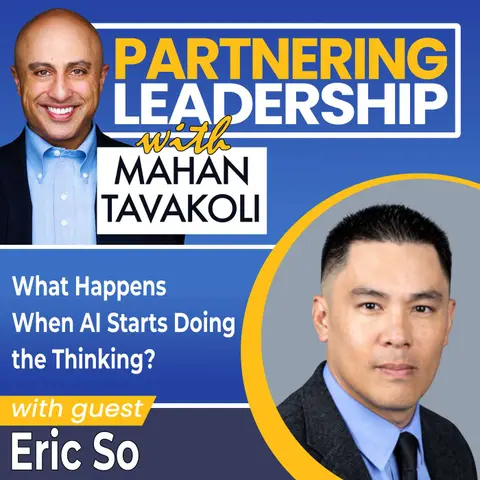
To explore these insights further and hear the complete conversation on what AI does to human cognition, Listen to the full episode of Partnering Leadership with Mahan Tavakoli and guest Eric So. Share this post with fellow executives committed to leading thoughtful, sustainable organizational transformations in the age of intelligent machines.

Influence vs Power in Executive Leadership: Lessons From the NFL and the Pentagon