

 Spotify
 Amazon Music
 Apple Podcasts
 iHeartRadio
 TuneIn
 Podchaser
 Overcast
 Castro
 Castbox
 Deezer
 PlayerFM
 Audible
 Podcast Addict
 YouTube
 RSS Feed
 47 Leading with a belief for the greater good and honoring a legacy with Dr. Charlene Drew Jarvis | Greater Washington DC DMV Changemaker
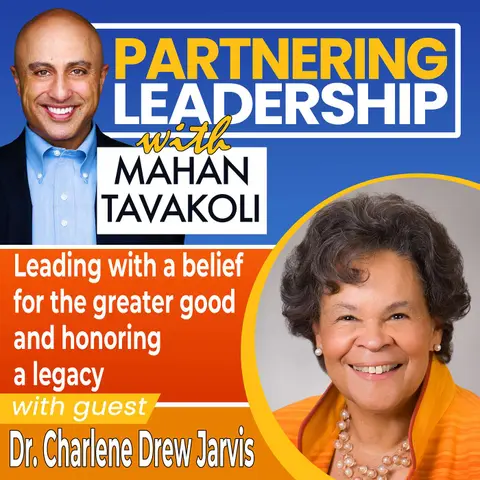
In this episode of Partnering Leadership, Dr. Charlene Drew Jarvis, neuroscientist and former Washington DC council member and chair of the committee on economic development, recounts stories of her father, Dr. Charles Drew, and shares stories of her life as a scientist and politician, and how the intersectionality of her passions empowers her to ask the right questions in solving complex problems and leading a community.
Some highlights:
- Dr. Charles Drew’s life and legacy as the pioneer of blood banking
- Dr. Charlene Drew Jarvis’ career as a neuroscientist
- Why and how Dr. Charlene Drew Jarvis left science for politics
- The importance of asking the right questions and how it helped Dr. Charlene Drew Jarvis in contributing to the economic development of Washington DC
- How Dr. Drew Jarvis’ passion for helping women and people of color led to her becoming president of Southeastern University
- Why Dr. Charlene Drew Jarvis believes that expanded support for mental health in insurance is highly crucial
- Dr. Charlene Drew Jarvis’ advice to young leaders.
- Advice on becoming an active older person
Mentioned:
EB Henderson, Former coach at Dunbar High School
Judge William Hastie, Former Federal judge
Mercer Cook, Former Chair at Howard University and second American ambassador to Niger
William Montague Cobb, Former head of anatomy at Howard University
Julius Rosenwald, Businessman, philanthropist, and founder of the Rosenwald Fund
Booker T. Washington, Educator, author, orator, and adviser to presidents
Spencie Love, Author of “One Blood”
Dr. DeMaurice Moses, Dr. Charlene Drew Jarvis’ husband
Arrington Dixon, Former chair and member of the council of the District of Columbia
Sharon Pratt, Attorney, politician, and the third mayor of the District of Columbia
Marion Barry, Former mayor of the District of Columbia
Muriel Bowser, Mayor of Washington DC
Jack Evans, Former member of the council of the District of Columbia
Abe Pollin, Former owner of Washington Wizards & Washington Capitals
Connect with Dr. Charlene Drew Jarvis:
Dr. Charlene Drew Jarvis on Twitter
Connect with Mahan Tavakoli:
More information and resources available at the Partnering Leadership Podcast website:
Connect with Mahan Tavakoli:
Welcome to Partnering Leadership, conversations with leading influencers in the greater Washington DC region and global thought leaders, helping you align better with your purpose, grow professionally with meaning, and have a greater impact. For additional leadership insights and bonus content, visit us at PartneringLeadership.com.
Now here's your host, Mahan Tavakoli.
Mahan Tavakoli:
Welcome to Partnering Leadership. I'm really excited to have you coming along with me on this journey of learning and growth as we have conversations every Tuesday with magnificent change makers from the Greater Washington DC DMV region and every Thursday with global thought leaders, primarily authors of leadership books, whose insights I believe can be truly transformative in the way we lead ourselves, our organizations and have a greater impact on our community.
Now, I know you are also enjoying these conversations based on your feedback, so keep those coming. Love hearing from you: mahan@mahantavakoli.com. There's also a microphone icon on PartneringLeadership.com, you can leave voice messages for me there. Don't forget to follow and are subscribed to the podcast depending on your platform of choice and those of you that enjoy it on Apple, a rating and review will help more people find these episodes and benefit from them.
Now I am so honored and excited to be sharing a conversation with you with Dr. Charlene Drew Jarvis, both about her own incredible journey of leadership and also we start out first talking about her father Charles Drew, who had such a significant impact on so many people's lives, including as father of blood banking, which saved countless lives on the battlefield in World War II.
Now Dr. Charlene Drew Jarvis has been impactful all throughout, first as a neuroscientist at NIH, then for over 21 years, serving on the council of DC, most especially, chairing the committee on economic development, which she did during the financial crisis, and also contributing to a new convention center, and what was MCI center, now Capital One Arena, establishing those in DC, eventually as president of Southeastern University.
Dr. Jarvis has won over a hundred awards for her leadership because she's truly been impactful throughout her career, but she's just getting started. As she's celebrating her 80th birthday, she is contributing even more to the organizations she's involved with which is why I am so excited to have this conversation with Dr. Charlene Drew Jarvis.
Mahan Tavakoli:
Dr. Charlene Drew Jarvis, welcome to Partnering Leadership Podcast.
Dr. Charlene Drew Jarvis:
I am delighted to be with you and with your listeners.
Mahan Tavakoli:
I am so thrilled to have you having watched the significant impact you have had on our entire region and community most especially Washington DC, and would love to find out a little bit more about your upbringing before going on to your leadership. Now, obviously, Charlene, I know you were born right here in DC to a significant man in history, and that's Dr. Charles Drew.
Dr. Charlene Drew Jarvis:
Yes, and I'm always delighted to talk about his contributions.
Mahan Tavakoli:
Now, it seems like based on my research, Dr. Drew became passionate about medicine when his sister passed away at age 13. This is right post the pandemic flu epidemic of 1918-1919.
Dr. Charlene Drew Jarvis:
Yeah, that is true. I am a native Washingtonian. I grew up on the campus at Howard University where my father was the chief of surgery at Howard University. And it was an idyllic growing up on the campus of the university, even though we lived in a city where discrimination by race was very obvious.
My dad was a very high achiever. And the thing that he taught us is that “Excellence of performance will overcome any artificial barriers created by man.” He was influenced to go into medicine because of the death of Elsie, his younger sister who died in the 1918 epidemic flu. She was in a household where her grandmother also had tuberculosis and his eagerness to be in medicine really started with that.
He was a graduate of the storied Dunbar High School. And I say “storied” Dunbar High School, because we were in a period of segregation and yet Dunbar High School graduates outperformed graduates at all of the high schools in the district of Columbia, irrespective of race. My dad was a great athlete and EB Henderson, who was a coach there at Dunbar, said that he wanted to make sure that all of his athletes not only were trained in their fields, but also were high academic achievers.
So from Dunbar High School, went four of those graduates to Amherst College. One of whom, Hastie became the first African-American federal court judge. Mercer Cook, who became a Howard University chair and ambassador to Niger. Montague Cobb, who became head of anatomy at Howard University. These were, at the time and now, people who made a difference in the world.
My dad went to Amherst College. He went to McGill Medical School in Canada. And he did his doctor of science degree at Columbia University in the field of banked blood. In fact, that was the title of his thesis. And because of the work that he did in blood banking, he was named the father of blood banking and his contributions were significant, particularly during the war when many thousands of lives were saved as result of the work that he did on the storage and preservation of blood.
He had a fight within because of the determination of the Surgeon General of the Army and Navy at the time, that there'd be segregation of blood. And my father said there's no scientific evidence for any reason, for segregation of blood by race.
He was a man who felt that the teaching of surgeons at Howard University was critically important because he thought that they ought to have the skillsets to make Howard University Medical School top rate. He sent his residents all over the country in order to be well-trained. And to bring that training back to the citizens of this city. And he implored them to remember his mantra, “Excellence of performance will overcome any artificial barriers created by man.”
Mahan Tavakoli:
What an incredible contribution, Charlene, your father has made and made to so many lives that were saved on the battlefield in World War II. And I understand that a partnership between philanthropist Julius Rosenwald and Booker T. Washington supported your father's journey along, as many other African-American students to pursue education and have a greater impact.
Dr. Charlene Drew Jarvis:
Yes, the Rosenwald Fund was tremendously important in helping my father to finish medical school at McGill, he would not have been able to finish medical school, we were in the middle of the depression, he'd lost his father, his father lost his job, later lost his dad. And the Rosenwald Fund stepped in and made available to him that scholarship which enabled him to finish medical school and to go on and finish his doctor of science degree at Columbia University, which is where he did his research on banked blood.
Julius Rosenwald Fund, in fact, supported many African-Americans early in their careers to make sure that they had some runway to finish the work which they had begun. I didn't know about the Rosenwald Fund. I didn't understand it. I knew it, I saw it on his resume. Until the fund closed down a number of years ago and someone from the fund called me and said that she had his application to the fund. And at the end of the closing down of the fund, his letter of thanks for having given him the chance to continue his education.
Mahan Tavakoli:
That is incredible in giving someone who was so bright, so driven to work so hard, the opportunity to impact so many lives. Now, unfortunately, eight years after you were born, Dr. Drew died in an automobile accident.
Dr. Charlene Drew Jarvis:
He did. My dad was going South. He was going to Tuskegee Institute with three of his medical residents. And at the time, we're talking about 1950, talking about the South, the highways on the South did not have hotels or motels that accommodated African-Americans.
And thus, my father and his residents were driving all night. My father was driving the car. He fell asleep at the wheel. The injuries which he sustained were grievous. He was treated at a hospital in Burlington, North Carolina. He was so severely hurt that there was no way in which his life could have been saved.
And yet there was a myth that grew that he had been denied medical treatment at a white hospital, and that he had been denied periplasm, which might have saved his life. My mother has always disabuse people of that notion as have I, because it is important that the truth be told. But it is important also to say that my father and those residents wouldn't have been driving all night, had there been a place to put their heads.
And my father's story was maintained as a myth at such high level, because in truth, there was a very segregated healthcare delivery system in the South. And it was very usual at hospitals to have beds that were reserved for whites and beds that reserved for blacks.
A very important book, One Blood by Spencie Love, outlines, what is probably responsible for the myth. And that is, that there was another gentleman who died on that same road as a result of an accident, on that same road, who was taken to Duke University Hospital. The beds reserved for black patients were filled. And although there were beds for white patients, that patient was sent on to another hospital where he died in transit. So Spencie believes that that was the origin of the myth.
I don't like to linger on the circumstances of my father's death, because I think it's his contributions to saving lives, which are so important. And it is the model which he has given to others who listen to that mantra: “Excellence of performance will overcome any artificial barriers created by men.” So he was determined that talent should understand its responsibility.
Mahan Tavakoli:
And it's obvious listening to that mantra is part of what gave you the passion for pursuing science. So before we get to that though, at 18, you married your childhood sweetheart.
Dr. Charlene Drew Jarvis:
I did and my mother offered me a trip to Europe if I wouldn't do that. And I didn’t choose the trip to Europe because I was an 18-year-old who was quite convinced of her own independence. But after my graduation from college, I had these two wonderful sons and so I'm glad I made that decision at that time.
And I'm glad that I made the decision much later, to marry another friend from my beach community, Dr. DeMaurice Moses whom we call Bucky, because that marriage has turned out to be one which is tremendously important to the two of us, because we have a chance to talk about so many things.
He is an expert, not only as a diagnostician, but he knows military history and he knows Roman and Greek history, and you know, the points in my education that I missed, I'm getting those now in a marriage that happened when both of us were in our late seventies.
Mahan Tavakoli:
One of the things that makes you so special, Charlene, is that you're constantly learning, constantly looking to grow, and constantly looking to contribute back. Now with respect to the learning, you did pursue science, a B.A., at Oberlin. M.S. in psychology at Howard, and then eventually you got your Ph.D., neuropsychology at the University of Maryland.
Dr. Charlene Drew Jarvis:
Yes. And the work I did was very exciting work at the University of Maryland. It was a study of the brain, a study of the visual system of the brain of non-human primates, answering the question of where in the brain we process visual information? Where do we process information that has to do with what something is? And where do we process information that has something to do with where something is?
And the amazing contributions to brain over the years have been really, really enormous and had not yet, at the time that I was studying, the reveal of the brain has been simply, simply extraordinary. So that we have a notion of where in the brain so many other functions lie that we did not then know at the time.
So I'm very excited about looking back at my science and wish a little bit that I'd stayed in it because the pandemic has shown us so much about the importance of science. And I wish that I could actually look at the brains as a result of the injury from the virus, to see what happened in the nervous system as result of that.
But I left science and I went into elective office because it seemed to me that we weren't, in the city, paying attention to the rebirth of the city after Martin Luther King's death and the riots that ensued.
Mahan Tavakoli:
Charlene, was there a specific thing that happened for you that brought that to your attention or really magnified the fact that the city wasn't paying attention, that urged you therefore to jump into public life?
Dr. Charlene Drew Jarvis:
I think so. I think it was getting in my car and driving away from the district into Bethesda at NIH, in what was an extremely rarefied atmosphere. And you know, Ph.D.’s are people who are said to know more and more about less and less. The group of people with whom I communed, were people who knew the brain and people who knew visual system and who, you know, further knew the functioning of the brain; but I thought, my goodness, this is 10 years after the riots and we are not redeveloping the city.
And I grew up in this city. And I lived very close to one of the corridors, the 14th street corridor that was burning at the time of the riots. And I thought, somebody ought to be paying attention to this. And then I thought as I drove out of the city every morning, well maybe, I ought to be paying attention to this because I'm a native, because I saw the flames of the riot, because I didn't know where my children were at the time and could not find them because I knew that it was our own community that was being affected by what happened.
And so I simply made the leap from science into the world of politics and ran for a seat on the city council. 15 competitors in that seat and someone who had never been in elective office at all. And I must say I thank Chairman Arrington Dixon for the support that he gave me during that time. I think I would not have been here except for Arrington and for the support of Sharon Pratt Dixon at the time. And because of Arrington, I got the coveted seat as chair of economic development committee. So I landed exactly where I wanted to be in the committee that had something to do with the revival of the city, and that's exactly where I wanted to be.
Mahan Tavakoli:
And you did contribute a lot to the city, most especially as chair of the committee on economic development. And I'll get to that in a minute, but you also took the opportunity to run against Marion Barry back in 1982 and a couple of other runs as Mayor. What got you to try to go for that step in your political career?
Dr. Charlene Drew Jarvis:
Well, honestly, I thought I wanted a bigger platform and I thought I brought some skillsets here. I look at the problem, I look at what can influence the problem, I look at how to produce outcomes and I thought, well, I want a bigger platform here because I think that it was the setting of the questions that was so important and a sort of global look at the questions.
And that's why I ran very shortly after I became a member of the council. It was a learning experience. Marion Barry was a learning experience itself. And I discovered then, and I look back on it now, that my emphasis was on getting things done, asking the right questions, not necessarily putting together the most effective operation to get to public office. So that accounts for the second run that didn't work either.
You have to have a good field operation. It can't just be about how you ask questions and how you frame questions. You really have to have a really tremendous field operation. And that was a part of politics that I didn't master ‘cause I didn't pay enough attention to it.
Mahan Tavakoli:
But as a scientist, you knew how to ask the right questions, which is why you contributed so much as chair of the committee on economic development, including the period when DC was going through a significant financial crisis, Charlene.
Dr. Charlene Drew Jarvis:
Yes, indeed. The city was looking for ways to increase its revenue. Honestly, initially the city did pretty well in terms of its revenue. It just had not focused on the revival of the corridors that would help to produce some of that additional revenue.
So along the way, I try to help figure that out. The neighborhoods were deficient in banking operations. And one of the things that I did was to use the power of that committee and the power of the Congress, which had given to the district of Columbia, the right to make a recommendation of approval or disapproval of a merger of banks. That was a federal gift to us. And I made use of that by requiring the banks that came in to merge with the district of Columbia in the early eighties to have a community reinvestment plan.
And that was an interesting period in my life because many of the bankers were very unaccustomed to having to report to a local elected official, a woman and a person of African-American descent. It was very uncomfortable for them, but I was very comfortable that I had been given this opportunity as the committee chair and that the city had been given this opportunity. And so we did send recommendations to the Office of the Comptroller of the Currency for mergers, which required community reinvestment plans.
Mahan Tavakoli:
And much of the development in the city and in neighborhoods has been a beneficiary of what you initiated back then.
Dr. Charlene Drew Jarvis:
I think in fact, that is absolutely true and a number of other kinds of supports for economic development, which we enacted at the council. For example, tax increment financing. There was a lot of vacant property. And tax increment financing says, developer, if you will put that property back in use, you can keep some of that revenue that is produced as a result of the development. Tax increment financing, very important.
I also created in the council, supported the housing production trust fund. The housing production trust fund’s focus was the producing the gap in financing that was necessary in order to produce housing for low and moderate income families. Mayor Bowser is now putting a hundred million dollars a year into the housing production trust fund.
There were other mechanisms of support for economic development. I had the opportunity to review industrial revenue bond financing proposals that came to the council. Those proposals allowed developers to get interest rates for their projects at lower than market rates because they were using our authority.
My view was if they're using our authority, then we should have a right to require certain things. For example, contracts with district bank businesses, jobs for district residents, training for district residents. And so my use of the committee economic development power was to make sure that we were empowering our communities and that we were using the option of development to figure out how to partner in a way that produce good outcomes for citizens.
Mahan Tavakoli:
You definitely did that. Along with that, there's also two major things in downtown DC that contributed to a significant economic development. One was a new convention center and one was what was back then MCI center, now, Capital One Arena where you played a role in both of those developments in DC.
Dr. Charlene Drew Jarvis:
Yeah, those were two important developments, the convention center and the MCI center. And of course, I would mention that Jack Evans was the council member from there too. So we had a great partnership in producing those outcomes.
The MCI center was an interesting one because there was tremendous financial input from Abe Pollin that helped make that possible. And of course, that has really invigorated the city and has produced what we hoped for the kind of excitement in basketball.
The convention center was hard because there were a number of citizens who vigorously opposed the convention center, and there were a number of council members who did too. And the problem that I always ran into in economic development was that citizens didn't sometimes understand the benefit of economic development.
They often thought it was really just lining the pockets of the developer. When in fact, big projects like the convention center have a huge spinoff in revenue that would go to the city coffers, and that would go to help, for example, the tourist related industries ramp up in order to encourage tourists to the city.
And I learned more about construction during that period than I've ever learned since about where we buy steel and whether it's steel from China or whether it’s steel from this country. And I mastered a lot of details that were in the end, very important to what was a very big project.
And the convention center has been a revenue producer for the city and one that now even has been very important in the pandemic offering that space, if necessary, to the mayor and the council to address the problem of space.
Mahan Tavakoli:
And those are just few of the things that you were able to achieve in 21 years on the council. Now in 1996, you were also appointed president of Southeastern University, which had been founded back in 1879 by the YMCA.
Dr. Charlene Drew Jarvis:
Yes and I made that jump for a reason. A lot of the time that I spent as chair of the economic development committee or in the period of time that I spent, it was very clear to me that women and people of color in small business needed to have some skillsets, really needed to develop skillsets, to be in the marketplace.
And that it was very important to have business plans. It was very important to have an understanding of taxes and financial management and human resource management. And for women of great talent, as well as African-Americans and others of great talent, women had been sidelined in terms of ability to get contracts because at one time, if you remember, women couldn't get contracts in their own names without their husband's approval. So we were dealing with those kinds of issues. And for African-Americans, many knew their craft, they were excellent at the craft, but it was just some of that planning of the business model.
So I thought, well, here is an opportunity at Southeastern. Southeastern was founded to give people in rural communities, access to the skillsets necessary in an industrial economy. And it was founded as a school of accountancy. So I thought, aha, this is the place where I might go to help build the platform for those businesses that needed to have support. And for whom we had done a lot in order to leverage the economic development committee so they could be successful.
So I made that leap and stayed in that for a long time. Actually, it was a university that had a small enrollment. And it depended for its enrollment, mainly for students who are coming at, Chinese students who were coming, who were essentially full pay students.
And so the problem that we got into financially was that we lost a lot of those Chinese students who were full pay students who were supporting our ability to help other students at a time when visas were being blocked some years ago. And so I sought a merger and my board supported the merger as well.
And we merged with the graduate school that served continuing ed courses for people in the federal government and in the local government. So we sent that merger to the accreditors in order to see if we could enlarge the operation of the university.
Mahan Tavakoli:
So Charlene, you've had a magnificent career as a scientist, as serving on the council for 20 plus years, most especially in economic development and then president of a university in the region. And you've won over 100 awards for your leadership, which one of those awards or which ones mean the most to you, Charlene?
Dr. Charlene Drew Jarvis:
Of course, I'm very proud of the honorary degrees that I've gotten from the institutions from which I graduated. But one of the awards that I'm very pleased about is one in which I could make the distinction in a piece of legislation between the kind of support given to mental healthcare and the kind of support given to other kinds of disease states.
And the example I used was this: If someone is injured in a baseball contest and breaks a leg or otherwise injures himself/herself, that kind of injury is well covered, injury is well covered for insurance. But if that baseball swings into the brain of an individual and that individual, as a result, suffers from mental health symptoms, those symptoms, that behavior is not supported at the same level as other kinds of injuries.
And I thought it was really important to emphasize that and to speak very strongly for expanded support for mental health in insurance. That kind of brought together both of my responsibilities as a council member and as somebody who was trained in the studies of the brain.
Of course, the awards, many of the awards I got were from community organizations that simply said, thank you for recognizing what we could solve a problem and you have to do that. And so I’m proud of those awards because that also brings together my science, which is what's the problem? What's the solution? And let's identify it legislatively, if possible. Or in other words, if likely that we can engage educators, for example, in addressing the problem.
Mahan Tavakoli:
You have married science with community impact all throughout your career. Now your father had a significant impact and has a wonderful legacy. When you reflect on what your hoped for legacy would be, what do you want people to say about Charlene Drew Jarvis' impact on this city and this community?
Dr. Charlene Drew Jarvis:
I want people to say that this was a hometown girl who solved problems in her hometown with vigor and commitment and passion.
Mahan Tavakoli:
And the wonderful thing is you still have that vigor, that commitment, and that passion. I know you will be celebrating 80th birthday, which is wonderful to see so much energy and enthusiasm that you still exude, Charlene. So I'm sure there is a lot more to be accomplished on your end.
Dr. Charlene Drew Jarvis:
Well, in fact, I'm working very hard on lots of things, on the board at Oberlin College, I'm on the board at University of the District of Columbia, I'm on the board of the New Washington Housing Conservancy that came out of the federal city council. And I am engaged in many ways that allow me to use the skillset that I think I have, which is, let me look at the problem, let me see if I can help you find a solution. And so I do spend a lot of time at that.
And I will tell your audience another thing, I truly, truly believe that dementia is something that you can push away from you if you recognize the kinds of ways in which you can process information in order to get a different part of your brain engaged. And I think that as you get older, you begin to have deficits in attention and intention. And so what you've got to say to yourself is: I have to pay attention to what I want to do until I'm finished doing it, right?
And in that way, what you've done is to really keep your brain at it until you get to the end of it. And if the hippocampus is going to let you down, which it will, because that's kind of the site of your placing of memories, then you've got to structure yourself so that you're training another part of your brain.
And I think it's important, for example, to talk out loud. Say “I intend to go to my office to get the paper that I want to see tomorrow. And when I get there, I intend to send it to him.” I said all of that in an auditory way. So I laid that down on another part of the brain. So this notion that you just get older and you decline is nonsense and you got to practice at being an active older person.
Mahan Tavakoli:
And that’s brilliant advice coming from a neuroscientist which is great to hear. Now, if you were to give advice to younger leaders or younger Charlene, as you were in your neuroscientist career or entering into politics, what advice do you give to younger leaders in terms of how to become more impactful in their leadership as you have been through the years with yours, Charlene?
Dr. Charlene Drew Jarvis:
I think it's very useful to decide that you want to be expert at something and that you really invest your time and energy in being expert so that you become a person who is a go-to person on that subject. So if it's leadership skills, then learn those leadership skills and impart them. If it is consulting skills, learn that. And become the go-to person. If it is some arcane kind of academic enterprise, be the expert in it.
You can see that what goes on in television is that there are experts drawn from every field to talk about how we should look at the world. So if you're going to be one of those people, then whatever it is that your interest goes to, make yourself an expert in it so that you are a person who becomes that's my go-to person on Einstein. That's my go-to person on consulting. That's my go-to person on equity. That's my go-to person on real estate.
Be that person who can lead an organization in such a way, or who can be a part of an organization in such a way that you're the go-to person, because you've spent some time understanding the field in which you have decided to spend your life or even part of your life.
Mahan Tavakoli:
Great advice, both with respect to deep expertise and the branding that leaders need to have for that deep expertise. Now, are there any leadership resources you find yourself typically recommending, Charlene, whether books, talks, anything that you typically find yourself recommending to leaders as good leadership resources?
Dr. Charlene Drew Jarvis:
I think biographies are good leadership sources. I think it's very important to read about the successes of others because that really gives you a sense of how they moved through their careers, of the obstacles that they found, of the opportunities that they missed, of the balance between work and family. I think biographies are really critical.
if you read the Obama Odyssey, it is like talking to the former president of the United States in such a way that you understand his goal of direction, how he asks questions, how he sees his life in relation to his work. The presidents, the biography of presidents.
The biographies that are done, for example, Einstein. If you're interested in the field of science, and if you read a biography like that, as I did, and you come away still not understanding e=mc2, then you know, it might not be your field. But I think biographies are very good. And particularly business people, read those biographies.
Mahan Tavakoli:
Biographies can be significant and impactful. And that's actually, Charlene, one of the reasons I enjoy having these conversations with magnificent leaders like yourself. Because while it's not as in depth as a biography, it gives all of us a chance to learn from your experience.
And I really appreciate having a person that has been so impactful in so many lives, so many ways in our region share your story, your father's story with the Partnering Leadership community.
Thank you so much, Dr. Charlene Drew Jarvis.
Dr. Charlene Drew Jarvis:
I'm delighted to have been with you. Thank you so much.
You've been listening to Partnering Leadership with your host Mahan Tavakoli. For additional leadership insights and bonus content, visit us at PartneringLeadership.com.
Neuroscientist and Chair of the committee on economic development,
In her long and distinguished career, CHARLENE DREW JARVIS has held positions as a neuroscientist, legislator and university president.
Dr. Jarvis’ educational background led to a career as a neuroscientist at the National Institute of Mental Health in Bethesda, Md. (1971-1978). She received a BS from Oberlin College (1962), an MS from Howard University (1964), and a PhD in Neuropsychology (1971) from the University of Maryland, all the while balancing the demands of being a wife and mother of two active young boys.
Her research with co-investigators appeared in scientific publications such as the Annals of Neurology; Neuroscience Abstracts; Brain Research; the Journal of Neurophysiology; and Brain, Behavior and Evolution.
Responding to the need to help rebuild the economy of Washington, DC, after the riots that followed the death of Martin Luther King, Jr., Jarvis ran for public office and was elected 6 times to the Council of the District of Columbia (1979-2000).
Her work as Chair of the Committee on Economic Development for more than 20 years was pioneering. The Washington Convention Center, the Verizon Center, Business Improvement Districts, Tax Increment Financing, and legislative initiatives designed to prevent redlining by commercial banks stand as important and collaborative contributions.
Dr. Jarvis was appointed in 1996 as president of Southeastern University, founded by the YMCA in 1879. True to the mission of the YMCA, her goal was to give students both theoretical and practical applications of knowledge. Thirteen year… Read More