Decision-Making in Turbulence: Lessons on Leading When Everything Is Changing
Navigating the Fog of Uncertainty
When visibility drops to zero in aviation, pilots must rely on their instruments rather than their instincts, which can easily be fooled by spatial disorientation. In business leadership, the "fog of uncertainty" creates a similar psychological phenomenon. When everything is changing, our natural human instinct is to freeze, to over-analyze, or to make impulsive moves just to feel a sense of control.
However, leading through turbulence requires a completely different mindset. It requires comfort with the unknown and the courage to act without complete information. The best leaders do not wait for the storm to pass before they make a move. Instead, they learn how to navigate directly through the storm. They understand that waiting for absolute clarity is a luxury that modern business rarely affords us. To lead effectively today, we must master the art of making consequential decisions amidst shifting paradigms.
The Information Trap: Why More Data Doesn't Mean Better Decisions
One of the most common pitfalls executives fall into when facing a crisis is the information trap. In the digital age, we have more access to data, metrics, dashboards, books, and articles than at any point in human history. When uncertainty strikes, the immediate impulse is often to gather more data. We commission more reports, hold more alignment meetings, and monitor every real-time metric we can possibly track.
Yet, more data does not automatically translate into better decisions. In fact, in highly volatile and rapidly changing environments, historical data can be entirely misleading because yesterday's trends may have zero relevance to tomorrow's reality. Furthermore, drowning in data often leads to analysis paralysis. Teams spend countless hours trying to quantify the unquantifiable, while competitors who are willing to trust their judgment make decisive moves.
The key is recognizing the difference between actionable insight and noise. Data should inform your perspective, but it should never replace critical thinking and judgment. When the ground is shaking beneath you, obsessing over spreadsheets can blind you to the intuitive signals and strategic realities unfolding right in front of your eyes.
Lessons from Ram Charan: Core Strategies for High-Stakes Leadership
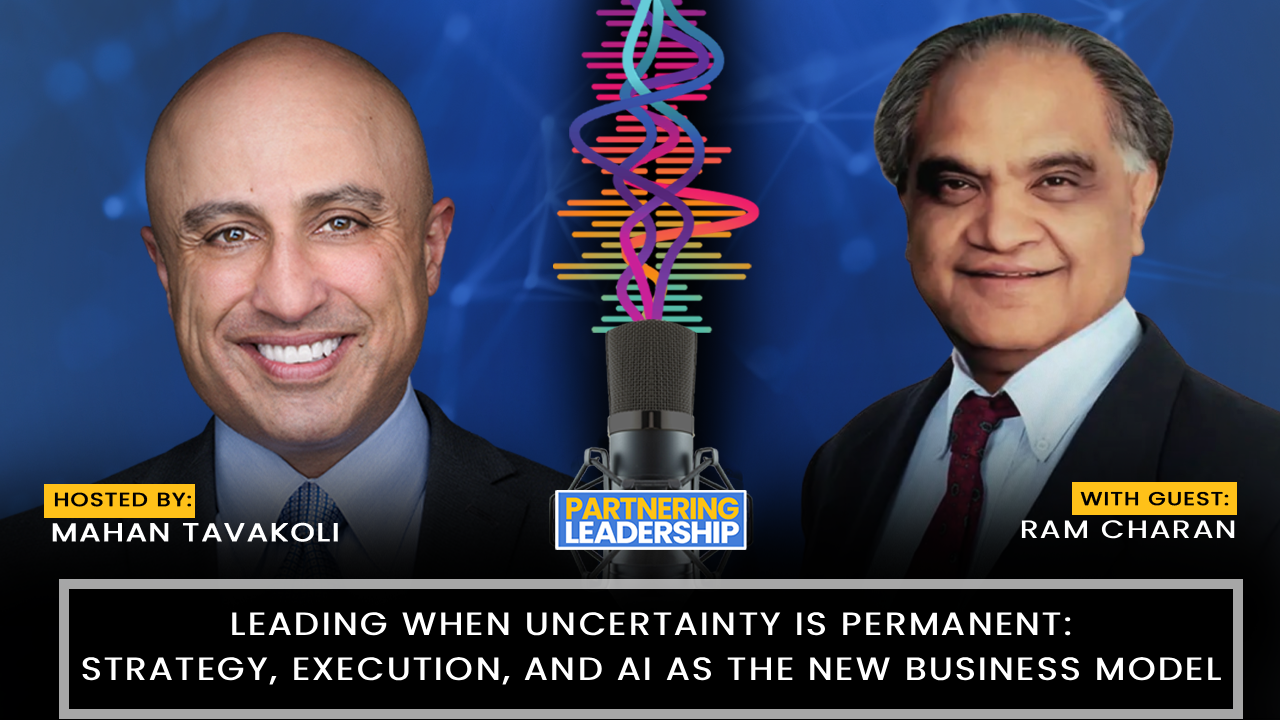
To truly understand how legendary CEOs navigate these complex moments, we can look to the wisdom of seasoned advisors like Ram Charan. Over decades of counseling the world's top business leaders, Charan has observed what separates organizations that thrive in turbulence from those that falter. His insights point to several core strategies for high-stakes leadership.
Focus on the Fundamentals of Value Creation
When everything is changing, it is easy to get distracted by short-term panics and noise. Charan emphasizes that exceptional leaders always bring the focus back to the fundamentals of value creation for the customer. No matter how much the external environment shifts, a business exists to solve a specific problem for its customers better than anyone else. By anchoring your decisions in customer value, you create a North Star that cuts through the fog of operational distractions.
Build Dynamic Adaptability into the Organization
Strategy is no longer a static, three-year document that sits on a shelf. In turbulent times, strategy must be dynamic and continuous. Leaders must build organizational agility by empowering teams closest to the market to make fast decisions. Bureaucracy and rigid hierarchies are the enemies of speed. If every decision has to travel up a long chain of command before action can be taken, your organization will always be a step behind the rate of change.
Maintain Financial and Operational Resilience
Hope is not a strategy. High-stakes leadership requires brutal realism about cash flow, liquidity, and operational capacity. Leaders must stress-test various scenarios, preparing not just for the best-case outcomes, but for severe downturns and prolonged ambiguity. Financial resilience gives a company the runway it needs to make bold, strategic bets while competitors are merely fighting for survival.
Slowing Down to Speed Up: The Value of Wrestling with Big Ideas
It sounds counterintuitive in a fast-moving world, but one of the most powerful things a leader can do during a crisis is to slow down. We live in a culture that glorifies speed, constant output, and rapid responsiveness. We rush from one meeting to the next, firing off emails and reacting to urgent demands without ever pausing to consider if we are solving the right problems.
True leadership breakthroughs happen when we create space to wrestle with big ideas. The challenges we face today cannot be solved by quick fixes or surface-level tactics. They require deep reflection, intellectual rigor, and the willingness to question our own foundational assumptions.
This is precisely why we must spend time with substantive insights rather than just grazing through endless streams of content. The books, conversations, and frameworks that truly transform how we lead are rarely the ones we consume in a rush. They are the ideas we return to, debate with our teams, and view through the lens of our evolving experiences. By slowing down to think deeply about core strategic questions, we gain the clarity and conviction required to execute with incredible speed and precision when the moment demands it.
Actionable Frameworks for Cutting Through Ambiguity
Knowing that you need to make decisions in ambiguity is one thing; having a practical framework to do so is another. How can executives operationalize these concepts in their day-to-day leadership?
1. Define the Irrevocable vs. Reversible Decisions
Not all decisions carry the same weight. Jeff Bezos famously categorizes decisions into two types: Type 1 decisions are consequential, irreversible, and one-way doors—you must walk through them carefully and deliberately. Type 2 decisions are changeable, two-way doors—you can easily step back through if the outcome is poor. In turbulent times, leaders often treat every decision like a Type 1 door, which slows everything down. Categorize your choices accurately so you can move rapidly on reversible decisions while applying rigorous thought to irreversible ones.
2. Cultivate Diverse Perspectives and Dissent
When the stakes are high and fear is creeping into the organization, groupthink becomes a major hazard. Teams naturally tend to agree with the highest-ranking person in the room to avoid conflict. As a leader, you must actively engineer dissent. Ask trusted advisors and team members to play devil's advocate. Inquire: "If we were to fail completely over the next twelve months, what exact path led us here?" This reframing helps unearth blind spots that consensus-driven conversations often miss.
3. Maintain Clarity of Communication
Ambiguity at the top inevitably creates panic at the bottom if it is not managed with transparent communication. Your people do not expect you to have a crystal ball. They do not expect you to know every answer in the middle of a crisis. However, they do expect honesty, clarity on what is known versus unknown, and a steadfast commitment to the organization's core values. When leaders communicate with calm authenticity, they anchor the entire organization and build the trust necessary to weather any storm.
Conclusion: Leading Your Organization Through What Comes Next
Leading through uncertainty is undoubtedly one of the hardest responsibilities an executive will ever face. It tests your emotional resilience, your strategic foresight, and your ability to inspire confidence when the path forward is obscured. But it is also precisely in these moments of turbulence that great leaders forge their legacy. By rejecting the information trap, focusing relentlessly on foundational value creation, slowing down to wrestle with transformative ideas, and deploying practical decision-making frameworks, you can guide your organization not just to survive, but to emerge stronger on the other side.
If you are ready to explore these concepts further and discover actionable strategies you can immediately apply to your own leadership journey, I invite you to listen to 463 [Leadership Reset] Leading Through Uncertainty: How CEOs Make Better Decisions When Everything Is Changing with Ram Charan. Take the time to sit with the insights shared in that conversation, ask yourself the tough questions, and apply those lessons to whatever challenges lie ahead for you and your team.

Strategic Advisor to CEOs & Boards | Host, Partnering Leadership
Mahan Tavakoli is a strategic advisor to CEOs, boards, and executive teams, working with them on strategy, reinvention, leadership, organizational effectiveness, and the implications of AI for how organizations create value and operate.
Earlier in his career, Mahan spent more than 20 years with Dale Carnegie, where he led operations and strategy and helped drive international expansion across more than 90 countries.
Today, his work with senior leadership teams is complemented by more than 450 conversations on the Partnering Leadership podcast with CEOs, founders, researchers, futurists, and leading thinkers on strategy, organizations, leadership, and AI.
Across both his advisory work and the podcast, Mahan focuses on a central question: What is possible now that was not possible before, and what do organizations need to rethink to make it real?
How to Avoid the AI Tax and Stop Dummifying Executive Strategy


![463 [Leadership Reset] Leading Through Uncertainty: How CEOs Make Better Decisions When Everything Is Changing with Ram Charan](https://storage.buzzsprout.com/nyttee122sjlr9tkmni1lx9j3hzn?.jpg "463 [Leadership Reset] Leading Through Uncertainty: How CEOs Make Better Decisions When Everything Is Changing with Ram Charan")