

 Spotify

 Amazon Music

 Apple Podcasts

 iHeartRadio

 TuneIn

 Podchaser

 Overcast

 Castro

 Castbox

 Deezer

 PlayerFM

 Audible

 Podcast Addict

 YouTube

 RSS Feed
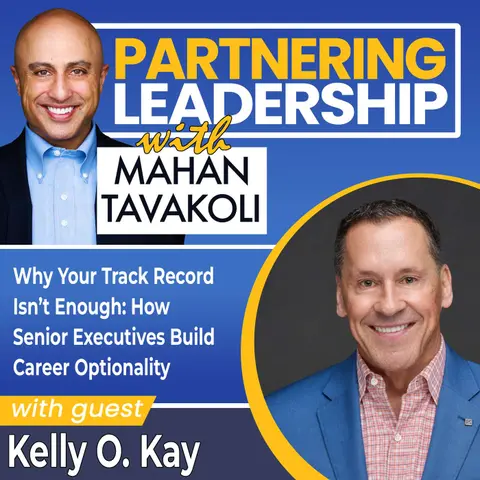
477 Why Your Track Record Isn’t Enough: How Senior Executives Build Career Optionality with Kelly O. Kay
Key Takeaways
- Senior executives must intentionally build career optionality long before they are ready to make a transition, rather than treating career management as a transactional reaction to a recruiter's call.
- An impressive track record alone is not enough to guarantee executive career momentum; past performance must be translated into the specific challenges facing a new organization.
- Approaching interviews as dynamic executive dialogues rather than traditional sales pitches allows candidates to showcase their actual thinking, self-awareness, and problem-solving abilities.
- Acknowledging capability gaps and being transparent about areas needing support demonstrates high self-awareness and strengthens a leader's candidacy rather than detracting from it.
- Building a strong personal brand, maintaining a positive reputation, and developing strategic relationships over years are critical components of long-term career success for senior leaders.
Senior executives can spend years thinking rigorously about strategy, talent, capital allocation, and organizational performance while giving surprisingly little strategic thought to their own careers. That gap sits at the center of this Partnering Leadership conversation with Kelly O. Kay, Managing Partner of the Global Software Practice at Heidrick & Struggles and co-author, with Jeffrey Sanders, of Show Up to Win: How to Land the Leadership Role You Want. Drawing on decades of executive search experience, Kelly offers an unusually candid look at how senior leadership opportunities actually develop, how executives are evaluated, and why an impressive track record alone does not guarantee continued career momentum.
Kelly challenges the transactional way many executives approach career decisions. A call from an executive recruiter does not have to mean deciding whether you want a particular job. It can be an opportunity to understand how the market sees you, build relationships with influential executives, directors, and investors, learn about another industry, or develop the fluency required to operate at a higher level. Those conversations can create options years before an executive actually needs them.
The conversation also gets inside the mechanics of senior-level hiring. Kelly explains why previous accomplishments must be translated into the specific challenges facing a new organization rather than simply presented as proof of future success. He shares how executive interviews have evolved from question-and-answer sessions into substantive executive dialogues, why self-awareness can make a candidate more compelling rather than less, and how reputations formed years earlier can quietly influence opportunities an executive may never know existed.
Mahan and Kelly also explore what happens after an executive lands the role. Kelly explains why a new CEO needs people willing to tell them what others may be reluctant to say, and why understanding the organization you are joining matters as much as convincing it to hire you. The discussion reinforces an important theme throughout Show Up to Win: career management is not something executives should suddenly begin when they are ready to leave. The relationships, reputation, judgment, and market understanding that create future optionality are built over time.
The episode closes with a practical discussion about AI and executive career management. Rather than using AI simply to research a company or generate polished answers, Kelly explains how senior executives can use it as an interview coach to role-play likely questions, sharpen their thinking, and prepare for the priorities of a particular interviewer, company, and role. It is a timely example of how technology can strengthen preparation while leaving the most consequential part of the process distinctly human.
Actionable Takeaways
- You’ll learn why career management should begin long before you are considering a move and how that creates greater optionality over time.
- Hear how to rethink the executive recruiter’s call and why a conversation can be valuable even when you have no interest in the job.
- You’ll learn why past performance is necessary but insufficient and how to connect your experience to what a new organization actually needs.
- Hear why executive interviews should feel less like selling and more like an executive dialogue that reveals how you think and what you would contribute.
- You’ll learn why acknowledging a capability gap can strengthen your candidacy rather than make you appear less qualified.
- Hear how reputations quietly shape opportunities before you even know your name is being considered.
- You’ll learn why aspiring CEOs need to develop the ability to think and communicate at a different altitude.
- Hear why every new CEO needs a truth teller willing to surface realities others may be reluctant to share.
- You’ll learn how to use AI as an interview coach to pressure-test your thinking and prepare for the people and priorities in the room.
- Hear why you should never simply put your leadership story on “play” and tell it the same way to every audience.
Connect with Kelly O. Kay
Kelly O. Kay at Heidrick & Struggles
Show Up to Win: How to Land the Leadership Role You Want
Connect with Mahan Tavakoli:
Frequently Asked Questions
Who is Kelly O. Kay and what is the book Show Up to Win about?
Kelly O. Kay is the Managing Partner of the Global Software Practice at Heidrick & Struggles and co-author of Show Up to Win: How to Land the Leadership Role You Want. The book provides practical, counterintuitive advice for senior executives navigating career transitions and leadership opportunities.
Why do senior executives often underprepare for their own career management?
Executives frequently bring immense rigor to business strategy but neglect their own careers because career management is rarely taught in academic programs, leading many to mistakenly assume their past performance and a linear progression will automatically secure their next role.
How should senior executives handle a phone call from an executive recruiter?
Rather than immediately dismissing a role because it is not a direct fit, executives should view the conversation as an opportunity to expand their network, learn about different industries, understand market perception, and build strategic relationships that create long-term optionality.
What role does self-awareness play in senior-level executive interviews?
Self-awareness is a critical superpower for modern leaders. Candidates who can realistically assess their strengths, acknowledge blind spots, and identify the complementary skills or executive coaching they need often come across as far more compelling and lower-risk to hiring organizations.
Welcome to Partnering Leadership, a top global leadership podcast for purpose-driven leaders with a growth mindset, seeking to learn from the leadership journey of change makers and business insights from leading global thinkers. For additional leadership insights and bonus content, visit us at partneringleadership.com. Now here's your host, Mahan Tavakouli.
SPEAKER_02Kelly OK, welcome to Partnering Leadership. I am thrilled to have you in this conversation with me. Thank you. I'm thrilled to be here, Mahan. I can't wait to talk about Show Up to Win, how to land the leadership role you want. But before we get to that, Kelly, would love to know a little bit more about you. Whereabouts did you grow up and how did your upbringing help contribute to who you've become?
SPEAKER_01Oh, I love that question to start. Let's see, grew up in Northern California. And probably, I guess what stands out from my upbringing relative to what I do today, I, believe it or not, was given a nickname by my friends as Mr. Question. And I think back on that, I guess it all makes sense. For whatever reason, I had a lot of curiosity and a lot of questions that I would ask. And that's the nickname I was given when I was growing up. Wherever, I'm not sure when it started, but when I look back now, I'm thinking, okay, those dots all connect given what I do for a living now.
SPEAKER_02What a powerful capability to develop, Kelly. I have lots of conversations on AI and its implications to us. We will need the power of questioning even more. I wonder what role questioning plays in your role at hydra and struggles.
SPEAKER_01It's everything, really, because at the end of the day, it's all about curiosity, not only on our side, but it's on the leader's side that we're meeting and interviewing and assessing. So it's you've written a lot about this as well, Mawn. Curiosity is a superpower, especially in today's world, in today's market, simply because there is no linear anything anymore. And everything is being discovered and imagined and innovated right now. And so curiosity is a self-awareness, I would put right up there with curiosity, as my colleague Les Serba had said in a prior podcast with you, that the self-awareness part as well as the curiosity are two of the superpowers. They really are.
SPEAKER_02And one of the reasons, Kelly, I was looking forward to having this conversation with you, is that when I interact with younger executives or people at the beginning of their careers, they recognize the importance of managing their career a lot more than some of the senior executives that still assume the linear progression that you were just talking about with respect to their careers. So would love to know why do you think that most executives bring more rigor to their business strategy than to their own careers?
SPEAKER_01Yeah, first of all, nobody's ever really been taught how to manage a career and the best practices of managing a career or a career transition. One, it's never been taught in college, it's never been taught in graduate school, nobody's ever taken a course on it. And the ones that do it well have had either good instinct or good mentors who happen to figure it out. But the patterns my co-author Jeff Sanders and I have seen for decades is it's just one of the things that people sometimes overthink, overcomplicate, or maybe underthink on the other extreme and underprepare. And what we've tried to do is write this book in a way that just really puts out their very practical advice and simplify this complete process because the art and science of this process is actually there's a lot that is fairly straightforward, but there's also a lot that's counterintuitive. And it's the counterintuitive parts of the process that sometimes chip up executives. What you said about executives performing well on their job, that's like the ante. You have to perform well in the job that you have because that's the basis of the experience that you get, the reputation you get. But most often, executives, when they do think about their career, usually they think about it at the moment they want to make a change. That's typically when they think about it. They might think about it in the abstract form of what I want to be doing at some point in the future, but it's usually when I want to make a change. And at that point, it becomes more of a transaction. And what Jeff and I have tried to really point out is that this is the advice that we're offering in, we refer to them, Mahan, as steps, as you've read the book and you've seen it. We've tried to make it a very linear process from starting with when you say yes to something all the way through to taking, agreeing on something and then starting. And it's the entire process. So that process is something that can be navigated throughout your career because much of it is about developing relationships, paying it forward when you don't need something, so that when you do get to that moment that you want to change jobs and you're looking at a career transition, it doesn't sound and feel transactional and doesn't sound and feel foreign.
SPEAKER_02What brilliant and important points, Kelly, I wanted to highlight a couple of things. First of all, you do outline a complete process, which is why it's important for people to read the book. I will touch on a few of those, obviously, in a 40-ish minute conversation. And the fact that in many instances, most of it is work that needs to be done on a consistent basis. So there was some data from LinkedIn that made me start paying attention to when people start becoming more active and posting, in that LinkedIn, with pretty high accuracy, can tell when people want to look for a new job, the number of times they visit, the places they go, so on and so forth. And I've tried to pay attention to some of the executives I know. It's interesting where people are silent for a year or two years, you don't see them, then all of a sudden they're active on LinkedIn. They start posting or they start commenting or engaging. Part of the point you're making as well with respect to careers is that this is something that needs to be nurtured on an ongoing basis. It is not the moment you decide it's time for a move. That's right.
SPEAKER_01I think there's an assumption that most leaders have that this career, whoever this career is for, is being managed by somebody else. Somebody else in the company is looking out for me. Maybe somebody else in my network is looking out for me. And the reality is it's just not true. The person who should be looking out for you is you. And the things that you should be doing, really, I as the book is we chatted about just briefly prior to the recording. The book was written for leaders at the peak of their career. That's what the book was written for. However, I think it's mine and Jeff and Heydrich's hope that your entire audience, whether you're earlier in your career, mid-stage in your career, or at the senior point of your career, there's lessons for everybody in this book. I think it's just a timeless sort of practical guide that you can pick up and read a single step. You don't need to read it step one to step seven. You can start at step five and go to step two. It's just the way we've written it to try and organize it so there's value for everybody.
SPEAKER_02Now you use Jerry Elliott as an accomplished tech executive, corporate director, including currently at Whirlpool. What does her story reveal about this trajectory, this process?
SPEAKER_01Her quote was, I thought, one of the quotes that stood out for me. We had some incredible contributors to the book. I think there's 20 total executives that Jeff and I interviewed all over the world. One of the comments that Jerry made early on, and I believe it's in step one, is there's three chapters to a career. The first third is really what you have to do. The second third is what you need to do. And the final third is whatever the hell you want to do. And I just thought her framing of that, while it may be a little bit different for different people, in general, that's a really good frame for the book.
SPEAKER_02Now, optionality for a lot of executives becomes important in their minds. What capabilities do you think, Kelly, create the greatest optionality?
SPEAKER_01Yeah, it's a really good point. And it's one of the key messages of the book, Mahan, where most executives, and they'll enter a process like this by getting a phone call from somebody like Jeff or myself or our colleagues, whether it's hijricker in the industry. And usually they think of the question, Mahan, here's an opportunity we'd like to chat with you about. And then Mahan says, I'll say 80% of the time, but it's probably closer to 95%. I don't like the company, I don't like the job, and I don't want to waste people's time. That's the starting point of this whole process. And the reality, optionality comes when you have a bit broader, more strategic lens for the intentional decision making. For example, instead of thinking of it through that prism, those three sort of filters, how about think about it from the point of view of is there somebody on the board that would be fascinating and interesting to meet? Is the CEO fascinating and interesting to meet? Is the company in a space that I can learn from? Are the investors quality investors that I don't know that I could meet in this process? All of that creates that's intentional strategic thinking, but it creates optionality when you take the meeting. It's one of the things, having done this for as long as Jeff and I have done this, oftentimes, you get a leader to just say yes because maybe it's a role they've never done, and they're interested to learn the fluency of how to speak at that altitude. But you take the meeting, and next thing there is much more there in terms of attractiveness. And now you've just, whether you go forward or not, or whether it's offered or not, you've created, you've expanded your network, you've learned a lot more, and it's just all about creating optionality throughout your career.
SPEAKER_02So does this optionality, Kelly, start with Kelly or Jeff or someone else following up with the executives, or can they create some level of that optionality ahead of time?
SPEAKER_01They can create the optionality ahead of time by building the network and building the brand. At the end of the day, so I'll give an example. Jeff and I were doing a public company, a very public branded CEO search. And during the course of that search, a name came up to the subcommittee of the board that was leading that of the non-gov committee, and someone brought the name up. And someone on the committee said, I would never think of that person because 20 years ago, that person left a very bad impression. So that individual will never know. His name came up, was considered. It's just happened behind his back or when he wasn't in the room. But because of that relate, that reputation that executive developed earlier in his career prevented him, whether he would want it or not, it's not even the point. He didn't get the optionality. So my comment is you create optionality before Jeff and Kelly and colleagues call you by building your network, by being having a brand that stands for something, that you're reputable, that people enjoy working with you, that you are conceived as an A player. Those are all things that can be done before Jeff, I'm going to call you.
SPEAKER_02It's interesting, Kelly, how many executives mentor others, young people in the organization, and tell them good work is not enough. However, when I see those executives and I work with them, they assume their good work by itself is enough.
SPEAKER_01You could imagine how many requests Jeff and I and our colleagues get from executives that are at that point where they want to make a transition and they don't know what to do. And they just think to your exact point, they just think, hey, listen, I had this role at this company, I was successful, the company was successful, and I should be competitive for these other roles. And the reality is that's really why we wrote the book. We wrote the book because what we found is that we were having to give advice to leaders on a one-off basis. And at the end of the day, if you're for giving advice like what's in the book, to leaders essentially at the peak of their career, what does that mean for everybody else? And if you don't have access to Jeff, myself, our colleagues to get that one-on-one advice, this is exactly why we wrote the book. So, yes, your achievement in your job today matters, but when you go start talking to people, the whole trick and the whole purpose is to repurpose what the skills, capabilities, outcomes, impact that you had in relation to the role in the company and the situation they're looking to fill that leadership hire to do. Because trying to just explain, here's what I did at this company, as if I'm just going to lift it up and implant it in this new company, that just doesn't work. It's gone and every situation is different. And the reality is those leaders that you talked about saying what I just did should sell me, if you will, or create me as a competitive candidate, it's not enough. You need to really do a lot more than just show up with your past success.
SPEAKER_02So that's what the candidates need to do. And in order to try to understand your perspective as you're looking at the candidates and the organization is looking at the fit as well, Kelly. I wonder what does fit actually mean at senior levels of organizations? How do you determine and how should they determine, the candidates, whether this is a good fit?
SPEAKER_01I think from the point of view of the firm, the recruiting firm, we'll spend a lot of time with leaders. Most of the leaders that Jeff, myself, and our colleagues know, especially in North America, where there's so much demand for leadership talent, most colleagues are very specialized in a sector, in a function, in a geography, in a stage of growth. And so the point is, it's most colleagues like Jeff and myself have a network of leaders that we've known for years. It's not like we're just getting acquainted with people. So we've seen people perform and gotten a long history of experience watching them in roles, watching them transition to other roles. It's actually the exception when you get to this altitude of leader that Jeff or I or our colleagues have never met you and just discover you for the first time. People aren't discovered very often. If you've been in a company that has performed really well at a senior level, everybody knows who you are. And everybody has access to a perspective from their relationships, from public media, et cetera. So it's a part of our process just to make sure that we know who these leaders are, assess them against the criteria that we're asked to go find and measure and rate. But to your question, it's also the company's perspective to put them through a process regarding fit. And usually what it means is they'll get interviewed by quite a few people. It's these are as these executive hires are complex, they're competitive, they're grueling in a lot of ways, especially for CEO hires. You're meeting people one-on-one, you're meeting people in groups, you're presenting case studies, you're presenting to the board. There's a lot of steps in a process. And so fit is established really by is this a person? Typically, the feedback we get, companies will say, is this a person that can they can recruit talent? People will follow them. Will they be additive? Will they get along with the people in the leadership team and the company in general? Will they fit the culture, whatever that is? And so they're doing their own assessment and analysis, just like Jeff and I and colleagues on this side, as well as references, we'll talk about fit. So fit is something that's not determined at one single point in the process. It's we'll give our assessment, the company will get their assessment, we'll get references to give their assessment, we'll get psychometric tests to get that assessment on fit. So there's lots of different ways to triangulate fit.
SPEAKER_02A couple of points before understanding that fit a little bit better, Kelly. First of all, you mentioned that you and your colleagues are focused and specialized, and that adds tremendous value. Shout out to my friend Julian Ha here in DC, very involved in the economic club and a lot of different associations. And he's very focused and knows everyone in public policy for organizations and knows association executives and people in government. So he is not going and doing Google search or going on LinkedIn or doing an AI search for that matter to find some of the best candidates because he already has those relationships, and those executives have already developed that ongoing relationship with him. So it's not something that starts the day the organization is looking for a person or the day a person is looking for a move. The relationship has been built, the understanding, the branding has been communicated over years.
SPEAKER_01Yeah, that's right. And Julia is an awesome consultant and uh good friend and 100% correct. At the senior level, the relationships, and Jeff and I talk about this in the book. Every one of the Shreks, and your audience, I'm sure, knows what the Shreks are, but just in case they don't, it's an acronym. S stands for Spencer Stewart, H for Heydrich, R for Russell Reynolds, E for Gun Zender, and K for Corn Ferry. So each of the Shrek recruiting firms, they have probably, I'll say one or two, but it may be one or two more. But it there's very few search partners in every one of these major firms that will specialize in exactly what your audience, each of your audience members, where they're at in their career. It could change throughout the course of their career, but the reality is just because somebody works at Hydric and Struggles doesn't mean they're a generalist and does everything to your exact point. So part of the challenge for leaders, it's misunderstood. They need to understand and find out who is the specialist that really is going to represent the kinds of roles at the quality of companies at the altitude. That's the search consultants you want to find a way to get introduced to if you don't know them already. If you know them already, then what I recommend is that you continue to form a relationship and help them offer to make introductions, offer to give perspective, offer to give back channels. There's lots of different ways to create value and create those relationships.
SPEAKER_02So I wonder with respect to that, also, Kelly, what role does personal branding play in this process?
SPEAKER_01It's a really big part of the process because at the end of the day, we all have our own brand. And you don't want your brand to be associated with lack of integrity. You don't want your brand to be associated with lack of moral compass. You don't want your brand integrity to be not a team player, difficult to work with. The list goes on. Your audience can fill in all those things that you don't want your brand to be associated with. Conversely, you want your brand to be associated with all the things that you would imagine: high integrity, high moral compass, impact player, team player, collaborative, all of those things. So this whole career journey and career arc and career management is really all about your brand. Because at the end of the day, yes, you have to show up in a competitive process and actually engage in a very thoughtful, intentional way. But the brand, the amount of time that you've had in your professional career to get you to that. Moment, that's the brand you have at that moment. The brand that you're going to keep building is how you show up every day.
SPEAKER_02Which is why it's also important going back to that first point that I'll keep repeating, Kelly. It is essential, regardless of what stage the executive is at right now, to think about and go through this process about their career. All of this is developed over years and over decades, whether it's the relationships or the brand and the associations, the contribution, the providing value to others. All of it is done over years. It's not one day you decide you want to make a change and then you read a book and then it starts.
SPEAKER_01Yeah, that's exactly right. And it's really great advice for your listeners and your audience because, again, this book was written for one segment of the market, but the reality is it applies to everybody. And that's just the truth. And it's the example I gave of the leader that sort of burned a bridge with the wrong person. And it could have been just that one wrong person, but that one wrong person created a situation where that individual didn't have the optionality to get that phone call or that CEO opportunity. For your audience, absolutely read the book. Follow the principles in the book in terms of relationship building, networking, learning how to speak. If you're talking about a role that you've never done, that fluency, and I've said this a lot of times to executives, like if you've never been a CEO, you know how to talk to a CEO as a leader, but do you know how to speak like a CEO? That's a really different fluency. And so go interview for CEO opportunities and learn how to speak and think like a CEO if you've never been one. That is all part of the process of building your brand that you just talked about.
SPEAKER_02So I want to touch on that process a little bit more, but before I do, over the years, you've done a lot of searches and placements and have seen other searches and placements. When an executive appointment fails, Kelly, how do you distinguish whether there was leadership failure or selection failure?
SPEAKER_01Honestly, I don't know if it's 100% clear all of the time. Everyone has their perspective. If you talk to a leader that's been fired, they'll give you their perspective of why they were fired. And it's whether it's and you can go reference back to where that executive came from, and the company will have their point of view. The executive's going to have their point of view. At the end of the day, like when there's a failed search, and by that I would say the leader didn't last at least a year or didn't make the impact that they thought they were making when they made that hire. Usually what will happen is they'll go back and look at the references. What was said, and they'll do an audit basically of the process. What did the references tell us? What did our interviews tell us about this person? Did we listen to our gut? Did we listen to our own feedback as we were debriefing on this candidate? Oftentimes there's value when they go do that and they can go find something and point to it that was missed in the process, but that was highlighted. It was just overlooked, or maybe said differently, the weighting on that particular piece of feedback was overshadowed by something else that was more attractive.
SPEAKER_02I love the way you talked about it. There is a looking at what lessons you can learn. However, there is a level of resulting that we do as well in that if it doesn't work, we assume it was the search process. No, there are cases where people, for a whole host of reasons, end up not being successful in a specific role, which is why one of the other points that you make in the book, and I see executives not do as thorough a job with it, is it's a two-way interview process. It is not a sales process from one side to the other. So I would love to get your thoughts on in what ways should the executives be interviewing to make sure they're walking into the right fit.
SPEAKER_01Yeah, we say that exact comment, Mahan, which is interviewing is not a sales process. I think for many senior leaders, there's a mindset that just doesn't exist anymore, which is an interview is I ask the questions and you answer the questions. That is a very legacy definition of an interview. In today's world, an interview is an executive dialogue. And it's an executive dialogue at the senior most level, at the mid-level, and even at the entry level. It's really about engaging with whoever you're meeting with curiosity, as we said, self-awareness, but doing in preparation, as Fiji Simo says in the book, which I thought this was a really great quote. Be clear about who you are, what you believe, and how you plan to contribute. Bring ideas, show them how you think. That quote, I thought was it captures it really well because what often we hear from leaders is I want that job. I can do that job. That is none of the things I just read in that quote. Like any of your listeners telling me or Jeff or you or anybody that you want a job or you can do a job, that is no value. Because the fact that you're sitting there or talking to us, that's already assumed. Now let's get to what Fiji Simo just said. Show me how you think, what you plan to contribute, and show me who you are.
SPEAKER_02That's an outstanding way of looking at it. I also love Kelly where a lot of times in all types of interviews and conversations, at some point the question comes up around weaknesses. And we can spend an entire hour on that. I don't want to do that. But what I love is an example you have in the book of a leader who explained complementary capabilities he needed around him. Les talks about self-awareness. I think nothing sells self-awareness as much as someone recognizing a real weakness along with the complementary skills that they need to surround themselves with.
SPEAKER_01The quote that you're referring to was from Anish Beit Lath, and it was a fantastic quote where he talked about one leader saying he was going to be perfect. He could do all of it, et cetera. And the other leader saying, hey, listen, here's the things that I'm particularly good at and give you examples of, but here's what I would need to have augmented and supported. And that, as Anish says in the book, that self-awareness, that ability to look, and at a senior level, let's face it, if you've gotten to this level of a career, you've been given a lot of feedback. You're very well aware of what your blind spots are in development opportunities. What Jeff and I see a lot of leaders do is what Anish talked about, the first leader, which is tries to come across as perfect, try to come across as I have no blind spots, I have no gaps in my skill set. And the reality is we all do. Nobody, none of your listeners are perfect. You and I aren't, none of us are. And you come across, although this sounds a little counterintuitive to a lot of people, but you come across as a much stronger leader when you can say, hey, listen, I can give you examples of experience and capability, et cetera, on these major elements of the role. But this one role, this one part of the role, I would really need to get supported. While that may sound like you're admitting a weakness, the reality is they're gonna find out anyways. You may as well be up front about it, you may as well take out the risk. I'll give you an example. I was talking to, this one makes me laugh when I say it. I'm not gonna say the name, but it was somebody that was going to step into a global sales role for the first time. And this individual had a very impressive background. And for as he was negotiating his cop's offer, and I suggested I said, Do you want to ask for an executive coach? And he said, that will make it sound like I don't know what I'm doing. And I said, But you've never done the role. And so they already know that. So you're not telling them anything new, but by asking for it, you're gonna come across as self-aware and you're gonna come across as, listen, you're gonna eliminate the risk from the investors because you're not gonna make rookie mistakes. So it's just be upfront about things and just have an executive dialogue.
SPEAKER_02A lot of times we try to portray an image, and when that image doesn't match reality, other people in many instances can see it. And I know at Hydreich you guys do a fantastic job of different assessments, different checks to try to get a good understanding of the candidates. So you do have a good picture. The only thing the person is doing to a certain extent is showing you whether they have self-awareness and they can see that picture as well. Now, another thing that you also talk about, wanted to touch on, is about reference conversations or reference checks. Do those ever change the decision that's about to be made, Kelly?
SPEAKER_01It surely does. Historically, references would be done towards the end of a process after a company has gotten to a point where they're thinking about narrowing down their conversations to one or two people. That's typically the way it used to be thought of. Today, these decisions, as Ryan Green from Francisco Partners points out in the book, you know, these are often billion-dollar bets on this level of executive. These are big bets, and in some cases, they're probably bets of whether or not the company is going to be around. You make a couple bad hires at a senior level in the market today that's moving as fast as it is, and the company can go from a category later upper right-hand quadrant to somebody that is not even on the radar anymore. So the references start, and your audience needs to know this for sure at a senior level, but I would even argue at mid-tier or mid-level in your career, they start before a phone call is ever made. Before Jeff and I and our colleagues will call somebody, especially somebody new. We're calling references that you've worked with that we have relationships with to get their perspective if you're worth calling. And then we're gonna call all the way through. The company is gonna call their the board of the company you're viewing at, the talent, HR team, the leadership team, they're all gonna call as well as it gets closer towards the end of a process. So references play a huge role in a process.
SPEAKER_02I've gotten over the past few years at least half a dozen, if not more, reference calls for people who had not necessarily mentioned me as their references. So you are doing reference checks, but it's not necessarily what people think of as reference checks. You check the real connections that people this person has worked with in the past, not the list of names that have been provided to you.
SPEAKER_01Yeah, there are still some executives that think when they are asked for references, that we are allowed to only call those names. There are times where somebody is in a role, is a 16B officer, there's a lot of sensitivity, and you have to be very careful how you do references in those situations for obvious reasons. But we will call anybody to get if we feel that there's reason to call beyond who they've given us. Typically, what's referred to as off-reference or informal references that are not names that were given or provided by the leader. So there are times where we're limited who we can call until a certain point in the process. But in general, your listeners should know and need to know is that references play a very important role. It's not just who you give us, they're being called throughout, and they're being called for the most part for your entire career. Now, are we going to go back 30 years? Probably not, but definitely the last five to 10. And it's investors, it's board, it's people that worked with you, people that were in the C-suite. It's all of the above. And so it's not just the one or two names you gave us, or very linear who you reported to.
SPEAKER_02Now, at a certain point, you go through that process, Kelly, and you've negotiated the compensation that you mention. That's not the only thing. There is so much more to those negotiations. That's a part of what you cover. But you also identify that as a new leader, there are six people that you need the expectation setter, champion, strategic guide, culture carrier, truth teller, and the expert. Which do you think is most often missing when people transition into a new leadership role?
SPEAKER_01I think the truth teller is a super important person to find. The person that can really help you understand what is the true North, what is the real situation here, because everyone's going to want, especially if you're coming in as CEO, everyone's going to want to tell you what you want to hear. Finding those people that will be bold, courageous, brave, whatever word you want to use, to be transparent about the team you're inheriting, the situation you're inheriting, the board, you're all of it is probably, they're all very important personas, for sure. And you might get different answers from different people you ask. But for me, the truth teller is a super important person to find in that mix of six.
SPEAKER_02It is absolutely critical. I couldn't agree with you more, Kelly. I think it's essential at all stages of a leader's career, at that beginning stage, when they become the new CEO of the organization, everyone's trying to make a good impression on this new leader of the team division. And people tend to censor or self-monitor what they say. So that is absolutely critical at all stages, most especially at the beginning. Now, before wrapping up, I would love to also get your thoughts, Kelly, on the impact of AI on all of this. So I do believe on the entry level for a whole host of reasons, besides the jobs that will get shifted, it is really muddying the waters in that everyone has the perfect resume matching the applicant tracking systems, the ATSs. Companies don't know what's what, people don't know what's what. There is a lot of noise and craziness there. That's not the focus of the book. That's not the focus of my audience, but I do think there is something that is woken at that level for hiring talent. Would love to know what has been, in your view, the impact of AI on the mid to higher level range of talent, matching talent recruitment, and then the on-ramp of these executives.
SPEAKER_01Let's face it, AI has been used in this use case, a use case being a career transition, leading up to a meeting, in some cases, interviewing even senior executives. There are some companies using AI to interview even senior level executives and listening for sentiment, clarity, conciseness, and different vectors and scores. And then afterwards as well, meeting summaries, et cetera. But at the end of the day, AI can't shake hands. It can't make a decision. But there's certain things that the human being are going to have to do. Where I've seen it have a huge impact to your point, mid-level to senior level. And this is in the book, and I highly recommend people do it because even today I'm giving this advice and people are acting as if it's a new idea. And what I'm going to say is not a new idea. But for many people and many listeners, it is a new idea, which is AI is a great interview coach. And if you're not using AI as an interview coach, and what I mean by that is many people are putting the job in to whatever LLM they use and asking questions. But the way I've seen executives use it in a very compelling way is they'll put their own resume into their LLM. They'll put as much data about the company and the role specifically, maybe the job spec. They'll put the person that they're meeting their LinkedIn bio or as much data as you have on them, and then toggle back and forth and have AI role play with you. What are the most likely questions this person at this company is going to ask this executive about this role? What are the most compelling answers for that company with that question for that person? And literally toggle it back and forth in preparation. That is a compelling way to use AI. It's not that it's giving you the answers because at the end of the day, you have to engage, as we said earlier in this call, you have to engage in the actual discussion. But it starts to get your headset with the right clarity, the right conciseness about the questions that are going to matter to that leader for that role at that company. If you're not doing that, if somebody is listening to this and they're not doing that, they're already behind. So, because there are lots of leaders doing that. And so to me, that's the thing I would say to your listeners, AI can play a lot of different roles. We use AI, we have a new assessment. We talked about how do we assess a fit, et cetera. Hijrick has come out with a new immersive AI tool that we use to really determine and assess people's agility and adaptability around how they would act in a certain situation with certain dynamics and variables. And so you can see real time, how they process data, et cetera. Again, that's fantastic. And it's been incredibly successful. But for your listeners, that's what I would do.
SPEAKER_02What an outstanding recommendation in that it can become the most powerful coach to help you refine your story. You also mentioned that in the book as well, Kelly. We all know our stories and own our stories. That doesn't necessarily mean we know how to communicate it in a way that resonates with others and then connects to the opportunities. So AI becomes a great partner in this instance to both ask the questions, to help us refine our stories. So when we are in front of the person, interviewing committee, board, whoever it is, we can be ourselves and share our own story. AI can't tell us what makes us unique and what makes us special, but it can help us refine our story.
SPEAKER_01Yeah, it's really true. When I ask executives, how are you using AI? I'll say 100%, but it maybe it's 99%. They all use AI to research the company and get prepared. It's like the one yard line. There's so much more that you could be and should be doing and using AI for this entire process, so that you do realize it's one of the things Jeff and I talk a lot about. And it's why this process is challenging for a lot of people. Because to your point, Mahan, you know your story. And most leaders are ready to tell their story. And it's push play and then rewind and play and rewind no matter who you're in front of. And that's the worst thing that somebody can do. Because you need to think of yourself as you're going to package your story because now you know what matters, what that company or that leader is listening for. They're going to tell you what matters to them. So just pay attention to what signals they're giving you that what really matters. And then repurpose your narrative and your story to match what matters to them. And every single person, it's probably going to have a different list of what matters to that individual. But the whole trick, if your listeners get nothing more from this discussion than this point, just repack it. Don't ever tell your story the same way every single time. It should be told unique, but spoke differently for what matters to that leader in that company at that moment. What outstanding advice, Kelly.
SPEAKER_02I really appreciate that. And also your book. Can the audience find your book, follow your writing and work as well?
SPEAKER_01I appreciate that, Lon. You can find it on Amazon, show up to win, how to land the leadership role you want. You can find on Apple, I target, Kmart, etc. Jeff and I, you can find us on the Hydric.com website. But your point is a great point to end with, which is yes, advice we're giving is really valuable at the moment of a transition. But the real value of this book is to start today. There's no reason to wait to go buy the book or start to practice some of the principles of developing a relationship, developing your brand, good career management starts today. It doesn't start when you want to make a transition.
SPEAKER_02Sometimes, Kelly, you want the expert in something to whisper the secrets in your ear so you know before you need it. This is the experts in executive recruiting whispering in your ear what you need to do on a consistent basis to be in a good position and have optionality if and when you need it. So I appreciate the conversation on your book, Shure Up to Win, How to Land the Leadership Role You Want. Thank you so much for joining me in the conversation, Kelly O'Kay. You're the best, Mahan.
SPEAKER_01It's been a pleasure. I've really enjoyed getting to know you. Thank you.
SPEAKER_00You have been listening to Partnering Leadership with your host, Mahan Tavakoli. If you enjoyed this episode, please leave a rating and review of the podcast on your favorite podcasting app and forward the conversation to a friend or colleague so you can help more people discover their purpose, grow professionally with meaning, and have a greater impact. For additional leadership insights and bonus content, visit us at partneringleadership.com.