Preparing Your Organization for What Comes Next: Adapting to Change Without the Whiplash
The Paradox of Success and the Challenge of Change
When an organization achieves success, it builds a complex web of processes, habits, and cultural norms that allowed it to win. These systems are meticulously optimized to deliver predictable results. However, this optimization creates a dangerous paradox: success breeds rigidity. When market dynamics shift, technology evolves, or consumer behaviors pivot, the very systems that ensured past triumph now make adaptation feel like moving a mountain.
Change management is often taught as a mechanical process of restructuring, rolling out new software, or announcing a fresh corporate vision. But true organizational adaptation is biological, not mechanical. It requires shifting mindsets, challenging deeply held assumptions, and creating an environment where people feel safe enough to let go of what used to work in favor of what might work tomorrow. Without a thoughtful framework for continuous adaptation, organizations suffer from severe change whiplash—lurching from one initiative to the next, exhausting their teams, and ultimately failing to transform in any meaningful way.
Why Successful Organizations Resist Adaptation
To understand how to foster change, we must first confront why resistance is so deeply embedded in successful enterprises. Resistance is rarely born out of laziness or malice; rather, it is a rational defense mechanism. People protect what they know because what they know has rewarded them in the past.
Consider the psychological safety of competence. High-performing individuals and teams take immense pride in being exceptional at their jobs. When a major shift occurs, it often introduces a period of incompetence—a phase where everyone feels clumsy, unsure, and vulnerable while learning new skills. High achievers hate feeling incompetent. Consequently, they unconsciously resist changes that threaten their sense of mastery.
Furthermore, legacy metrics and incentive structures often work against adaptation. If your bonus or quarterly performance review is tied to maintaining the stability and efficiency of a legacy product line, you have zero incentive to cannibalize it for a risky, unproven future initiative. Overcoming this resistance requires leaders to actively redesign the ecosystem so that exploring new horizons is rewarded just as heavily as exploiting current operations.
The Information Overload Trap: More Ideas vs. Deep Reflection
We live in an era characterized by unprecedented access to information. Today, leaders have more books, podcasts, articles, and leadership insights at their fingertips than at any point in human history. It is easy to fall into the trap of believing that consuming more ideas equates to becoming a better leader.
In reality, information overload is the enemy of implementation. When we rush from one brilliant leadership book to the next viral management article, we scratch the surface of profound concepts without ever letting them take root. True leadership growth does not come from the sheer volume of ideas you ingest; it comes from the depth of reflection you apply to a select few transformative insights.
As we emphasize in our Summer Leadership Reset, the challenge today isn't finding more information. It is spending enough time wrestling with the ideas that have the power to fundamentally alter how we think, decide, and lead. When organizations try to chase every new trend, agile methodology, or technological breakthrough simultaneously, they experience intellectual and operational indigestion. Slowing down to reflect deeply allows leaders to filter out the noise and focus exclusively on the strategic shifts that truly matter.
Building Resilient Teams in a Rapidly Shifting Landscape
Resilience is a buzzword that gets thrown around boardrooms constantly, but what does it actually look like in practice? A resilient team is not one that never fails or never encounters disruption. Rather, resilience is the capacity to absorb shock, learn rapidly from setbacks, and reconfigure quickly without losing momentum or morale.
Building this kind of resilience requires moving away from rigid, top-down command-and-control structures and moving toward distributed autonomy. Teams cannot be resilient if every decision has to crawl its way up a bureaucratic ladder for approval. Leaders must establish clear boundaries, articulate a compelling vision, and then give teams the freedom to experiment, stumble, and find solutions locally.
Moreover, building resilience means normalizing experimentation as a standard part of the operational workflow. When failure is treated as a catastrophe, teams become risk-averse and hide their mistakes. When failure is reframed as a valuable data point in an ongoing experiment, people lean into uncertainty with curiosity rather than fear. This shift in posture is foundational for any organization hoping to navigate continuous change.
Fostering Trust as the Foundation for Organizational Agility
You cannot execute meaningful change in an environment of low trust. When employees do not trust leadership's motives or competence, every strategic pivot is met with cynicism, suspicion, and passive resistance. Trust is the invisible currency that makes agility possible.
Fostering trust requires radical transparency and consistency between words and actions. Leaders must be willing to admit what they do not know. In a rapidly shifting landscape, pretending to have all the answers is a fool's errand that instantly erodes credibility. When a leader stands up and says, "We don't have all the answers yet, but here is how we are going to figure it out together," it builds profound psychological safety.
Trust also means protecting your people when experiments don't go according to plan. If teams see their colleagues thrown under the bus the moment a calculated risk fails, trust evaporates instantly. Cultivating agility requires a culture where people know their leaders have their backs, even when charting uncharted territory.
Future-Proofing Your Leadership Approach with Marcus East
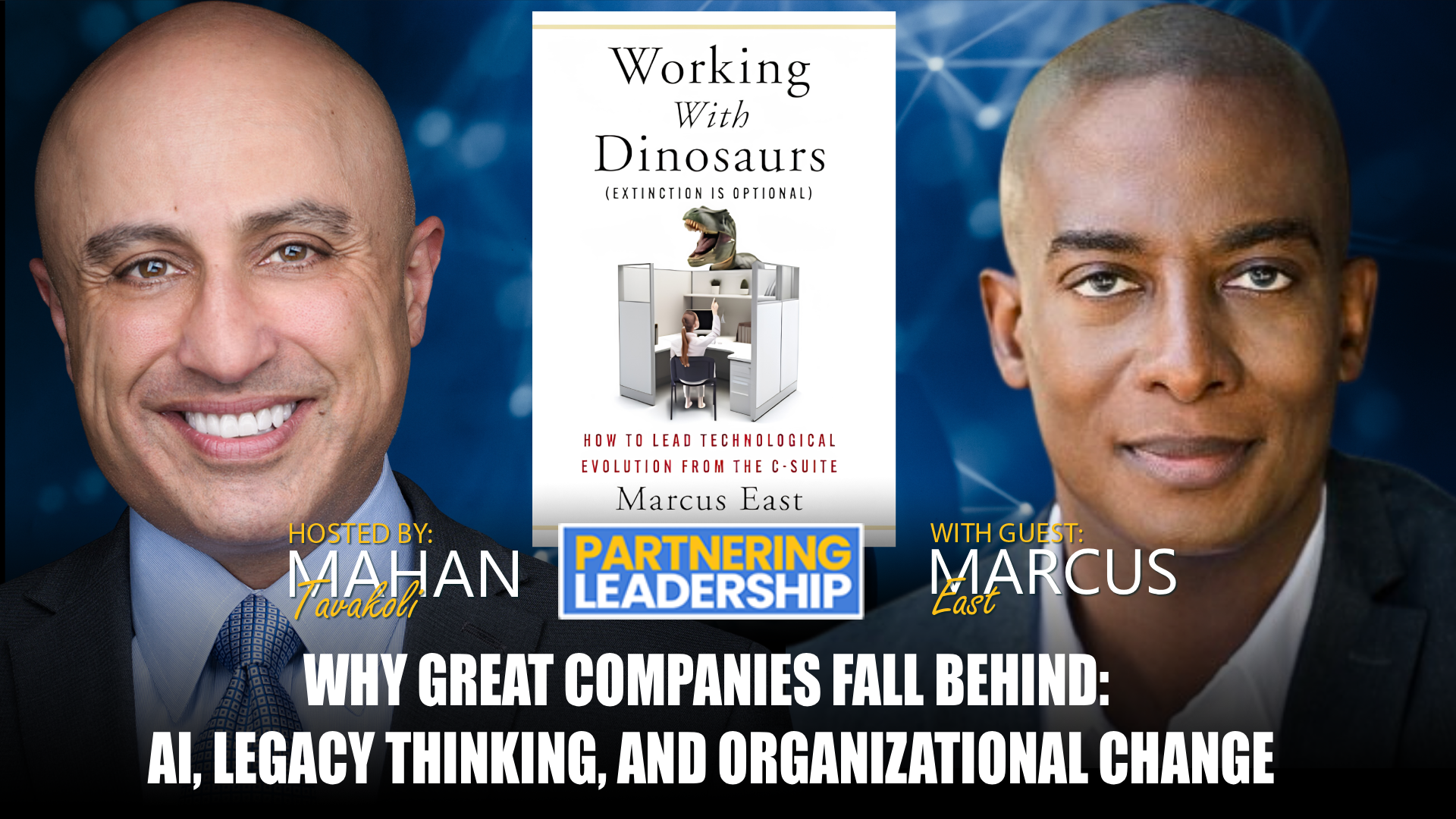
Future-proofing your organization ultimately starts with future-proofing your own leadership approach. In our conversation with Marcus East on the podcast, we explored the nuanced realities of driving transformation in complex environments. Marcus brings a wealth of insights on how leaders can navigate the friction between maintaining core business operations and innovating for the future.
One of the recurring themes from that discussion is the necessity for leaders to cultivate personal adaptability. If you, as a leader, are defensive about feedback, resistant to new technologies, or rigidly attached to how things "used to be done," your organization will mirror those limitations. Future-proof leadership is an inside-out job. It requires relentless self-awareness, a willingness to unlearn outdated habits, and the humility to continuously update your own mental models.
Marcus highlighted how successful transformation relies on aligning people around a shared purpose rather than just enforcing process changes. When leaders focus on the "why" and connect daily work to a larger mission, they unlock intrinsic motivation that makes structural adaptation infinitely smoother.
Actionable Strategies for Continuous Adaptation Without the Whiplash
Knowing that you need to change and knowing *how* to change without burning out your organization are two very different things. Here are several actionable strategies you can implement to foster continuous adaptation without inflicting change whiplash on your team:
- Implement the "One In, One Out" Rule: Before adding a new strategic initiative, project, or process to your organization's plate, evaluate what existing initiative can be sunsetted. Protect your team's cognitive bandwidth by actively managing their workload.
- Create Dedicated Reflection Spaces: Schedule regular retrospectives not just for technical projects, but for leadership habits and team dynamics. Give your people the time and space to step off the hamster wheel and think deeply about what is working and what needs to evolve.
- Reward Smart Experimentation: Celebrate learning moments, even when projects fail. Establish forums where teams can share what didn't work and why, transforming individual failures into collective organizational wisdom.
- Communicate with Clarity and Empathy: Acknowledge the emotional toll of change. Do not sugarcoat difficult transitions, but paint a clear, compelling picture of the destination on the other side of the turbulence.
- Pilot Before You Scale: Avoid massive, all-at-once organizational overhauls whenever possible. Test new ideas in controlled, low-stakes environments, gather feedback, refine your approach, and then scale gradually.
Conclusion: Questions Worth Thinking About Long After the Episode Ends
Organizational transformation is not a destination you finally reach and check off your strategic list; it is an ongoing capability. The organizations that thrive in the coming decades will not be the ones with the most rigid master plans, but the ones that have mastered the art of continuous adaptation without inducing organizational whiplash.
As you reflect on your own leadership journey this week, consider these questions:
- Where are you currently mistaking the consumption of information for deep reflection and actual implementation?
- What outdated process or success metric is your organization holding onto simply because it worked in the past?
- How can you build higher levels of trust and psychological safety within your team to support them through the next wave of change?
If you want to dive deeper into these concepts and hear incredible, tactical insights from a world-class thinker, make sure you listen to Episode 462: Why Successful Organizations Struggle to Change with Marcus East. Take the time to sit with the conversation, apply one concrete insight to your team, and find a question worth thinking about long after the episode ends.

Strategic Advisor to CEOs & Boards | Host, Partnering Leadership
Mahan Tavakoli is a strategic advisor to CEOs, boards, and executive teams, working with them on strategy, reinvention, leadership, organizational effectiveness, and the implications of AI for how organizations create value and operate.
Earlier in his career, Mahan spent more than 20 years with Dale Carnegie, where he led operations and strategy and helped drive international expansion across more than 90 countries.
Today, his work with senior leadership teams is complemented by more than 450 conversations on the Partnering Leadership podcast with CEOs, founders, researchers, futurists, and leading thinkers on strategy, organizations, leadership, and AI.
Across both his advisory work and the podcast, Mahan focuses on a central question: What is possible now that was not possible before, and what do organizations need to rethink to make it real?
Diving Deeper Into The Octopus Organization: Moving Past Permission-Based Cultures


![462 [Leadership Reset] Why Successful Organizations Struggle to Change with Marcus East](https://storage.buzzsprout.com/fhqrtp21flnggw77src0lod060tw?.jpg "462 [Leadership Reset] Why Successful Organizations Struggle to Change with Marcus East")