Rethinking Work and Competitive Advantage in the Age of AI
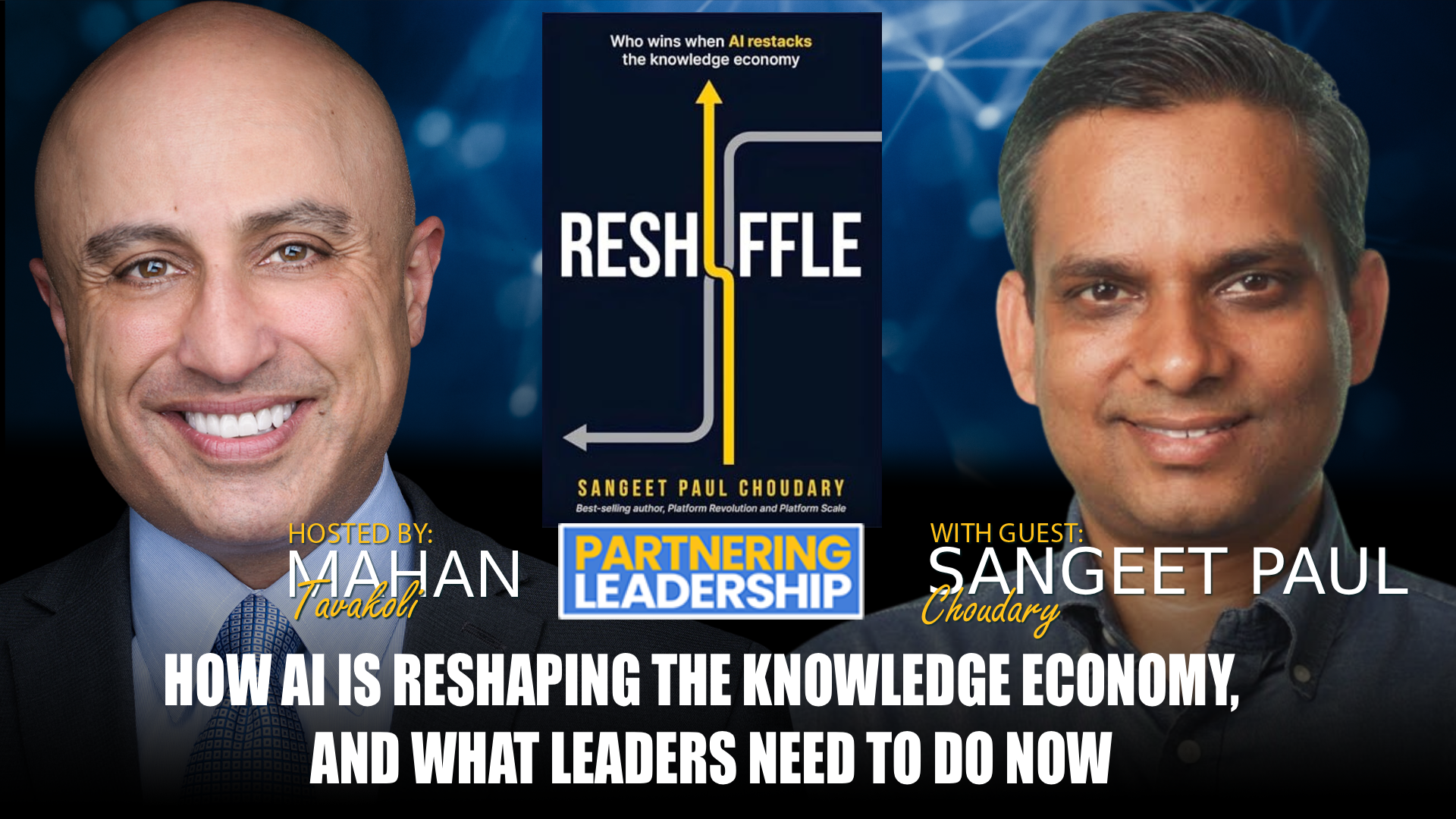
Artificial intelligence is one of those monumental shifts that demands more than a superficial glance or a quick implementation strategy. It requires deep reflection. To explore this vital topic further and listen to the complete discussion that inspired these insights, be sure to check out episode 461 [Leadership Reset] How AI Is Reshaping Value Creation and Competitive Advantage with Sangeet Paul Choudary on Partnering Leadership. Let us dive into what it truly takes to rethink work, redefine competitive advantage, and build resilient organizations in the age of artificial intelligence.
Rethinking Work and Competitive Advantage in the Age of AI
For decades, traditional business strategy was built on a foundation of industrial-era assumptions. Michael Porter taught generations of leaders about competitive positioning, cost leadership, and differentiation within fixed value chains. We optimized operations for efficiency, built massive proprietary moats around physical assets or large internal workforces, and scaled linear processes to drive profitability.
Today, generative artificial intelligence, machine learning, and autonomous agent systems are dismantling those historical playbooks piece by piece. Work is no longer merely about human labor augmented by software tools; it is about cognitive capabilities being scaled, automated, and reimagined at machine speed. When a machine can draft a complex legal brief, write sophisticated software code, analyze medical imaging, or generate targeted marketing campaigns in seconds, the old definitions of productivity and skill begin to fracture.
This technological revolution forces leaders to fundamentally rethink what work actually is. Is our primary function as an organization to execute routine tasks faster, or is it to solve novel problems, orchestrate complex ecosystems, and envision entirely new customer experiences? If your competitive advantage relies solely on executing standardized knowledge work efficiently, artificial intelligence will inevitably commoditize your business model. True competitive advantage in the age of AI requires transitioning from operational execution to systemic orchestration, creative problem-solving, and continuous reinvention.
The Shift from Linear Efficiency to Networked Value
Historically, organizations achieved scale through internal hierarchy. You hired more people, bought more machinery, and expanded your physical footprint. In the digital and platform economy—now turbocharged by AI—scale is achieved through networks and data loops rather than headcount alone. Organizations that cling to linear models of value creation will find themselves outpaced by platform-native competitors who leverage AI to learn faster, personalize deeper, and deploy resources dynamically.
As leaders, our mandate is to look past the hype cycle of generative AI tools. We must move beyond simply asking how we can use a chatbot to save ten minutes on an email, and instead ask how artificial intelligence fundamentally alters our ability to create unique, defensible value for the customers and communities we serve.
Key Insights from Sangeet Paul Choudary on Value Creation
To truly grasp the mechanics of this transformation, we look to leading thinkers like Sangeet Paul Choudary, a globally recognized expert on platform economics and modern business architecture. In our comprehensive discussion on Partnering Leadership, Sangeet unpacked how artificial intelligence alters the fundamental architecture of value creation.
In traditional pipeline businesses, value flows in a straight line from producer to consumer. Think of a traditional manufacturer that builds a product and sells it through a distributor to an end user. The firm controls the steps of creation. However, platform businesses shift this dynamic by facilitating direct value-creating interactions between external producers and consumers. AI supercharges this platform model by dramatically reducing friction, lowering transaction costs, and enabling hyper-matching at a scale previously unimaginable.
Furthermore, Sangeet highlights how AI transforms data from a passive byproduct of business operations into an active engine of competitive differentiation. In the past, companies collected data to report on what happened yesterday. Today, AI allows organizations to leverage data to predict what is happening right now and autonomously optimize what will happen next. This creates a powerful self-reinforcing loop: better data leads to superior AI models, which deliver enhanced user experiences, which attract more users, which generates richer data.
Unbundling and Rebundling Expertise
Another critical insight regarding value creation in the age of AI involves the unbundling and subsequent rebundling of human expertise. For generations, professionals spent years mastering specific domains—such as tax law, copywriting, coding, or financial analysis—because holding that specialized knowledge was the primary source of economic value.
AI democratizes access to baseline expertise across almost every domain. When foundational knowledge is instantly accessible via intelligent systems, the value shifts away from mere memorization or standard execution. Instead, value concentrates at the absolute margins: the ability to ask the right questions, synthesize disparate ideas across multiple disciplines, exercise ethical judgment, and inspire human collaboration. Leaders must recognize that their teams’ value proposition has shifted from knowing the answers to defining the problems.
Building Adaptable Organizations for Technological Disruption
Understanding the economics of AI is one thing; building an organization capable of absorbing and thriving amidst constant technological disruption is an entirely different leadership challenge. Most corporate structures are built for stability, predictability, and risk mitigation. Unfortunately, these exact traits often make organizations brittle when faced with exponential technological change.
To build an adaptable organization, leaders must intentionally dismantle silos and foster a culture of continuous experimentation. Innovation cannot remain locked inside a isolated research and development department or delegated solely to a newly formed chief digital officer. Every team, from human resources to finance to customer service, must be empowered to test, learn, and adapt how they utilize emerging tools.
Psychological Safety as a Strategic Imperative
Adaptability is fundamentally rooted in human psychology and organizational culture. When employees fear that artificial intelligence will render their jobs obsolete overnight, their natural response is self-preservation: resistance, hiding inefficiencies, or flat-out rejection of new technologies. This defensive posture is fatal to organizational agility.
Leaders must cultivate deep psychological safety by reframing the narrative around AI. Rather than positioning technology as a replacement mechanism designed for headcount reduction, visionary leaders frame AI as a force multiplier that frees human talent from mundane drudgery to focus on high-impact, creative, and relational work. When people feel secure, they are far more willing to experiment with new workflows, admit failures quickly, and share insights across the enterprise.
Decentralizing Decision-Making and Empowering Edge Teams
In times of rapid disruption, top-down command-and-control hierarchies create catastrophic bottlenecks. Senior executives sitting at headquarters cannot possibly understand every nuance of how AI is impacting customer interactions on the front lines or operational workflows in regional offices.
Building an adaptable organization requires decentralizing decision-making. Empowering edge teams—the people closest to the technology, the data, and the customers—to pilot AI solutions, adapt processes, and make autonomous choices is critical. Leadership’s role shifts from dictating every step of the process to setting clear strategic guardrails, providing adequate resources, and clearing organizational roadblocks.
Wiser Decision-Making for Future-Ready Leaders
With an overwhelming volume of information and rapid technological advancements bearing down on us, the quality of executive decision-making determines which organizations thrive and which quietly fade into irrelevance. Future-ready leadership requires a deliberate upgrade in how we think, evaluate risk, and commit to action.
Wiser decision-making in the age of AI begins with intellectual humility. The future is no longer a linear projection of the past. Historical trends, past market cycles, and traditional forecasting models are increasingly inadequate when exponential technologies alter the rules of the game overnight. Leaders must become comfortable operating in deep ambiguity, acknowledging what they do not know, and building optionality into their strategic plans.
Balancing Speed with Long-Term Wisdom
AI encourages extreme velocity. We can analyze data faster, launch campaigns quicker, and automate decisions in real-time. However, speed without wisdom is a recipe for accelerated failure. Future-ready leaders must master the art of dual-speed leadership: moving with immense agility on tactical execution while maintaining deep, deliberate patience when evaluating foundational strategy, ethics, and long-term organizational impact.
This means asking deeper questions before deploying automated systems:
- What are the unintended ethical consequences of this AI implementation?
- How does this technology impact our core human relationships, both internally with employees and externally with customers?
- Are we solving a genuine human problem, or are we simply adopting technology because we feel pressured to keep pace with market hype?
- Does this decision align with our organization’s enduring values and long-term purpose?
By pausing to wrestle with these foundational questions, leaders protect their organizations from short-sighted traps and position themselves for sustainable, principled success.
Conclusion: Sitting with Ideas That Shape How We Lead
As we navigate the complexities of the summer leadership reset, it becomes abundantly clear that the future belongs not to those who consume the most information, but to those who pause long enough to let transformative ideas reshape their thinking. Artificial intelligence is fundamentally rewriting the rules of value creation, competitive advantage, and organizational design. Navigating this disruption requires more than surface-level adoption; it demands a profound shift in leadership mindset, a commitment to building adaptable cultures, and the wisdom to make deliberate, future-ready choices.
The insights shared by Sangeet Paul Choudary remind us that the old playbooks of linear efficiency and rigid hierarchy are giving way to networked ecosystems, data-driven loops, and the unbundling of expertise. To thrive, we must embrace this transition with curiosity, psychological safety, and intellectual humility.
If you are ready to dive deeper into these vital concepts and hear the full, unfiltered discussion that sparked this reflection, I encourage you to listen to episode 461 on Partnering Leadership. Take the time to sit with these ideas, discuss them with your leadership team, and apply the insights that will help you and your organization not just survive, but truly lead in the age of artificial intelligence.

Strategic Advisor to CEOs & Boards | Host, Partnering Leadership
Mahan Tavakoli is a strategic advisor to CEOs, boards, and executive teams, working with them on strategy, reinvention, leadership, organizational effectiveness, and the implications of AI for how organizations create value and operate.
Earlier in his career, Mahan spent more than 20 years with Dale Carnegie, where he led operations and strategy and helped drive international expansion across more than 90 countries.
Today, his work with senior leadership teams is complemented by more than 450 conversations on the Partnering Leadership podcast with CEOs, founders, researchers, futurists, and leading thinkers on strategy, organizations, leadership, and AI.
Across both his advisory work and the podcast, Mahan focuses on a central question: What is possible now that was not possible before, and what do organizations need to rethink to make it real?
Why Senior Executives Fail at Career Optionality (And How to Build It)


![461 [Leadership Reset] How AI Is Reshaping Value Creation and Competitive Advantage with Sangeet Paul Choudary](https://storage.buzzsprout.com/y9e6b8bpvrgr15baihgwrrj3s2rg?.jpg "461 [Leadership Reset] How AI Is Reshaping Value Creation and Competitive Advantage with Sangeet Paul Choudary")