

 Spotify

 Amazon Music

 Apple Podcasts

 iHeartRadio

 TuneIn

 Podchaser

 Overcast

 Castro

 Castbox

 Deezer

 PlayerFM

 Audible

 Podcast Addict

 YouTube

 RSS Feed
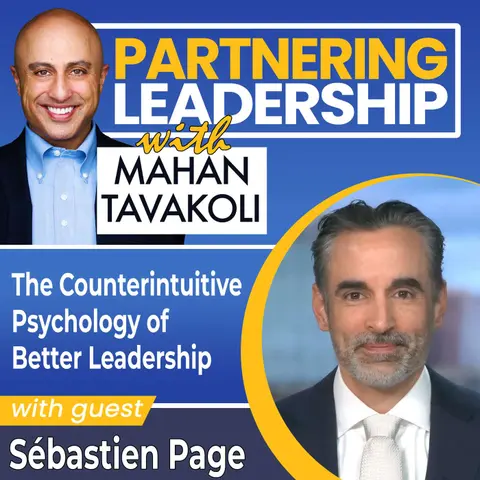
479 The Counterintuitive Psychology of Better Leadership with Sébastien Page
Key Takeaways
- Measurable goals can drive alignment and execution, but they also create goal-induced blindness, causing executives to sacrifice health, relationships, and ethics for the sake of the metric.
- Effective leaders must learn to interrogate their successes as aggressively as their failures, separating decision quality from outcome quality to build better judgment under uncertainty.
- Practicing vulnerability by saying 'I was wrong' and 'I don’t know' actually demonstrates executive confidence rather than weakness, helping leaders avoid blind spots at the top.
- Proactively asking for feedback is a surprisingly simple yet powerful tool that reduces the psychological stress response for both the giver and the receiver.
- Sustained high performance requires a healthy balance between ego orientation and mastery orientation, along with adequate rest and recovery.
What happens when the qualities that helped make you successful begin working against you as a leader? Sébastien Page has spent more than 25 years in investment management and serves as Chief Investment Officer at T. Rowe Price. But his growing interest in leadership took him beyond finance and into psychology, where he spent years exploring research from sports, positive, and performance psychology. That journey became the foundation for his book, The Psychology of Leadership: Timeless Principles to Improve Your Management of Individuals, Teams, and Yourself.
In this episode of Partnering Leadership, Sébastien Page challenges several assumptions that are deeply embedded in high-performance organizations. Measurable goals can focus attention and drive results, but they can also create what he calls “goal-induced blindness,” causing executives and teams to overlook health, relationships, ethics, and even the quality of the processes producing those results. The risk may be particularly acute among high performers, precisely because they are so motivated to achieve.
The conversation also explores one of the most important distinctions in executive decision-making: the difference between a good outcome and a good decision. In uncertain environments, smart decisions can produce disappointing results, while poor decisions can occasionally succeed. Sébastien explains why leaders who want to improve judgment must look beyond the scorecard and examine the process behind both successes and failures.
Sébastien and Mahan also discuss some deceptively simple behaviors that become harder as executives gain authority: saying “I was wrong,” admitting “I don’t know,” and actively asking others for feedback. They explore the psychology of engagement and meaning, why extrinsic rewards alone rarely create sustained motivation, and how leaders can help people connect everyday work to a larger contribution.
The conversation concludes with two increasingly relevant leadership tensions. First, AI can dramatically improve productivity while simultaneously making communication feel less human and authentic. Second, the goal of high performance should not be to eliminate stress altogether. Sébastien explains why the right level of pressure can sharpen performance, why chronic stress remains dangerous, and why leaders need to become better at calibrating the difference.
Actionable Takeaways
- You’ll learn why highly measurable goals can produce unintended consequences and why some of the highest performers may be particularly susceptible to goal-induced blindness.
- Hear how to distinguish decision quality from outcome quality and why evaluating the process behind both wins and losses can improve judgment in uncertain environments.
- You’ll learn why a mastery orientation can strengthen high-performing teams by shifting some attention from simply hitting the number to continually improving how the work gets done.
- Hear why saying “I was wrong” and “I don’t know” can demonstrate confidence rather than weakness, particularly as executives rise to levels where fewer people are willing to challenge them.
- You’ll learn a surprisingly simple way to make feedback less threatening and why proactively asking for it changes the dynamic for both the person giving and receiving it.
- Hear why engagement requires more than compensation and incentives and how relationships, meaning, and intrinsic motivation influence the energy people bring to their work.
- You’ll learn why AI creates an authenticity challenge for leadership, even while making communication and knowledge work faster and more accessible.
- Hear why trying to eliminate stress completely may actually undermine performance and how leaders can think differently about pressure, recovery, and sustained high performance.
- You’ll learn why Sébastien still answers “everything” when asked what he wants to improve as a leader, and what that reveals about maintaining a mastery mindset even after decades of professional success.
Connect with Sébastien Page
Connect with Mahan Tavakoli:
Frequently Asked Questions
Who is Sébastien Page and what is his book about?
Sébastien Page is the Chief Investment Officer at T. Rowe Price and author of The Psychology of Leadership: Timeless Principles to Improve Your Management of Individuals, Teams, and Yourself, which explores how sports, positive, and performance psychology can improve executive decision-making.
What is goal-induced blindness in leadership?
Goal-induced blindness occurs when leaders become so hyper-focused on achieving a specific measurable goal that they lose sight of non-goal areas such as employee health, personal relationships, long-term well-being, and ethical standards.
How can leaders improve decision-making under uncertainty?
Leaders can improve decision-making by focusing on the underlying process rather than just the final result, and by critically evaluating both their successes and their failures to avoid the trap of 'resulting'.
Why is asking for feedback less stressful than receiving unsolicited feedback?
According to neuroleadership research, when leaders proactively ask for feedback, the neurological stress response for both the giver and the receiver is reduced by up to 50%.
Welcome to Partnering Leadership, a top global leadership podcast for purpose-driven leaders with a growth mindset. Seeking to learn from the leadership journey of change makers and business insights from leading global thinkers. For additional leadership insights and bonus content, visit us at partneringleadership.com. Now here's your host, Mahan Tavakouli.
SPEAKER_01Sebastian Page and welcome to Partnering Leadership. I am thrilled to have you in this conversation with me.
SPEAKER_02Mahan, I'm fired up. I'm fired up. I've been looking forward to this. I know we live in the same area. Maybe next time we'll meet in person, but I've been looking forward to this.
SPEAKER_01I look forward to it as well, both meeting in person and getting some of your insights based on your experience and your book, Sebastian. Timeless Principles to improve your management of individuals, teams, and yourself. Before we get to that, though, Sebastian, we'd love to know a little bit more about you. Where about you grew up and how did your upbringing help contribute to who you've become?
SPEAKER_02Love that question. I'm French Canadian. I grew up in Sherbrooke, Quebec, Canada. Half my life have lived in Canada, the other half in the US. I have both citizenships. The trade negotiations are breaking my heart right now, but that's not the topic of the podcast today. Today's about leadership. I grew up on a farm, and most people seem surprised when I tell them I grew up on a farm because Mahan, I wear suits every day and I can't fix a light bulb around the house. I was a fairly good student in school. My father is a finance professor. I want to take you to a critical moment that explains the beginning and, in a way, my career. I'm doing my master's degree, and I'm just done with a math test. This was a tough one. It was about bond pricing, really nerdy stuff, using derivatives. I hit 100% on the test. Wow. I know this is a moment that I should capture. I go talk to the professor right away. And I go, I want an internship. I know you're connected in the industry. I don't mention the test. I know he knows, I know. And I have his attention with my perfect score. He ended up lending me in Boston. Mahan landing there for a non-paid internship with no guarantee of a job at a global bank called State Street, still a bank that's doing very well. I had a bit of imposter syndrome. I was sitting to my right as a Harvard PhD who's coding a thousand lines a day, and to my left is an MIT student, and that's my competition to lend the job. I worked around the clock. I became incredibly passionate and motivated and intrigued by financial markets. I was building mathematical models to predict the returns on different financial markets in different countries and how to trade them using mathematical predictions. And it was so engaging. Now I'm looking back at an over 25-year career in money management. I'm chief investment officer at T Row Price, and I'm still going. I still love it, but I'm very passionate about leadership now as well.
SPEAKER_01Now, as you were the successful executive, your wife played a role in shaking Europe and saying maybe something isn't right with this.
SPEAKER_02She's so wonderful. She's my sounding board. She gets me back on track when I'm off track. We've been together since the beginning, since the college years. And this was a moment where she could see it. I didn't have to say it. I'm not someone who likes to talk about work when I get home. It's my sanctuary and I like to relax. But she could see something going on. And she said, You gotta do something. That started an exploration. To me, sports psychology was the immediate outlet or body of knowledge that I became interested in. I talked to a famous sports psychologist here in Maryland, where I live, and he pointed me to the research. He ended up being a consultant on the book and the research behind it is a very interesting sport psychologist because he's also an athlete himself. He's one of the top for his age group now, handball player in America. He's won 44-0 national title. His name is Daniel Zimmett. He actually ended up writing a couple pages at the end of the book. But you're right, Mahan. It was my wife. And she just looked at me and said, you got to look at things differently. You know what was interesting though? Is that when I told my father, for example, or other colleagues, I'm doing research in psychology and I'm learning things about positive psychology that are amazing, that are underused in business. It's like a gold mine. I need to write about this. I love to write. Maybe there's a book. I was told to stay in my lane. A lot of people told me, just write another finance book. I had already co-authored a finance book and then authored a finance book. Stay in your lane. Agents told me stay in your lane as well. And that was horrible advice because we innovate as a society when people step out of their lanes and make connections between different things.
SPEAKER_01It's value added in a lot of different perspectives, Sebastian. When is for the individual, going outside of your lane expands your own thinking, your own understanding? Then when you convey that to others, you convey it very differently than someone who has been in that lane all their lives. Now, why this attraction to the non-quantitative?
SPEAKER_02One of the biggest challenges that we have in money management, and I will guess, Mahan, with a lot of your listeners, where expertise is highly valued inside the enterprise, is that we promote domain experts, people that know their stuff. Maybe they're great salespeople, maybe they're great engineers, maybe they're great portfolio managers, money managers into positions of leadership. That transition is not obvious. And I've made that transition myself. And I've realized that all the soft people's skill aspect of things becomes so important. And in a sense, high-performing experts aren't really trained for this. I love that you keep bringing back that I've gone outside my lane and with a curious mindset and earlier, and you talked about your listeners that way too, people that like to learn, business people that will learn their entire life. When I wrote the book, The Psychology of Leadership, it was for me to learn and improve myself as well. In fact, my agent wanted me to, I had to take something out of the book because, in hindsight, arrogant, but I said, like Marcus Aurelius, I'm writing this book for myself as much as for you, dear reader. Now, Marcus Aurelius wrote one of the most famous self-help, self-improvement books of all time. He was a Roman emperor. I like the example of he's going to work every day, right? He's not writing from the ivory tower. But also, scholars have surmised that he's writing the meditations in particular as notes to himself, reminders to himself. I ended up writing in the intro, I'm writing this book for self-improvement. I'm assuming you're reading it for the same reason. We're all learning. Self-improvement is awesome. It's not if approach right, and if backed by research, it's fantastic. It's one of the great enjoyment that people can have in life, is to focus on their self-improvement. And you know what? In leadership, it's about helping others perform at their best. The best way to do that is to improve your mental game as well.
SPEAKER_01So, in doing that, you warned Sebastian about goal-induced blindness. So, what is goal-induced blindness?
SPEAKER_02I want, before I answer, to give a caveat. Measurable goals are very powerful and they work. They can align people, they can clarify what needs to be done, they can be very motivating. Measurable goals are effective. But like any strong medicine that's effective, they also have side effects. Goal-induced blindness is well documented in the psychology literature. It occurs when you're so focused on your goal, which almost always is a measurable goal, that you lose sight of any non-goal area in your life. It could be you're so focused on achieving your goals at work that you neglect your family. It could be you want to reach that goal so badly, the top of Everest, that you're going to sacrifice your own health and well-being to get there. You might also sacrifice your own sense of ethics. You might also start to cheat. These are all manifestations of goal-induced blindness. In self-improvement, we often think it's about someone who's not performing well and getting them to perform to a certain level. That's interesting. But self-improvement is also about high performance, ultra high performance. I was talking last week with a portfolio manager about coaching, and I said, Would you be receptive to coaching? He looked at me and he said, Absolutely. Rafa Nadal has a coach. Why wouldn't I have a coach? But when you get to these high-performing, ultra-high performing levels, that's where goal-induced blindness occurs. I talk a lot about Mount Everest because it's used in the literature as an example of where goal-induced blindness tends to occur. If you want to reach a summit, out of every 100 people who will, four will die. That's what we're talking about on Mount Everest. If you've done it, kudos to you. But you have to step over frozen dead bodies to get to the top. That's the type of goal that people get obsessed with. And they suffer goal-induced blindness, and so it's documented around Mount Everest, but it's everywhere. That's exactly what I was wondering, Sebastian.
SPEAKER_01There is always the yes, but, and then the rationale behind the reasoning for this goal-induced blindness. So, how do you recommend for people, Sebastian, to balance that in the real world as there are organizational demands? As you said, one of the values you bring to your insights is that you do have a boss, you do have an organization you're responsible for. How do you balance that with then not having the goals blind you?
SPEAKER_02I want to be realistic. In a hyper competitive world, in the high performance echelons, there are moments where you might have to pull all-nighters to give maximal effort. And this can be in any job. So I want to be realistic about that. But I'm going to make a statement that I've made to my team repeatedly. A well-rested team will outperform an overworked competition any day. It's very clear in sports, delivering high performance requires periods of rest. And so to an executive who would say to you, Mahan, forget seven or eight hours of sleep. My competition is going to beat me. Maybe, maybe you have to do it for a couple of days. But if you think that's a requirement, you're just grinding down your health, fitness, your mental acuity, and your overall longer-term performance is going to be worse. Let's take Simone Biles, because I think that's a great sports example. Famously at the Tokyo Olympics, she walked out. We're talking about one of the top gymnasts in the world. Walked out of the Olympics. She had the twisties, which means in gymnasts' term, she couldn't figure out where she was in the air. And it was anxiety related and over-training related. She walked out and she was clear that it was for mental health reasons. Then the next part of that story speaks to goal-induced blindness and periods of rest. Over the following few months, famously because she was on Twitter, she would talk about how she was really happy to have slept eight hours. She would talk about how she had watched Netflix for an entire Sunday doing nothing. She had talked about how she would push back on her coaches. Now, she was still training very hard, but she learned to build rest and to work on mental fitness, just like you work on physical fitness. And then she came back. This was in 21, she came back in 23, and she won four gold medals. So Simone Biles became a better gymnast by building rest into her routines. Any top athlete knows this. That's what I would tell the big ego CEOs that say, I'm so important. This is so difficult, it's so competitive, I don't have time to sleep. It's not that impressive because you just lack of sleep, you know what it does to you? If you're on three or four hours of sleep and you're driving, you're basically as impaired as being over the drinking limit. That's what lack of sleep does to you. It destroys your immune system. You're gonna get, you're gonna get cold, you're gonna get flu, it destroys your mental balance, you're gonna get hungry, you're gonna overeat. It's not gonna work.
SPEAKER_01With that glow-induced blindness that you talk about, Sebastian, having the wrong measures produces the wrong outcomes as well. Now, what I wonder is you also talk about the importance of looking at the process rather than just results. How does that help us, both with respect to our goal setting, but also our leadership approach, focusing on process, not just results?
SPEAKER_02I love that question. Let me add a little something about goal-induced blindness, and then I'll answer the process question. Over the weekend, I participated in a challenge to run or walk as many miles as possible. It was a group challenge, and everybody could see how many miles you were putting in. And Mahan, I did 34 miles on Friday, about 40% running, 60% walking, 34 miles on Saturday, and then I thought I need to do 100. So I did 32 on Sunday. I injured myself. I had goal in death blindness. Your podcast guest was pontificating. I had goal into I'm limping today. I got this shin split on my right shin, right? So we're all subject to that. I just wanted to add that on process, focusing on process. It's absolutely true that sometimes we set the wrong goals. Wells Fargo famously had a goal, a metric of how many accounts can you open? And they would measure and set targets on how many new bank accounts. So what happened? People started opening dummy accounts, like fake accounts. I remember they had a pretty good mortgage rate asking for a mortgage, and they were like, oh, your credit's outstanding. We'll give you the mortgage. But can you just open a bank account? I'm like, I don't need a bank account. No, you need to open a bank account. And so that the wrong goals. That leads us to the process. When I met Dr. Danielsim at the sports psychologist, he told me a fascinating story about the best handball match he ever played. It occurred 10 years prior, but he remembered every single thing about that match. Where the ball was at point number three, how it bounced off the wall. He's telling me this with so much passion. At one point in the story, he's on his knees. He makes a shot that's impossible, but he makes it. He never thought he would make it. People in the stand are screaming, the beer is flying, and I could tell the emotion is there. He's almost crying. It's almost like the tears in his eyes. But then there's a very strange letdown, at least for me, because he just very nonchalant says, and then I lost the next two points. And he actually lost the match. I thought best match he ever played. You remember everything about it. You lost it. That was his way of introducing to me the concept of sports psychology of differentiating between ego and mastery. For him that day, this was his best match because he was playing a much stronger opponent. And he realized that he was now able to play the game at a much higher level. So, from a process or mastery perspective, his game had improved drastically, and this match was the culmination of this. The score did not matter. Now, in sports, people have an ego orientation or obsessed with the score. They might get lucky or win ugly, and it doesn't matter because it's winning at all costs. And winning is great, and it's a great goal to have. But if you have the pure ego orientation, you forget about the importance of the process. And then the process is, instead of Wells Fargo saying, let's open as many bank accounts as possible, they would say something like, we got to get better at our sales process. What sales technique can we use to increase our closing rate? See how that's a little different mindset, right? In money management. Okay, I want to beat the markets. I want to make money for my client for sure. That's an important goal. But what about mastery? Are we getting better at research? Are we using AI to build an edge to beat the markets? That's a mastery question. All the way to nitty-gritty stuff. Like, are we running the meeting the right way so that we get the best ideas from everybody? That's a total mastery question. I'm arguing for a better balance between ego and mastery, between measurable goals and softer goals and processed goals. I'm not arguing for a black and white view of the world, but in general, especially in high-performing teams, we have more of an ego of a measurable goal orientation, and we could benefit from a mastery orientation. Rory Mekroy, last time he won the tournament, he was interviewed, and I loved it because he said every point I played, the entire tournament, I kept repeating to myself, your process, process, focus on your process.
SPEAKER_01What a beautiful way of putting it, Sebastian. And as you're describing this, there are a couple of things that come to my mind. Traditionally, that focus on mastery and process has been a tiny bit more Eastern, and the pure outcome orientation has been a little bit more Western. What you're saying is it's not one or the other, and I couldn't agree with you more. It's an understanding and it's a balance that is required. One without the other doesn't work. And I think it's as important for individuals as it is for organizations. The other thing you mentioned that I want to underline also reminds me of Annie Duke, the world champion of poker, studied psychology as well. Outstanding book Thinking in Bets. And she talks about resulting, which is we look at a result. And assume the process or the decisions that led to the result were right. Or if the result wasn't good, as in the handball game, we assume that the process and the decisions that led to it, there must have been something wrong with it. And the point she makes is we need to learn from the process and the decision making, not just the result. So those are outstanding ways for us to view our own leadership and organizational decision making. The other thing is you challenge us to interrogate success as aggressively as we interrogate failure.
SPEAKER_02On Annie Duke and her work on resulting, which I agree with you, Mahan, it's excellent. If you win, if you have a good outcome, but you didn't really do a good job, you just got lucky. It's very difficult to be self-aware enough. There was a moment recently in the World Cup soccer where they interviewed the England coach, and he was very down in there, just won. And he said, we played horribly. And he was criticized all over social media. But I get it. He was not resulting. He looked at the process and they got lucky and they won. Just to put a big exclamation point on this, let's do a theoretical experiment, Mahan, you and me. Let's say we go out to dinner and we have a bottle of wine each, which is way too much alcohol, and I decide to drive home and I make it home safely. Should I conclude that this was a good decision? No. It was a horrible decision, but it was a good outcome. Now, let's say you get in an Uber and the Uber driver crashes. Should you conclude that you made the wrong decision? No, you made the right decision. It was just a bad outcome. So you have to interrogate your wins, you have to interrogate your losses. Human nature, and this applies to athletes and to business decisions, is such that when we get it right, we think we're smart. And when we get it wrong, maybe we think we're unlucky. Right? There's a mentor in business who told me there are only two types of money managers, those who are talented and those who are unlucky. You'll never find another kind of investor, right? Never find an untalented investor. So it takes self-awareness. But the prize, why would you do that? Just for fun, just to torture yourself? No. The prize is that you will build an edge in decision making under uncertainty. And Mahan, you have a business audience. What do people who listen to this? What do they do every day? They make decisions under uncertainty. If you can get better at that, you're just going to be better in your business. It's difficult making decisions under uncertainty, but that's the price. That's why you interrogate your wins, you interrogate your losses, you think about your process. And it's hard. It requires vulnerability, but once you get it into your routine, you'll see that your decisions will improve. There's research that was made on super forecasters. So they had a bunch of people do forecasting about everything politics, like election results, or economics, or financial markets. And they identified this small group of people that were really good at forecasting. And then they said, okay, what makes these people different? And part of it, not all of it, but part of it, was the ability to evaluate their wins and losses, this vulnerability, this ability to change your mind in the face of new evidence. I use your phrase, which I love, to interrogate your successes as aggressively as you interrogate your losses.
SPEAKER_01That takes some of the humility that you were talking about, Sebastian. How do you make sure that you both interrogate the process, but in essence interrogate yourself to make sure you maintain as an executive as small of a blind spot as possible?
SPEAKER_02So feedback, especially if it's synonymous, can be helpful. But I want to give something to our audience that's way simpler than that and that works. I'm gonna give you two very short sentences that you as a leader should think about using. And I guarantee you most of our audience doesn't use it. And if I'm not careful, I won't use them myself. And find occasions to use them over the next week and see how it feels. The first sentence in front of your team, and by the way, no one gets everything right, so it's a normal sentence to use. As a leader, are you able to say I was wrong in front of your team? Because I guarantee you you're not always right. But how often do you say, I got this wrong? And you don't need to leave it at that. You can say, here's why, and here's what we're gonna do, and here's what. I was wrong. How often do you hear that? That's a powerful way to very counterintuitively, Mahan, show confidence. By saying I was wrong, it feels like you're showing weakness. No, you're showing confidence. And the other one is similar. And this is hard for me, especially because I often get interviewed on live national TV, including tomorrow morning on CNBC as we record this. I haven't said it on live national TV yet, but as a leader, are you able to say very clearly, I don't know? Someone asks you something, are you able to say, I don't know, instead of trying to make up an answer and you know what? I don't know. And leave a pregnant pause after it. These help, I think, with avoiding these blind spots. And as you climb, it's true that as you climb the hierarchy in an organization, people won't really tell you those things about feedback if you can ask for it proactively. Research shows that it's much less stressful to receive feedback if you actually ask for it. Some of the top leaders I've worked with actually will come to you and say, Hey, how did I do in that sales presentation? Anything I should be doing different next time. Asking for feedback is a very simple, powerful tool. Dr. David Rock, he's a pioneer of a field called neuroleadership. He hooked people up to sensors, like measuring your heart rate and other stress responses. And then he had people give and receive feedback. And he realized that if the person asked for the feedback, the stress response for the giver and the receiver, the stress responses were both 50% lower just by the process of asking for it.
SPEAKER_01Three incredible pieces of advice. One, ask for that feedback, reduces the stress for you and the person giving you the feedback. There can be value to that. I don't know, and I was wrong. And you're absolutely right, where we all have situations, circumstances on an ongoing basis where we could do that. But some of the traditional thinking we've had on leadership and how leaders should behave doesn't lend itself to that. Now, you also use, Sebastian, Martin Seligman's perma model. And you argue that we often use the wrong definition of success. In your view, what are we getting wrong with our definition and approach to success?
SPEAKER_02We think short term. And positive psychology forces us to think long term. Positive psychology is about what makes people thrive in their lives. Seligman famously has a model called PERMA, P-E-R-M-A. The P is positive emotions, and that's what we seek day-to-day. And you know what? The reality of life is that negative emotions are there too. And you can't suppress them. It's part of the human condition. Irma, E-R-M-A, is where it gets interesting and where you start thinking longer term. Engagement, relationships, meaning, and long-term accomplishment. Irma. Seligman, the father of positive psychology, has found that people thrive in the long run when they're engaged in their work. 70% of Americans right now would answer I'm not engaged in my work in surveys.
SPEAKER_01Sebastian, let me jump in there because I want you to expand on each one of them. I wonder why has there been very little to no progress in that? I think I probably saw Gallup doing that survey in early 2000s. I'm not sure exactly the date. But if you look at it, it's gone up a couple of points, it's gone down a couple of points. But in essence, with the billions of dollars that we spend on leadership development, training, all these different initiatives, that engagement piece that I want to understand before we go to the others hasn't moved.
SPEAKER_02How come? Daniel Pink, who's a great author, focuses on psychology, would say we've focused so much on the extrinsic rewards, the monetary, the bonus, the salary, that counterintuitively we've made the we're signaling by giving very measurable rewards and looking at money and extrinsic things. But by the way, money is really important and it's a great goal to have to make money. But what he's saying is we don't realize that by doing that, we implicitly send the signal that the work is not that valuable in itself. So it's a lack of intrinsic motivation for the work, which counterintuitively comes from, according to Daniel Pink, at least, the fact that we give too much emphasis on the extrinsic rewards. So what makes one intrinsically motivated? Something you want to do, anyways, like this podcast, Mahan. I'm not making any money from this podcast. I'm doing this at the end of a workday where I'm otherwise tired, but I'm super intrinsically motivated to do it. The same thing with my books. I'm not making money with this psychologist. It's selling well, but it's not making books aren't profitable, really. So it's intrinsic motivation. And that's, I think, what's lacking. That's why the surveys keep coming out very badly. And for intrinsic motivation, I think you start looking to the other parts. There are positive relationships. I think it's much more fun to go to work. It's not about kumbaya and holding hands every day, but when you have positive relationships built on trust and mutual respect. And we got to examine that as one of the reasons why people aren't intrinsically motivated to work. They're probably a relationship aspect. How do we handle feedback and so on? The meaning, people pontificate a lot about meaning, but it really matters if you have meaning in your work. I'll just wrap up my answer with this, Mahan. I think it'll bring the point home why the surveys are not showing any improvement in engagement at work. It's the bricklayer analogy that I talk about in the psychology of leadership. An architect walks to three bricklayers. They're doing the exact same job. He asks the first bricklayer, What are you doing? The first bricklayer is tired. He answers, I am laying bricks, I hate it, it's stirring. The second bricklayer is working a little bit faster. He answers, I'm a wall builder. I'm building a wall. And there's a bit more satisfaction and therefore engagement and energy. The third bricklayer is ahead of the other two, is smiling, is energized. They're doing the same job. But that third bricklayer answers, I am a cathedral builder. I'm building this awesome ode to the Almighty. We're talking about three people doing the exact same job. Very different sense of meaning. And the meaning comes from understanding how you contribute to the broader goal. In my work, I could go to three analysts working on a spreadsheet. The first one could say, Oh, I'm just fixing this spreadsheet. This is boring. The second one, more engaged, could say, I'm finding ways to beat the markets. It's kind of fun. The third one, super motivated, might be saying, I'm going to make money for a bunch of people, like hundreds of thousands or millions of people, and they're going to get better retirements. That's what I'm working on. The three of them are doing the same job, different levels of engagement.
SPEAKER_01Makes a big difference for everyone in the organizations. The challenge that I see, Sebastian, is how leaders who, in many instances, understand that conceptually and intellectually and have versions of purpose statements written up on walls and on websites conveyed in a way that people feel that sense of purpose rather than something that is just communicated. So a lot of organizations now have that, a lot of leaders now say that, but obviously people aren't feeling that sense of connection the way you're talking about it. One is that purpose. You also mentioned the relationships that are critical to that. So I wonder, Sebastian, one of the things that is impacting leadership, some of the human interactions, some of the engagement, part of what you have talked about in the book is the advancement of technology. And I wonder how you see technology playing a role in leadership and how we need to adjust our leadership based on the technology.
SPEAKER_02I see advantages and I see risks. I was in Asia recently and met with a colleague in Hong Kong, and they said my written English is not very good, but he's a very good analyst. And he goes, I used to spend so much time fixing my English in my research notes. And now I can do more work, and my research notes are much better, and everybody's happy. So there are real advantages. There's no more writer's block anymore. You can just ask AI to complete what you've started, and that'll give you a bunch of ideas. But I also see risks. Mahan, before we started the podcast, you and I talked for a few seconds. And I asked you some questions about how you want me to answer questions. And you said, Sebastian, we're having a conversation. It's you and Mahan. You almost have to forget that there's an audience. Why did you say that? I think you can correct me if you think I'm wrong. You said that because you wanted us to have an authentic discussion.
SPEAKER_01Absolutely.
SPEAKER_02I worry with AI that we lose authenticity. I worry with the mission statements, back to what we were talking a minute ago, that we lack authenticity. This is the meaning of what we do, but it's just a bunch of words. There's a show called Silicon Valley where the entrepreneurs go on stage and they pitch their company and it's all technical stuff. But at the end of the pitch, they also say, Oh, and we want to make the world a better place. We're fixing the speed of data transfers, and then they go, to make the world a better place. So when you talk about meaning, you have to mean it. I have this story in the book, The Psychology of Leadership. But authenticity is a problem. It bugs me when I see something on social media or when someone sends me an email and it says, This is not X, it's Y. The contrast that's always written by AI, or it has a I can recognize sentences and I can pretty much recognize AI writing. It bugs me. It just doesn't feel authentic. And the world craves authenticity, I think, now more than ever. So we have to keep our humanity and our authenticity and like we have right now, have real conversations. Instead of having this conversation today, you could have sent me a list of questions. I could have run them through AI and said, look at the psychology of leadership, craft some answers, and then you would have received the report. It would have looked pretty good, pretty clean. What would you have done? You would have used AI to summarize it. So now my AI is talking to your AI, and we're not having this fun discussion where we laugh and talk about leadership. So I don't want our society to lose that authenticity.
SPEAKER_01As we are surrounded with more of those inauthentic interactions, Sebastian, the role of that human leadership and the relationship building that you talk about, all the aspects that you mentioned becomes even more important. Then to your point, one of the senior executives at Microsoft that said something funny, which is so true, said, now we've gotten to the point where CEOs take three bullet points, give it to AI to come up with a 10-page report or document to send to their employees. Then their employees upload it to AI to get three bullet points summary of what the CEO sent to them. That's a good example. So a couple of other questions for you, Sebastian, before we wrap up. You spent four years really immersing yourself in the psychology. You've studied it, you wrote about it. I wonder if there is anything you changed your mind about.
SPEAKER_02A lot of things, but I'll give you a major one that had a big impact on my life, my professional life, and my personal life. There's a concept in sports psychology that maps performance to your stress level. It was a revelation to me to realize that optimal functioning, optimal performance does not occur at a stress level of zero. So up to a point, as your activation increases, as you get a little bit anxious about something, your performance in sports or cognitive tasks increases. So walking around day to day trying to bring your stress to zero is completely counterproductive because feeling stress is part of the human condition, but also because stress, or as sports psychologists would like to reframe it, activation helps you focus. It prepares you to fight or to run away, but it helps you focus. It prepares you, it increases the blood flow, it prepares you for a stronger athletic performance. If you and I'm a hunter standing at the start line and we have to run a hundred-meter dash and you're anxious about it, and you've got adrenaline going. If we're exactly the same speed in normal conditions, you're going to beat me. If your surgeon is going to do surgery on you, you want them to be a little nervous about how it's going to go because it increases their focus, their preparation. They're going to triple check the scan. And when they do the maneuver, they're going to be on. So it kind of was a revelation. You remember I was telling myself I was too stressed. Two layers, right? Stop being so stressed. You've been doing this for 25 years, stressing about stressing. You can take that away once you realize that. Okay, that was a revelation, and it was really important for me. It's important for organizations, right? You want to calibrate the right level of pressure you put on the team, for example, or with the goals. Now, I've said all this. I'm sure there are people in the audience right now listening to this that are screaming, dude, I'm stressed enough, right? Because it is true that stress, once you pass that point of optimal functioning, is incredibly bad for you. It'll change your appetite, your sleep, your, again, your immune system, your sex drive, your everything, your concentration. It'll kill you ultimately, chronic stress. So I want to be clear that I'm not dismissing the negative effects of extreme or chronic stress. But at the same time, what a takeaway. Optimal performance doesn't occur at a stress level of zero. Stop beating yourself up. Embrace it, turn it into excitement, channel it, and see it as fuel for performance.
SPEAKER_01That's a beautiful lesson to learn. And the sports analogy holds perfectly with respect to that. Now, I wonder, Sebastian, what are you still trying to get better at yourself? Everything.
SPEAKER_02It's the mastery mindset. I want to get better at how I run meetings. I want to get better at having difficult one-on-one conversations. I want to get better at painting a vision for the organization. We can always get better. This goes back to the portfolio manager who told me last week. Absolutely, I want to coach. Rafa Nadal has a coach. Roger Federer had a coach. An Ragassi had a coach. I don't know why I'm picking on tennis players, but you get my drift. So everything, Ma. I think that's what keeps us engaged. Going back to engagement, too. The ability to learn and improve will keep you more engaged.
SPEAKER_01Absolutely. And that's one of the reasons I love these conversations. And I love my podcast listeners as well, Sebastian, because they are the kind of people who seek insights to learn from and grow. For them to follow your work, find your book, where would you send them to?
SPEAKER_02For the book I'd go on Amazon as The Psychology of Leadership by Sebastian Page. And these days I write a story every Sunday on Substack, SebastianPage.substack.com.
SPEAKER_01I so appreciate the conversation, Sebastian, and your book, The Psychology of Leadership: Timeless Principles to Improve Your Management of Individuals, Teams, and Yourself. Thank you so much, Sebastian Page. Thank you, Mahan.
SPEAKER_00You have been listening to Partnering Leadership with your host, Mahan Tavakoli. If you enjoyed this episode, please leave a rating and review of the podcast on your favorite podcasting app and forward the conversation to a friend or colleague so you can help more people discover their purpose, grow professionally with meaning, and have a greater impact. For additional leadership insights and bonus content, visit us at partneringleadership.com.