

 Spotify

 Amazon Music

 Apple Podcasts

 iHeartRadio

 TuneIn

 Podchaser

 Overcast

 Castro

 Castbox

 Deezer

 PlayerFM

 Audible

 Podcast Addict

 YouTube

 RSS Feed
480 Thursday Refresh: The Conversations Leaders Avoid and the Cost Teams Pay with Liane Davey
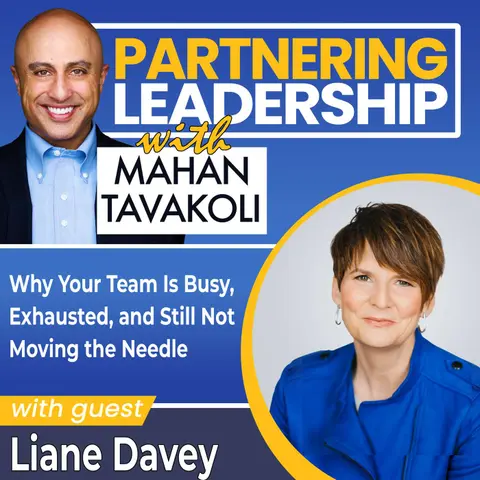
Why do so many teams work harder than ever but still struggle to make meaningful progress? In this episode of Partnering Leadership, Mahan Tavakoli speaks with organizational psychologist and bestselling author Liane Davey, author of Thoughtload: Manage the Madness and Free Your Team to Do Great Work, about why leaders need to rethink how they approach priorities, productivity, and performance. Liane explains why the biggest challenge facing many organizations is not simply the amount of work...
Key Takeaways
- Many organizations operate at full throttle while losing altitude because they add effort instead of reducing drag and clarifying true priorities.
- Thought load is the invisible tax on performance driven by cognitive demands, emotional burdens, and depleted energy reserves.
- Productivity can be a trap when organizations create endless outputs without questioning whether those outputs drive meaningful outcomes.
- Emotions are part of the human operating system, and processing them effectively prevents them from turning into costly workplace drama.
- Social pain is processed in the brain in the same way as physical pain, making psychological safety and emotional literacy critical for high-performing teams.
Why do so many teams work harder than ever but still struggle to make meaningful progress?
In this episode of Partnering Leadership, Mahan Tavakoli speaks with organizational psychologist and bestselling author Liane Davey, author of Thoughtload: Manage the Madness and Free Your Team to Do Great Work, about why leaders need to rethink how they approach priorities, productivity, and performance.
Liane explains why the biggest challenge facing many organizations is not simply the amount of work people have to do. It is the invisible thought load created by competing demands, constant interruptions, emotional strain, and unclear priorities. Drawing on her work with leadership teams, she shares why many organizations are operating at full throttle but losing altitude because they keep adding effort instead of reducing drag.
In the conversation, Liane discusses why leaders often confuse activity and output with meaningful progress. She explores how organizations unintentionally reward busyness, why constant responsiveness can pull people away from their highest-value work, and how leaders can help teams focus on outcomes rather than simply doing more.
Liane also explores the impact of AI on leadership and the future of work. While AI can reduce some workload, she explains why it can also increase thought load by creating more information, more decisions, and more complexity. Her insights challenge leaders to think differently about human capacity, emotional energy, and creating the conditions where people can do their best work.
Actionable Takeaways
- You’ll learn why teams can be working harder than ever and still fail to achieve the outcomes that matter most.
- Hear why Liane Davey believes leaders need to move beyond measuring activity and productivity to focus on true effectiveness.
- Discover how rewarding constant responsiveness can unintentionally reinforce distraction and prevent people from doing their most important work.
- You’ll learn the difference between workload and thought load and why the hidden mental burden on teams impacts performance, creativity, and collaboration.
- Hear why productivity can become a trap when organizations create more outputs without questioning whether those outputs create value.
- Discover why emotions are not separate from performance and how leaders can help teams process emotions before they create unnecessary friction.
- You’ll learn why a lack of conflict can be a warning sign and how healthy tension helps teams make better decisions.
- Hear how leaders can uncover the unseen work that drains people’s capacity and address the sources of overload.
- Discover how AI can reduce workload while increasing thought load, requiring leaders to rethink how people and technology work together.
- Learn why managing focus, energy, and human capacity will become even more important as organizations face greater complexity and faster change.
Connect with Liane Davey
Connect with Mahan Tavakoli:
Frequently Asked Questions
What is thought load in the workplace?
Thought load is the invisible tax on team performance and presence caused by competing cognitive demands, emotional burdens, and depleted energy reserves.
How does workload differ from thought load?
Workload refers to the actual labor and effort required to produce job outputs, while thought load includes workload plus the cognitive and emotional drag of constant interruptions, unclear priorities, and stress.
Why do leaders need to focus on outcomes rather than activities?
Focusing purely on activities or outputs encourages busyness and productivity traps, whereas focusing on outcomes ensures that team effort actually moves the needle on what matters most.
How do emotions impact team performance?
Emotions are a natural part of human decision-making and performance. When leaders help teams process emotions efficiently rather than repressing them, it prevents friction and reduces team drama.
Welcome to Partnering Leadership, a top global leadership podcast for purpose-driven leaders with a growth mindset, seeking to learn from the leadership journey of change makers and business insights from leading global thinkers. For additional leadership insights and bonus content, visit us at partneringleadership.com. Now here's your host, Mahan Tavakouli.
SPEAKER_01Liam Davy, welcome to partnering leadership. I am thrilled to have you in this conversation with me.
SPEAKER_02Oh, thanks, Mahan. I'm so excited to be here. Looking forward to this.
SPEAKER_01Can't wait to talk about your newest book, Thought Load, Manage the Madness, and Free Your Team to do great work. There is a lot of madness in our work environments, Leanne. There is. Before we get to that, we'd love to know a little bit more about you. Where about did you grow up and how did your upbringing help contribute to who you've become?
SPEAKER_02Yeah. So I grew up very close to where I am today, which is I grew up right near Toronto, Canada, with a really incredible family. My dad was an entrepreneur, super curious guy about the world. And my mom was a corporate badass before it was a thing for women to be corporate badasses. Like in the late 50s, they met in the Air Force. So my mom was in the first year ever of women officer trainees in the Air Force. So I was super lucky, grew up with them. And then my brother, who's a cancer research scientist. So I'm a nerd because of them. So probably the one story that put most people think is funny. Having a very strong nuclear family, people always imagine in the 70s and 80s that we sat around the dinner table. And we never sat at the dinner table. We sat in front of the television because we watched the local news and then we watched the national news. And then we watched the PBS McNeil Lear News Hour. And as we watched, if there was something you didn't know, you had to get up and go over to the Encyclopedia Britannica and look it up. Or if there was a place you didn't know, you had to go get the Atlas. So curiosity, just a fascination with the world, all of that comes from the very beginning for me. And I'm still just as big a nerd today.
SPEAKER_01What an outstanding way to nurture that curiosity in you by your parents in your family. And obviously, you have kicked up that one of the things, Leanne, I continually talk about is the fact that we need even more of that curiosity as the world around us continues to change a lot faster. And that's where I see a lot of relevance to some of your thoughts and perspectives in Thought Load, in that the vast majority of executives I deal with, Leanne, are feeling extremely overstretched, overburdened, overwhelmed. What was it that got you to start thinking about this being an issue that you wanted to address with your latest book?
SPEAKER_02Yeah, so by way of background, I have a PhD in organizational psychology. And so I've spent my whole career working directly with clients with a lens of an organizational psychologist and a toolkit of an organizational psychologist. And every five to 10 years, the most important challenge for my clients evolves and changes as I'm using that lens. And so about maybe seven or eight years ago, before the pandemic, I started noticing that people wanted to talk about change management, they want to talk about the pace of change. And I was getting called on as a keynote speaker to talk about this all the time. And the thing that I really noticed is that while the psychology of change, the human reaction to change is no different today than it was a hundred years ago. Change still throws us off our game, makes us anxious, that change in organizations had changed. It used to be an event. I still have from early in my career, I have like hats and t-shirts and swag associated with changes that were so big that you got swag with the name of the change on it. You would plan for it, have binders with tabs and laminated stuff. And at some point, six or seven years ago, I started to notice that change wasn't an event anymore. Change was now perpetual. And Gartner did some research that backed that up for me, which is that in 2016, the average organization would go through two enterprise level transformations a year. And only six years later, that number was up to 10. So I thought this is what needs my attention right now. So that's where it all started.
SPEAKER_01You opened your book with the pilot metaphor. Yeah. Full throttle, no lift. What I wonder is what did that leader see that most leaders miss in your view?
SPEAKER_02Yeah. So that's a chief technology officer of a Silicon Valley company, wonderful person. And they were just post-IPO. And what everyone was paying attention to was what were the gaps in their feature set for their product? What did they have to do to catch up? How far behind were they? They were really focused on how to do more. And what he saw was that there was no more. Like it wasn't going to be possible. And as a pilot, he understood that when you get behind the power curve and there's too much drag, you can be at full throttle and you can actually stall out and crash. What he understood was the only thing to do when you're in that position is to point the nose down, which sounds terrifying, and to actually pick up speed by reducing drag, and then you can recover. He was the only person who understood that they needed to get focused. They needed to reduce the drama. They needed to calm things down so that they could then pick up speed. It was one of the most brilliant analogies I've ever had a client just use spontaneously in a session. It's still with me all these years later because that's what it feels like. We are at full throttle and so surprised that we're losing altitude.
SPEAKER_01It is a brilliant analogy. And it What I wonder though is a lot of executives say there's one thing to say do less and they recognize focus on less. One of the authors whose book I love, Lighty Klutz, he's a professor, multidisciplinary professor at the University of Virginia, wrote a book called Subtract and the power of subtraction. Yeah. In conceptual terms, people understand do less, focus. But it's easier said than done.
SPEAKER_02Yeah. I think it's we pay attention to the wrong things. So I talk about three things in the book that we can pay attention to. We can pay attention to activities, we can pay attention to outputs, and we can pay attention to outcomes. Most of us, most leaders, most individuals, are paying attention to activities. How do I go to all the meetings that are in my calendar? How do I respond to all the emails? How do I lift my head every time there's a Slack notification? And if you pay attention to activity, what you're going to get is busy people.
SPEAKER_01I get in this habit myself and I see it with a lot of executives. We feel good when we are wanted and we are busy, and there is an inbox that's overflowing and we are constantly keeping up with it. So there is a level of satisfaction, I don't know why, that we get from actually deleting emails or going through all of those activities.
SPEAKER_02I get it. So I wrote this book and I was stuck at O'Hare for six and a half hours last week. And I found myself sitting there, first of all, feeling overwhelmed at how much I have to do in this book launch kind of phase, refreshing my email, hoping for a new email. What are you hoping for? What are you doing? So I get it. So that's where most of us are. We're in some dopaminergic loop. We are looking for input and activity and a chance to check off a box, all those things. When we shift to paying attention to outputs, that's when we become productive. And most leaders, when they hear that, get all excited. And that's when I know we're in trouble because productivity is a massive trap because we are pumping out stuff, reports and products and feature sets and banana Kit Kat formulations. The world didn't need banana Kit Kat. So we're creating output, being productive, but the only thing we should be paying attention to is outcomes, because that's when we become effective. And if we're producing all the outputs in the world, but they're not moving the needle on the outcomes that matter, that is wasted effort. So that's the biggest problem is that we are in this very tight feedback loop of paying attention to activity, being rewarded for activity. Biggest trap I see managers rewarding the heck out of people who are responsive. I promise you, if they are immediately responsive to you, it is because they are distracted from their core job, because they're putting your priorities ahead of theirs. And that will be one of your least productive employees that you are giving a gold star to. So it's a huge problem. So that to me is one of the things leaders are failing in their ability to define the single most important outcome people are supposed to be driving toward. They're not making that clear. They also don't have effective ways of measuring whether the outputs are creating the outcome. And so, in the absence of good information about meaningful outcomes, we're just measuring people on how busy are you? Because that's what we're given gold stars for. So we're not going to cure the thought load problem until we get off of busy, get off of productive, and start paying attention to effective.
SPEAKER_01That is really hard to do, Leanne, understanding what the real outcomes are and focusing the team and the individuals in the team toward those outcomes. So you're saying do away with those productivity hacks.
SPEAKER_02I'm okay with productivity if it's productivity in service of effectiveness. So what I don't want is just people producing work slop. And whether it's you producing it or AI producing it, there's so much work slop getting produced. Reports that never go anywhere. I told this story in an old book, but I had a friend, oh my God, I love this man, Jim Pierce, amazing, amazing guy. And he was the head of IT for the Canadian subsidiary of a big computer company. And he was spending, he and his team were spending hours and hours a month creating reports to send to the head office. And because he's a bit of a cheeky monkey, he he one day took every page of every report and plastered the boardroom with every page. And he said to the Canadian CEO, Do I have your permission to stop sending one report a month until somebody notices? And the Canadian CEO said yes. And he went eight months with no one noticing. So, how much energy is going into production that clearly was not moving the needle on any outcome that mattered or any at all. So that's what I'm worried about. I'm worried that a huge amount of our production is in service of production. It's just as opposed to the outcomes that we're actually here for. And in the book, I tell my own epic fail, which is I started in 2012 writing a weekly blog. And I was so proud of myself for how consistent I was. I would see other people's blogs, I'd click on, and the last one would be like four years previously. I'm like, I'm so consistent. I never, I was so proud of myself. And at some point I realized that people were unsubscribing, that this was not what was a way to deliver these kinds of ideas. Was I actually helping people to achieve amazing things together, which is the outcome I'm after? And I was like, oh no, oh no, I have to take my own medicine. I'm proud of my output that is not moving the needle on the things that I care about. So it, I know it's hard because I fall victim to it, but there's nothing better than writing a book to increase the accountability to change your behavior.
SPEAKER_01It is a hard reality for all of us, Leanne. And I appreciate you sharing that story with respect to you having to look at your own output and seeing if that's really moving the needle or not. Now, you talk about thought load. Yeah. What is thought load and how do you differentiate between workload and thought load?
SPEAKER_02Yeah, I just look at work as the actual outputs that lead to the outcomes of the role. Is it actually your work? To me, most people I talk to would be thrilled to do the work. They're like, it's interesting, it's challenging, it's good, but my work is five hours a week. Or 10 hours a week if you're lucky. Then I'm in 20 hours of meetings, doing 11 hours of email, five hours of responding to Slack channel, two hours Sally perching her right butt cheek on my desk complaining to me about everything, right? It's the two hours I spent this week fielding calls from my kids in the middle of the day about some project they were working on, that whatever, right? So thought load is the invisible tax on our performance and our presence that comes from a combination of three things: the cognitive demands we're under, the emotional burdens we're being triggered by, and the depleted energy reserves that we're trying to carry the load with. So, workload to me is how much effort and labor needs to go into producing the outputs of your job. Thought load is all that and everything else. And the problem is that the neuroscience of thought load is really scary. I call the three things the treacherous triad because, for example, as your energy goes down, one of the first things to go is your ability to calibrate what you should pay attention to and what you shouldn't. So all of a sudden the cognitive demands go up because you're paying attention to things that don't matter. One of the next things to go is your ability to figure out is that really a threat? Is the boss really mad at me? Or and you're triggered much, much more easily. So as one becomes a problem, it affects the other two. And we just go in this sort of death spiral of thought load. And thought load, as your thought load gets heavier, your productivity goes down, your creativity goes down, your presence goes down, you just go inside to try and cope. You're less accessible to your teammates. It affects trust and collaboration. You have nothing left for your family at the dinner table. Your head is still at work. So thought load is incredibly costly. If we can lower our thought load, it's amazing how much workload we can produce. But unfortunately, most of us are just riding with such a high thought load that there's no space for any of the things that help us contribute effectively.
SPEAKER_01For executives listening, how can they reduce the burden of that thought load?
SPEAKER_02So let's take the three in order, right? So we've talked a lot about the cognitive demands. The most important thing an executive can do to reduce cognitive demands is focus on a priority outcome. And when I say priority, the word priority comes from the Latin that means first. And we had the word priority in the English language for 400 years without it being pluralized because you can't have more than one first. And at some point, probably some consultant somewhere decided we could have priorities and totally shifted the meaning to a priority is something important, not something first. We have got to claim back our word priority. So you can't have more than one priority. You can have priority one, two, and three, sure. But they have to be in order because it means what comes first. So first, outcome-oriented, and second, in order. That's the biggest thing that you can do as a leader. And helping people reconcile with, okay, what if these two things are in tension with one another? What do I do? How do I make sure that this cascades down appropriately through the layers of the organization, not just the CEO being at the top and then hoping it cascades, but making sure it cascades. So that's number one. Number two, emotions are not optional. And we need more leaders to understand that emotions are part of the human operating system. And the more we try to deny that or make people believe that emotions are unprofessional or unproductive, they're not negotiable. So I don't know why we're having this fight. What we want is to be able to help people process emotions efficiently, because emotions are full of data. But if we don't interrupt and work with the emotion before it turns into feelings and stories and narratives, feelings are full of drama. So that's the second thing. We gotta learn. And I just saw the most phenomenal study of Navy SEAL type people in the Australian military who, having done a little bit of this emotional regulation training, understanding how to process emotions, they had incredibly different performance on all sorts of critical outcome tasks. So emotions and being able to deal with your emotions is not for airy fairy, wimpy liberal snowflakes. It's for badass Navy SEAL. So we need to get better at processing emotions, taking out the data before they turn into drama. That's number two. And number three, we need to understand that humans have renewable sources of energy if we allow them to renew them. We can get energy from what I talk about in the book as waterfalls of energy, working in flow, working on something really meaningful. And we can get energy from a deep well that we have to dig for. But we need to think about energy in high performance. So not continually sprinting marathons. And when I saw all the stuff out of the AI company saying, for the next six months, we're in the race of our lives. You have to work 996. So nine to nine, six days a week for the next, no, you're gonna get bugs in the code, you're gonna get people wigging out. It's not gonna be good for your business or the humans. So the third thing is we need leaders to understand energy is a renewable resource, but not if you try and sprint a marathon. So, how do we have sprint and rest? How do we have reflection? So, those three things, if I could get leaders to focus on outcomes, help people process emotions, and treat energy more as a renewable resource, I would be thrilled and people's businesses would be much more successful.
SPEAKER_01Those three are powerful. And I hope everyone listens and re-listens to that clip right there, Leanne, because it will make a significant difference to how we are able to take advantage of the human potential in our organizations, which I do believe will become a lot more critical. And to your point on uh processing emotions, actually, one of my repeat guests is Rich DeVinny, uh former Navy SEAL commander, 20 plus years. Yeah, and he also talks about how Navy SEALs train on that processing of the emotion and recognizing it because, in order to be able to have high performance, you do need to be able to first understand and then process those emotions. So, as you're saying, this is human and the highest performing humans have to do it. It's not just something that a particular set of people pay attention to. But interestingly enough, Leanne, I find in many of our organizations, we've tried to divorce people from dealing with emotions, processing emotions. So many of the managers and executives don't know how to deal with it.
SPEAKER_02The other funny thing, so I was giving the keynote about this to a group of engineers recently, and I was talking about the emotional piece. And as I'm talking about it, I can just see some of them rolling their eyes. And every said, You're right. You're probably thinking that there's there are gender differences here. And I said, You're absolutely right. The studies show men are more emotional at work than women. Men have more emotional episodes each day, but those emotions are more anger and frustration and impatience. And somehow they choose not to label those things as emotions, but they're equally as hijacking. As sadness or any other emotion. So we just we have no emotional literacy at the top of house in organizations right now. And we're really going to pay for it. And we also have folks who the bro culture pretending that they're like stoics. And obviously they've never read about stoicism because stoicism says you must process the emotion first. And so there's just so much crap out there. So Rich is a wonderful guy and he gets it. The same would be true with Olympic athletes. If you want the highest performance, you are all over processing your emotions, not repressing them, not pretending they're not there. So let's make some progress on that in the workplace.
SPEAKER_01Absolutely. But this is the other thing you talk about as well. You describe emotional contagion and the impact that the leader's emotional tone has on the rest of the team and organization.
SPEAKER_02Yeah. Yeah. So emotional contagion is the unconscious spread of an emotion from one person to another. We're still trying to understand the neuroscience of it. They believe it's a mechanism of our mirror neurons that you feel a certain way, your body reflects how you feel. So if you're feeling demoralized, your pupils may expand, your brow furrows, your shoulders slump. And my mirror neurons pick that up and I mirror you because we're very social creatures and most of us mirror. So then all of a sudden, I'm slump. And then my brain goes, oh, your shoulders are slumped and your brow is furrowed. You must be sad and demoralized. So we believe that's the mechanism by which an emotion spreads around a team, but we don't even know it's happening. But you've all been in a room where you felt the vibe just suddenly go, or go the other way. It can go both ways. So for a leader, becoming very emotionally literate about what's going on in the room. And what we want to differentiate here is a difference between sympathy. So we're back to Latin again, feeling with, versus empathy, feeling for. So we do not want sympathy in our team. We don't want everybody to go to the same bad place. We want to interrupt that with some great questions, with curiosity, with getting it into more of the frontal lobe, the more cognitive. Oh, what's going on? How do you see this playing out? What are you imagining? And that way people in the room can feel empathy for the person without feeling sympathy. Because if we all go down together, nobody's helping. So we've got skills to build in this whole emotional domain. And we are not going to fix thought load. And every interview I have, it's amazing how quickly people will start just talking about cognitive load. And they'll say it's not called cognitive load because cognitive load is only one piece of the puzzle. If we do not equally understand that you remember the was it Porter culture each strategy for breakfast?
SPEAKER_01Well, it's attributed to Peter Drucker. Oh, Drucker, Drucker. Okay. He never said that. But anyway, go ahead.
SPEAKER_02But that line, right? I would say emotional load eats cognitive load every time because that's the way our brain is structured. If something triggers your threat response or a fear response, the cognitive load's irrelevant. Your brain is built to focus everything on that. So that's what really worries me, is and that's why I had to write the book. There's a lot of great stuff out there from productivity-focused people, but they do not factor in the fact that if we do not address this emotional piece of the puzzle, it will eat the rest for breakfast.
SPEAKER_01It's interesting, Leanne. Even as you're talking about this, I'm reflecting on the fact that there is a lot of focus on cognitive load. But the CEOs or executives I deal with when the emotional load is higher, it limits the bandwidth for the cognition or the work drastically. It impacts everything they do. But as you said, we don't pay much attention to it. It's as if people walk into the organization, leave their emotional selves out on the curve.
SPEAKER_02You'd only need to be in a meeting for 10 minutes before you realize that's absolute crap. People are taking everything as well. Would that recommendation reduce the size of my team? Would that take away my power? Is that a new way of doing it that I'm not as good at? What good at? Or like all of that is in the room. Just the emotions associated with, did she just like completely give me the side eye there? Was that sarcastic comment about my presentation? Like, is that true? Are they joking? All of that is going on. So one of the things I talk about in the book that I just find fascinating is the concept of social pain. So humans evolved and got to where we are on the food chain, not because we are run faster, have sharper teeth, or are better camouflage. We got where we got to because we cooperated more effectively. And so our whole threat system is very tied to are we in or are we out? It's why survivor has reached 50 seasons, because in the tribe or out of the tribe is the most fundamental human thing there is. So what we now understand is if we get information from our environment that we aren't worthy, we don't belong, we're not in, that our brain processes that in exactly the same way as it processes physical pain. My husband's a neuroscientist. If you showed him an fMRI of someone who'd just been criticized by their teammate or who had just been hit with a hammer, he wouldn't be able to tell the difference. One of my favorite studies recently, one of my colleagues from graduate school did some research trying to really help people understand that this is pain in the same pain mechanisms as other pain. And what he showed is we can reduce social pain with Tylenol. Are you thinking about which meeting next week you might want to take a couple Tylenol before? But once we understand that as team dynamics play out, as we get information from our environment that our idea wasn't good or people didn't like it or whatever else, that is painful to us. And we will go out of our way to avoid that kind of pain. It's why we get into conflict debt. It's why we, right? All sorts of things stem from that. So if we don't understand the emotional dynamics of the team that we're leading, if we don't understand emotions being different from feelings, if we don't understand how emotional contagion, sympathy, and empathy work, if we don't understand the basic mechanism of social pain, then we have no hope of providing the leadership our teams need. And just not enough people are incorporating this into how they think about leadership.
SPEAKER_01Such a powerful point. And what beautiful examples with respect to the impact, even as you were mentioning, your husband looking at the MRIs wouldn't be able to tell the difference between the physical versus the emotional pains impact. Therefore, Leanne, as leaders of teams and organizations, which is the vast majority of my listeners, part of this is how we manage the madness for ourselves, which is really important. The example we set for others is critical. You also mentioned this in the book, where you can't help others if you don't first address the issue for yourself. But that said, you right now shared a lot of great thoughts with respect to how this impacts people's emotions, how it impacts how people view themselves.
SPEAKER_02Yeah. So let's do three points, right? Number one, get on your own game first. Tie to your own house first. Because if you are in overwhelm, if your thought load is very high, you will struggle to add the value that you need to as a leader. That's why the whole first half of the book is just helping you get your own thought load under control. So that's first. Second, the second half of the book is about the proactive things you can do to support your team in improving their focus, processing their emotions, and renewing their energy. One example, I give a tool on the toolkit for the book to identify what I call unseen work. So managers tend to think they know what's taking up people's thought load, and they really don't, right? There's many more things. So this is an exercise you can do with folks to help expose things that are coming at them from maybe one of your peers, coming at them from the shared services in the organization, even things that are coming at them from their home life or other things they're paying attention to. Because if we don't have a role in helping them triage and prioritize and figure out what they need to put first and what they can put off, then we aren't helping them. So there's a whole bunch of tools to help a leader to help their team proactively. And then the third thing is be very aware for the signs, the second line of defense, right? The signs it's not working. Are people going back to default answers, going back to things that that's what we did last time? If you start to see people going back to old answers, it's a good sign their thought loads probably getting too high. Watch out for them having too little productive conflict because conflict takes a lot of energy. It requires heavy thought load. And so when our thought loads are too full, we'll pull back. We're like, I can't, I don't have the energy for it now. So watch for healthy conflict going down. Watch for signs that people are becoming less present. So are they on their phones in meetings? Are they just like staring out the window at some point? Are they contributing less on other people's topics and only contributing when they're on the hot seat? Get your own house in order. Do the proactive things to help your team like understand and triage their work and process their emotions. And then watch, be very aware for the signs that the thought load is getting too high and you need to stop the presses and do something to move a bunch of thought load off. That's how I would think about the three categories.
SPEAKER_01I love what you mentioned, Leanne, and wanted to underline a couple of things. First of all, with respect to unseen work, I think in addition to the managers being able to support their people in prioritizing some of the work, sometimes just recognizing the unseen work and understanding that unseen work by itself is meaningful to the person. So just listening to try to understand the unseen work.
SPEAKER_02Yeah. For example, I think I give an example in the book of if you know that the person has to go spreadsheet spelunking the last Thursday of every month on some big report. And unfortunately, it can't be stopped, it can't be delayed, it can't even really be shrunk. Like you've done what you can, then that last Thursday of the month, like you buy a coffee or donuts and you bring them to the desk, or you collect up a funny meme during the month at some point, and you always send it on my it's your like terrible report Thursday, meme of the day, or right? Those little things that say, I know, I see, I value, yeah, they help thought load because then we get that positive emotional uplift as opposed to going the other direction. So I completely agree with you. It's not always about taking work off. Sometimes it's about taking the thought load off. Okay, at least I know I'm getting my gold star for this report.
SPEAKER_01The other thing I love that you mentioned is recognizing when the team, organization, or individual is not engaging in healthy conflict, in that sometimes managers or executives think it's good that there is no conflict. But as you mentioned, for a whole host of reasons, it is not, including the fact that people disengage. And when they disengage, that's when they reduce in engaging in healthy conflict.
SPEAKER_02Absolutely. So in my previous book, The Good Fight, that it's all about that, how to use conflict as a force for good. And we can think about two different forms of conflict. The healthy form feels like tension. They're putting tension on ideas, and the unhealthy form feels like friction. What you'll find as thought load gets high, tension goes down, friction goes up because you're impatient, you're emotionally triggered. So the friction is happening, but the good, productive tension is not. So that's another great indicator that, oh, we're in trouble.
SPEAKER_01Now, Leanne, at this point, we are awash in everything, AI. It has impacted already. Knowledge work, content production, you name it, it's impacted. I think it will impact a lot more. So it's increasing speed and volume. I would love to know your thoughts on its impact on thought load and how we can view it and manage it from that perspective.
SPEAKER_02Of course, agentic AI has really come on strong since I wrote the book, right? And the book isn't even dry off the presses yet. And this is so new. But I am so glad that I have introduced this differentiation between workload and thought load because it is just in time. Because what's happening with agentic AI is it might be great for taking on some of your workload, but at a massive cost to your thought load. So let's imagine you have five agents that you send off doing awesome things for you. Each of them is coming back with notifications. You are having to validate the work, update the prompts. And so you're getting that from it, it's not like being in a batting cage. It's like being in five batting cages at once that the speed is turned up to 120 mile an hour fastball. So that's all coming at you. We heard an admission from Amazon that a bunch of stuff that got vibe coded was what was responsible for taking the system down because obviously somebody was getting the fastballs and didn't do the validation that was necessary. So now think of the cognitive demands, but think of the emotional burden of what's in here, what's gonna go wrong, what's gonna blow up in my face. And we know that on the energy side of the equation, we're already getting brain fry, we're already getting burnout. I'm a fan of AI. I think it's gonna do some really exciting things, but we need to be able to talk about not just workload in the AI conversation. We need to think about thought load. And we have to think about what is a reasonable amount of work that you can manage your agents doing. Then one other thing that I'm seeing early days, and this is in the HBR study that got published. The other thing that's happening is scope creep in people's roles. Now that I have this great agent, I can be like, I've never been too impressed with how Missy's doing her job. Well, let me just ask Claude how Claude would do Missy's job better, and it's gonna produce a 70-page report that I'm gonna send to Missy. Now, Missy gets a 70-page report that might have some great insights, probably has some work slop, maybe some hallucinations, some poorly calculated numbers about the potential ROI. She has to add that to her cognitive demands. Now, think about the emotional burdens of are you saying I'm not doing my job? And what are you saying about me? And oh, maybe you could just do your own job. We are not ready for the impact of that AI scope creep on our team dynamics. And I promise you that early days, the examples I have seen, it is not pretty. It is not pretty at all. So, a couple of things. I couldn't be more excited of offering the world this thought load concept as a way to manage your AI, not just your AI workload, but your AI thought load in a way that's manageable. So I hope it helps and contributes to the right conversation to use AI to help us be more effective as opposed to contributing to greater burnout.
SPEAKER_01Absolutely. And I love the analogy you use with respect to being in a batting cage and balls coming at you at all speeds from all different directions. AI is doing that to a certain extent. However, the responsibility still stays with the human. Therefore, the outcomes become more important, how you focus and keep the right priority as your priority becomes more important. So, what you mentioned becomes even more important in managing the thought load in this age of AI. I'm also very hopeful with respect to what it can do for us if we manage the human side of it, which is ourselves and our teams, much more effectively than we have up to this point. So, Leanne, for the audience to both find the book and also follow your writing and your work, where would you send them to?
SPEAKER_02The easiest place is just to go to thoughtload.com. And I would love if they connected with me on LinkedIn. Those are a couple of great places to find me.
SPEAKER_01What a joy it's been, Leanne, learning more from you and your insights on Thoughtload, manage the madness, and free your team to do great work. Thank you so much for joining me in this conversation, Lian Davy.
SPEAKER_02Thank you so much, Mahan. I really enjoyed it.
SPEAKER_00You have been listening to Partnering Leadership with your host, Mahan Tavakoli. If you enjoyed this episode, please leave a rating and review of the podcast on your favorite podcasting app and forward the conversation to a friend or colleague so you can help more people discover their purpose, grow professionally with meaning, and have a greater impact. For additional leadership insights and bonus content, visit us at partneringleadership.com.