

 Spotify

 Amazon Music

 Apple Podcasts

 iHeartRadio

 TuneIn

 Podchaser

 Overcast

 Castro

 Castbox

 Deezer

 PlayerFM

 Audible

 Podcast Addict

 YouTube

 RSS Feed
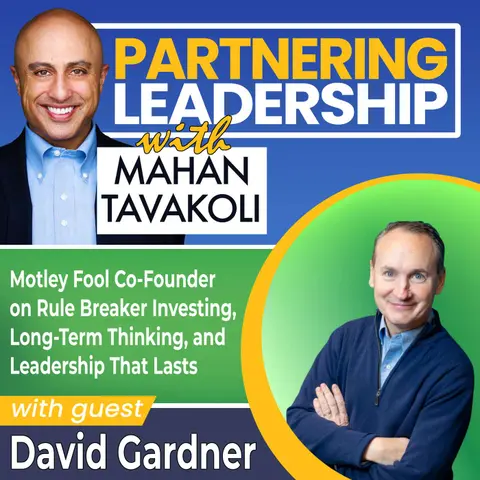
483 [BEST OF] David Gardner on Rule Breaker Investing, Long-Term Thinking, and Leadership That Lasts

Key Takeaways
- David Gardner's legendary stock picks include Amazon, Netflix, Tesla, and NVIDIA, proving that a long-term 'Rule Breaker' mindset can generate astronomical returns.
- Rule breaker investing relies on the philosophy that you do not need to be right all the time, as a few massive winners can easily carry your whole portfolio.
- The most important trait of a rule-breaking company is being a top dog and first mover in an important emerging industry.
- Investors should manage their holding periods by taking their average holding time and doubling it, as patience is the ultimate competitive moat.
- A well-diversified portfolio of companies you know and love helps eliminate the fear of failure and allows you to hold through market volatility.
In this episode of Partnering Leadership, Mahan Tavakoli speaks with David Gardner—legendary investor, co-founder of The Motley Fool, and author of Rule Breaker Investing. Over the past three decades, David has not only beaten the market—he’s reshaped how long-term investing is understood and practiced.
David’s track record is extraordinary:
- He recommended Amazon in 1997 (up 86,000% since)
- Tesla in 2012 (up 80,000%)
- Netflix in 2004 (up 937,000%)
- And NVIDIA in 2005 (up a staggering 1.2 million percent)
But what’s even more compelling is how he did it—and how those principles translate far beyond investing. David shares a deeply thoughtful approach to decision-making, pattern recognition, and long-term conviction that applies to business leaders, not just individual investors.
The conversation ranges from why “indexing is the new active,” to how embracing joy, optimism, and curiosity has made him a better investor, entrepreneur, and human being. For CEOs and leaders navigating uncertainty, David’s blend of rigor, irreverence, and wisdom offers valuable takeaways on strategy, innovation, and leadership mindset.
Whether you’re responsible for growing an organization or stewarding your own portfolio, this is a rare chance to learn from someone who’s played the long game—successfully, repeatedly, and with purpose.
Actionable Takeaways
- Hear why most people invest backward—and how a “Rule Breaker” mindset flips the script.
- Learn the six traits David looks for in exponential companies—and how those same traits show up in standout leaders and teams.
- See why long-term thinking is the ultimate competitive moat—for investors and CEOs alike.
- Explore how optimism, when grounded in conviction, becomes a leadership advantage—not a liability.
- Understand how joy and playfulness build trust, culture, and long-term performance.
- Hear how David picked Amazon, Tesla, Netflix, and NVIDIA early—and why the key wasn’t spreadsheets, but belief in innovation and people.
- Discover why bold action beats cautious consensus—and how to reframe fear of failure into fuel for success.
- Get a behind-the-scenes look at how The Motley Fool disrupted financial services—and what it taught David about culture, mission, and momentum.
- Why the best investors and leaders ignore the crowd—and how to strengthen your internal compass.
Connect with David Gardner
Rule Breaker Investing: How to Think Long Term in a Short-Term World
Rule Breaker Investing Podcast
Connect with Mahan Tavakoli:
Frequently Asked Questions
Who is David Gardner and what is he known for?
David Gardner is a legendary investor, the co-founder of The Motley Fool, and the author of Rule Breaker Investing. He is widely recognized for identifying revolutionary companies like Amazon, Netflix, Tesla, and NVIDIA early in their lifecycles.
What is the Rule Breaker investing strategy?
The Rule Breaker strategy focuses on identifying top dogs and first movers in important emerging industries. Instead of chasing short-term trends or trying to avoid all losses, investors buy a basket of innovative companies and hold them for the long term.
Why does David Gardner advocate for holding stocks long-term?
Holding stocks for the long term allows investors to capture exponential gains that far outweigh the limited risk of a 100% loss on a failing stock. Short-term trading exposes investors to unnecessary volatility and taxes.
When should an investor sell a stock?
According to David Gardner, you should sell a stock primarily to fund important life goals like retirement or a major purchase, or if the original business thesis proves fundamentally flawed.
Welcome to Partnering Leadership, a top global leadership podcast for purpose-driven leaders with a growth mindset. Seeking to learn from the leadership journey of change makers and business insights from leading global thinkers. For additional leadership insights and bonus content, visit us at partneringleadership.com. Now here's your host, Mahan Tavakouli.
SPEAKER_01David Gardner, my friend, welcome back to Partnering Leadership. What an incredible joy and honor it is to have you back in this conversation with me.
SPEAKER_02I am so delighted to be back. Mahan, thank you so much for taking the time to think a little bit more like a rule breaker this week. I know I'm speaking to somebody who does break the rules, who understands which rules to break and which ones not to, which is very important. Somebody who at his heart has such a love and understanding of leadership as you do, Mahan. And while I've written a stock market book here, in a lot of ways, we're talking about the humanity that runs businesses and which ones we want to buy to hold for the long term. And so I suspect we're going to be talking leadership as much as we're talking stock market.
SPEAKER_01Absolutely, David. And I have loved and enjoyed every chance to interact with you. I would encourage the audience to listen to my episode 11. We are past 400 now, episode 11, December 1, 2020, where I had the joy of having a conversation with you, David, part on your upbringing, founding the Motley Fool, Conscious Capitalism, a lot in there. Then I had the honor of being a guest on your podcast, which we released on this feed, episode 280, September 12th, 2023, on AI and leadership. I do want to focus some on your book, Rule Breaker Investing. First some investing ideas and lessons before we transition to leadership. I want to build the context for the audience, David, before asking you some questions. And after hearing this, if everyone doesn't go out and buy a copy for themselves, copy for their partner, and everyone they love in their lives, I haven't done my job.
SPEAKER_02Oh, thank you.
SPEAKER_01So you picked Amazon back in 1997 when it was 321 a share. And now it's around 224 with all the splits and everything else. 1,397 times gains in 28 years. You pick Netflix at 185 in 2002, and now it's at 1,224, 9,266 times the value counting those splits. You pick Tesla at 639 in 2010. Now it's $343 approximately, 806 times those gains in 15 years, and the most valuable company in the world. You pick Nvidia at six twelve in nineteen ninety-nine, It's now at 180, again, accounting for the splits. 14,144 times the gaze. David, that is not luck, my friend. Those are astronomical numbers.
SPEAKER_02Thank you very much, Mahan. And you've skipped very mercifully, you've skipped all my losers. And I know we can talk some about that. I'm sure we talked about some of that in December of 2020, but I think it's very important to recognize that part of picking the best stocks of one's time involves picking stocks that you think might also be the best stocks of one's time, but end up not being so, and being comfortable with that, being okay with losing. There's a really important part early in the book, Mahan, where I talk about losing to win, which is one of my themes in life. I think you have to lose to win. I don't think it's just win, win and win all the time, and all I ever do is win, win, win. I think it's lose, lose, win. But in the stock market, especially, if you do that in sports, you will be fired as head coach. If you lose win, you're not going to last very long. But in the stock market, your wins hugely exceed your losses. And this is the critical point. The most you can lose on a bad stock would be 100%. I still have never done that. That's bad. But what's the most you can make on a good stock? It's not just 100% or 200% or 1,000% or 50,000%. It could be even more than that. But without talking about the grand numbers, and thank you for leading off with my greatest hits at the start of our album together, but truly involves being willing to hold, to get those great wins. Sometimes hold stocks that were winning grandly and then fail you somewhere in the middle of the race. And then sometimes just having bad stocks right out of the gates. I love to use horse racing as an analogy. Some just horses trip right out of the gates, and sometimes you end up being surprised who's in the winner's circle. But I think a big part of it is I try to buy all the best horses and let them run, let them teach me who's going to win and who's going to lose. And at no point when I picked Amazon or NVIDIA or any of the companies you just mentioned was I saying at the start, this one's going to be huge. Just watch. This is the next big winner. Nope. We just discovered that together, and that's a very important point. Anytime we talk about these grand numbers, Mahan, we need to understand how we got there.
SPEAKER_01Yeah, so that is a key point that you make as you mentioned, David. And I want to try to understand that a little bit better. You say a few big winners can carry your whole portfolio. Understood. And you say you don't need to be right often, you just need to be right big. But help me understand that we try to be right all the time. I want to be right all the time. So, what is the difference between the mindset that you're talking about than the mindset the typical investor would take to investing with this respect?
SPEAKER_02So I think especially about new investors and people who are listening to us today who've never bought a stock directly, they may have a good 401k at work. They may check the box that says the growth fund or the one that does well over time, but they wouldn't feel comfortable buying a stock directly. But Mahan, I think that for many people, and we see this at the Motley Fool all the time, somebody will join our services. It's a subscription product, right? So you pay $100 or something and get our first few stock picks. And if one of them doesn't go well, it's devastating for that person. Now, I don't think it should be, and it isn't for me, but I completely empathize and understand. Because just to lay a little context here, most people don't save very much. So the heroes in our society are those who do save. And my favorite Aesop's fable is the one about the grasshoppers and the ants, and the grasshoppers are partying all summer long. The ants are just getting it done here. They're building up, they're saving for winter. And I love the ants. I want as many ants in our society as possible rocking Aesop. So it's heroic to be a net saver. You could have spent it, you could have enjoyed it. Instead, you, with discipline, you saved the money and then you followed our advice or you followed your own advice. You invested and it went down. It's devastating. You can easily see how hard that is for people. And yet, investing is not Olympic figure skating. Good news, Olympic figure skating. You fall over, you don't hit that triple lots quite right. It's all over. You will not win the gold medal. And I think a lot of people approach investing as hibits like in Olympic figure skating. And of course, every figure skater wipes out hundreds of times, thousands of times before they finally get their shot in the Olympics. So I think we have to remember all of the falls that are necessary, and we not need to be okay with losing. So I would say for someone who's listening to us today, let's say you save $10,000 beyond what you already have in your 401k, and you're like, I want to start my own investment account. I would say, great, buy 20 stocks. So $500, 20 different stocks, $10,000. That's the way to start investing. Out of that base of 20, those are companies you should know and love. And not everybody has a list of 20 companies. They're like, wait, I only three companies. I'm like, great, we'll try to like 20, but we'll start at three and build from there. But for most people, having that broad base so that they're not sweating that one stock that they picked or that one big investment, they're diversified, but in things that they know and love, that's the real challenge for investing. So again, I think a lot of people think it's Olympic figure skating. It's devastating to save and then lose. So people try not to lose, and that's not the way to win. You need to lose to win.
SPEAKER_01Yeah. So what you're sharing, David, is quite different from a lot of popular advice on investing. I hear two ends of the spectrum. On one end of the spectrum, you have people with daily, nightly shows that recommend buy it, buy this now, sell this now. It's buy, sell, buy, sell. And then you have others on the other end of the spectrum that say no one can really beat the market averages in the long term. Put your money in an index fund. Don't think about it. You have a very different approach. Before getting a little bit more into that approach, I want to find out how did you come up with this rule breaker investing approach before finding out your views on where this falls?
SPEAKER_02Yeah, I think that for me, I just grew up as a person who loved games, first of all, loved sports, loved stats, numbers. When Bill James started to change how baseball was thought about, I was writing avidly about that. I got a few published articles in support of Moneyball back when it wasn't cool, it wasn't Brad Pitt. It was Moneyball. So I will just say I've always loved games, tracking numbers, what performs, what doesn't. I'm okay with losing. I've learned that over time. Now at the age of 59, I'm surprisingly able to lose in a way I never would have been at the age of 19. And I think a lot of it just comes down to an enjoyment of the game, especially parts of the game where people are misplaying the game. It's like you see somebody at the golf course with a bad swing, you can't really intervene, or you're like, it's probably not going to work that well for that person because their swing is off. So I feel like I can see that in certain situations. And for me, the stock market ended up being that thing. I love baseball, but I probably wasn't going to be Billy Bean. I wasn't going to be Brad Pitt or Bill James. But I realized you could take that same mentality and you could apply it to a different game, the stock market. A game where we're all on the same field together. That guy who's yammering at night on CNBC about the stocks that you should be buying and selling, yammering way too much, by the way, and causing people to overtrade, which is a tragedy, I think. But that is one way that people think you should play the game. And I obviously completely disagree with that. So it's, I think I also grew up, Mahan, as somebody who, if you started saying that, if you said potato, I started saying, actually, I'm going to say potato. And if you say tomato, I'm going to say tomato. I was a little bit standoffish and would often take the other side of arguments, especially when the person on the other side was so headstrong. And there's such a headstrong case these days against investing directly in stocks. It's amazing. The entire industry is dedicated to causing people to think that they should never buy a stock directly. They should just give their money over to professionals who would do it for you, or just index, not even care, just buy all the stocks, which by the way means you're buying all the worst companies. I'd prefer just to buy the best ones. So maybe that's a little bit of like where it came from.
SPEAKER_01It's interesting, David. I was mentioning to you a couple of weeks ago in a conversation. I serve on a foundation board and one of the major banks that also has an investment arm. They were talking about some of the poor returns they had over the past six months or year. And they were saying, these are professional managers looking at the data. And if you were looking at the data that they were with the tariffs, with wars around the world, everything else, you would have pulled all of your money or a lot of it into cash because, in greatest likelihood, stocks would be going down. But that's not what happened. I want to understand why it is that more people don't listen to David Gardner and become rule breakers.
SPEAKER_02I hope they will with Rule Breaker Investing hitting Amazon.com, Mahan. Obviously, a big part of me here now. This is my final stock market book. So this is the end of my stock market career. And I just basically wanted to, in a fast, fun read, under 250 pages, just lay down everything that I think that leads to winning and help as many people as possible. And I really hope that people will start to realize the benefits of buying stocks directly. You don't have to have your whole portfolio or all of your net worth just invested directly in stocks, but how about one? How about one stock? A lot of people, that's more than they have. And so I'm a huge fan, of course, of becoming part owners of the companies that we love, whose products and services we esteem. That's a big part of rule breaker investing. And I think I've told you the story before. I might have said it five years ago on your podcast. I apologize if I'm repeating myself, but I grew up with a dad who, when we went to the Safeway in Washington, D.C., right near where I grew up, he'd be like, hey kids, Saturday morning, there with dad shopping for groceries. Hey, kids, look, chocolate pudding. We own some of the company that makes that chocolate pudding. Let's go get more chocolate pudding. And that made him such a great dad. We loved it. Yeah, let's go get chocolate pudding. We own some of that company, right? Home team. And I wish more Americans would transfer or take a portion of our love of sports and wearing the home team jersey for our NFL football team. I know you and I are both fans of probably the same team here in Washington, D.C. I wish people took the same approach with their money and bought and held things that they loved and stuck with them. Didn't listen to somebody yammering that you should buy and sell every other night on CNBC, but instead realize that you're becoming a part owner of that chocolate pudding company or that robotic surgery company or that e-commerce juggernaut. You're becoming a part owner. It's a miracle, really, that you and I grew up in a society where that's possible. We're in an ownership culture. Very few cultures today or historically, certainly, have had anything like that opportunity. So I just want people to realize you can become a part owner of Netflix. You can become a part owner of Nike. The list goes on, Chipotle. You should, your kids should be starting investing, just like my dad got me started. I'm so eternally grateful that dad started us as kids at Safeway with chocolate pudding. And it's okay. The Walmers, I know they're tariffs. I know the stock market every three years, one year and three, loses value. I know that's true. We have a hard business to run in the Malifula. One year and three, we're now in our 32nd year. One year and three, people are paying us for our advice, and they're going to lose money that year as they're paying us for our advice. So that doesn't feel great. And yet it all works because the other two years that are every three, the market goes up and it averages 9% or so gains annualized over any meaningful period of time. And all of us should be invested in it. And getting more Americans saving and investing is a big part of what the Motley Fool's trying to do. Anyway, I obviously am straying a little bit because I what I love most of all, Mahan, is breaking the rules. When you take things that people think and you're like, I disagree, and I'm going to put my money on it. Let's see what happens. Those are the most fun, satisfying situations when you win.
SPEAKER_01And in breaking the rules, David, you do have traits of rule breaker stocks. So it's not just our love and affection for a brand in the marketplace, which is of value. I appreciate that thought. And I remember one of the first books I read on investing was Peter Lynch's. And he was talking about something similar. He said, look at the brand that you love. See if you and your family love it. Maybe they're absolutely right. So you share six traits of rule breaker stocks. You say, one, they need to be top dogs or first movers.
SPEAKER_02And the other part of that phrase is in an important emerging industry. So, Mahan, I'm looking for the companies that are out front as new products or services or technologies come to market. So a good example would be Netflix, something that we all can relate to and see. And actually, Netflix has tweaked itself. It's morphed over the course of time. But really, Netflix came in a blockbuster era when we were all late with our video rentals, paying $7 extra because we didn't bring our VHS tape back. And that was the industry in which Areed Hastings launched Netflix. And Netflix back then was the DVDs that you were mailing with the red envelopes. And it seemed clunky, right? Why wouldn't you just drop off the video of Blockbuster half a block away? Why are you mailing DVDs back and forth to Netflix? But what Netflix was doing is it was changing the business model of the industry. So top dog, because it turned an industry that was all about rental fees into a subscription business, a much better business model. And obviously, we're not even talking about streaming or original content or all the things Netflix has done since. So this is a classic example of a top dog and first mover in an important emerging industry. Entertainment's always going to be important, especially in our society. And Netflix is a great example. But these traits are shared by all of the great stocks that I have picked. Intuitive Surgical is robotic surgery. Intuitive Surgical has been the top dog and first mover in an important emerging industry. We're living during a time in which much, maybe most, possibly all surgery in time will be robotic assisted. It will not be the human hand. And intuitive surgical is by far and away the leader and has been for 20 plus years. If you walk around in the street here in Washington, DC and say, hey, intuitive surgical, heard of it? Most people are going to say, no, I've not heard of that. And I love that, right? Because they're now in their third decade of crushing the market with no real visible competition, with so much ahead still for them. And most people have not heard of this company. So that would be an example. But anyway, each of those totally different industries is a top dog. And first mover, nobody else was catching up, nobody else was ahead of Reed Hastings, other than like with the old business model the Blockbuster had, as he's done everything right for Netflix, with the exception of Quickster, which was a funny disaster 14 years ago, which we can talk about. But anyway, that to me of the six traits, Mahan, that is the most important one because each of those companies, if they're little fish, that's a stocked pond. If you just pick stocks from the companies that are the top dogs and first movers in important emerging industries, genomics, AI, the list goes on, you are going to find in that pond some of the great companies of the next 25 years. And you and I already talked about it a little bit. Doesn't take all of them, just takes a few of them to create market crushing returns, even alongside laggards and losers.
SPEAKER_01I love that perspective, David. What I wonder though, and I imagine that has been the case with Netflix, what you say and what I hear from you is find them, invest in them, then hold on for the ride. There have been times where people have been looking at different metrics for Netflix data points and said, sell Netflix now, sell Netflix. It's overvalued. But you don't believe in that. You commit to these market leaders and you stay with them for how long?
SPEAKER_02Yeah, for a long time. Netflix, its worst year, I think it was 2011, there was a Quickster disaster where they decided to separate the DVD rental service from their new streaming service. So you, as a customer, if you were a customer of Netflix, all of a sudden you're being told you need to have two subscriptions now. And one of them is rebranded as Quickster, QWIC. This is all real and it happened. And over the course of about nine months, Netflix lost two-thirds of its value. So we had bought the stock in 2004. Here we are, we were way up, and it loses two-thirds of value in eight months. By the way, that tends to happen if you're gonna hold for 30 years, as I do, that's gonna happen many times.
SPEAKER_01As Netflix had lost one-third of its value before it lost two-thirds. Weren't you experiencing some indigestion and saying, ooh, we got to get out of this?
SPEAKER_02I certainly was concerned, but there's a difference between concern and a decision to kinetically exit, click your computer mouse or tap your phone and exit the position. And I very infrequently do that, Mahan. So I think I have a disconnect in my brain where I don't want to just knee jerk react. I actually want to let some time pass and understand a little bit more. And the amazing thing about Netflix was I think they had something like around 25 million subscribers back then, Quickster. And so if you followed the business results over the succeeding few quarters, as they realized they'd made a bad mistake and pulled it and unraveled the whole thing, I think they went from like 25 million to 24 and a quarter million subscribers. That was the extent of the disaster that caved the stock market price more than two-thirds of its value in nine months. They lost a small percentage of their customer base. Now, they were expected to be growing their customer base, right? It was supposed to go 25, 30, 40. So if all of a sudden it's going backwards, you can see how that would hit the stock, but not nearly as hard as actually, it should never have been hit that hard. Mahan, I had picked Amazon. You were gracious to mention my Amazon call at the start of this conversation. I picked it at $3.21 back in the day. It went to 95. So from 1997 to 2000, it went from 3 to 95. I watched it drop from 95 to 7 and upheld all the way down. And it's not just me with my little portfolio. I'm out there out front, fool.com. I'm the Molly Fool. One of the brothers just started it. I'm out there going, we're holding this thing. So it's not just each of us in the quiet of the dead at night looking at our like I'm on record with hundreds of thousands of people. Like I'm saying this. And obviously, as it goes from 95 to 75, that doesn't feel good. 75 to 55, that's not good. 55 to 35, 35 to 15, 15 to 7. But we can now look backward and go, oh my gosh, you know what? Amazon was an unbelievable buy at 95 before it dropped to seven. And by the way, at 200 and 300 and 400. And if you're playing the long game, you simply react differently, I think. And I think it's all about a mentality. And maybe again, my wires are crossed, or I'm a crazy man, I'm a rule breaker, I'm a fool. But I actually think in this book, I can help everybody become more foolish, capital F, and realize play the long game. Don't react like Wall Street does and the media does, overreacting in the short term. Like Netflix was never that damaged. Even Amazon, watching its stock go from 95 to 7. It's not like they weren't delivering books anymore or couldn't expand into other. No, these are vital businesses. So a lot of it comes down to the stock market makes more exaggerated moves than the actual businesses themselves. The media reacts to the stock market's exaggerated moves. It creates this sense that you're crazy to keep holding Netflix through Quickster until you, like a year or two later, you're like, oh, we're back to where we're yet. And by the way, we're now 10 times ahead of that. And so I think now at the age of 59, I have a perspective that I have earned and lived that I'm just sharing to help people think a little bit longer. My brother has a great line. Whoever you are as an investor, my brother Tom says, whatever your average holding period is, double that. You will do better.
SPEAKER_01It's brilliant advice, yet it's hard, David. I was reading an article just the end of last week. Mateoshi's son was mentioning that he had been an early-ish investor in Nvidia and had sold with gains, but if he had held on now, it would have been worth hundreds of billions of dollars. So he left a lot of money on the table by cashing out of NVIDIA. So what you are recommending is not necessarily practiced by some people like him either. What I wonder though is do you at any point pull the cord and sell? Or is it that if you have a 20, 30 year perspective, a long-term perspective, you hold to the ups and downs no matter what?
SPEAKER_02So the answer is we do sell sometimes. And I'll give an example or two in a sec. But let me just say that forget about individual stocks right now. Let's just talk about the entire market, just the stock market and its performance. What's the time that you should sell, if ever? And the answer to me is never. You should get invested as early as possible. If you have kids or grandkids, you should be getting them invested. Things compound over time at a rate of roughly 9 to 10% with all the bad moments, the 2008-9s, great recessions, the COVID, the dot bomb of the 19201, all of those things are included in that 9 to 10% annualized return. So if we just have a sell conversation and we just throw out all of the companies, we just say, let's just talk about the whole system here. The answer is you should never sell unless you're going to do something else with the money, which by the way is a great reason to sell, which is why we all invest in the first place. Buying a house, putting a kid through college, taking a trip around the world with your three best friends, these are the reasons to sell. So I don't believe that well served by having target prices and saying this stock is like things aren't how they should be. I'm just gonna sell or I'm gonna jump back in later, which usually people don't. I think we should just think of the whole system. You want to get on that train as early as you can and you want to enjoy the longest ride you can, which means you need to manage your health too, by the way. It's not just about your money. If you're not around for your money, compounding doesn't mean much. But I think that's the proper mentality that we should all have. And not everybody has that. Financial literacy is not maybe what it should be or what we'd love it to be. So a lot of people think the stock market is what goes up must come down. They actually think it's a parabola when it's actually a hyperbola. It goes lower left to upper right. But that's not how it's covered by the media. It's all transactional and it's fear-based. And so we end up with lots of people sell out with Masay Yoshi Son, they
unknownsell
SPEAKER_02out out of their NVIDIA because, but most people will have eras of omission. They will have regrets that they didn't hold something. That is a much more powerful and true regret than that you bought a bad stock and it went down. Because a stock can only go down 100%. We talked about this earlier. It can go up infinite times, which means most of us should be regretting that we sold Apple in 2000 or whatever. Because that's what I want to guard against. So for that reason, I do not have those regrets because I buy and then I hold things. And the only thing I will add to things when they're up, I will not add to any stocks that are down. I never throw good money after bad, as my father taught me. And that's certainly in the book as well. That's one of my principles. We only add up to things that are going up. We do not double down on things that aren't doing well. Anyway, then to give a short-circuited quick answer to your cell question, if a company, based on a premise you had or a thesis you had in your mind, like this is going to become the leader in AI, and all of a sudden it's increasingly evident they are not ever going to be a leader in AI. Or in my case, let's go with 3D printing, which was such a huge thing about 10 years ago. There were lots of 3D printing companies coming along, and I was like, this is going to be huge. And it ended up being a flash in the pan. Although, ironically, 10 years later, 3D printing is quite a substantial important business, but there's not at all the sex appeal or interest around the companies anymore. And there aren't any real clear plays. And the only ones that were there, I had a 10-bagger in 3D systems that ended up, I sold it a loss. So I am, again, comfortable with losing. I hope in a way other people are, especially once they get the education and some savier. But I understand many people wouldn't want to have that feeling or ever have that feeling. But I am willing to have that feeling, Mahani, because I know the benefits of the winners that go up way more than 10 times, especially if you hold them over a long period of time, which is the point. So to me, you sell when either why were you investing in the first place? You sell for that reason to fund that thing in your life, retirement. And then a second reason to sell would be if the company, if it's done something really wrong in the marketplace or really doesn't fulfill your thesis, I could see selling. But that it made a temporary mistake when we're all making mistakes all the time, quickster. Nike is having a slow moment now. Kava had disappointing earnings in August. Lots of companies have moments where the tide subsides. We keep holding all of them and are hugely rewarded for doing so.
SPEAKER_01And it's outstanding, David, in that both with your book and the explanation, a lot of this is not some of the quantitative analysis that some on Wall Street and CNBC types keep recommending. It's actually a certain level of common sense. You have a theory about AI based on understanding, based on reading. You believe AI is going to transform the world. Therefore, you think this is a dominant player in AI. Therefore, I want to invest in this dominant player and hold through the ups and downs. This is not analyzing the cash flow and all the data crunching that some seem to recommend, which is mind-boggling and therefore makes investing less accessible to the average person.
SPEAKER_02Yeah, I totally agree with that. And I try to speak to that in the book, some too. A lot of people think that they have to understand all the macroeconomics headlines and have developed viewpoints and target prices for everything. And it makes it intimidating until you realize you could have just bought Apple our whole lives long. I'm 59 years old, I have the earliest days I can remember. Apple public company, the 80s. I was like a teenager. And I finally came around to buying Apple in 2008. And I felt like I was so late. Jobs is already back, the iPod was out, the iPhone had just come out the year before. And I'm like, okay, these guys are huge now. And I recommended it to Mollyful members. And it's not in my hall of fame, greatest stock picks, because it hasn't risen over a hundred times in value, but it is up 35 times the value since 2008 when I thought I was late. I was like, I'm still gonna do it. So I think that just recognizing that you don't have to be first, you don't have to be early. The biggest regret most people have is they think they missed Amazon and you should be buying Amazon today. You should be buying NVIDIA today, Apple today, and Intuitive Surgical, and a whole bunch of other companies we can talk about. You should be buying them all today. You didn't miss it. Maybe you didn't get as much as you would have. And if I'd bought Apple in the 1980s, I'd be even happier than I am today. But I'm still pretty happy with my 35 bagger. And so these are things that people tell themselves. And so we're basically fooling ourselves, small F on a regular basis. And that's why I think rule breaker investing is effective, because it helps you become more self-aware and recognize that it's actually all about the future. Not any of the stocks we've talked about right now, those wonderful numbers you let off with on that's all in the past. All that matters now is what happens next. But what happens next is usually better than most people think. Most people are pessimists, not optimists. And they think that they miss, they're looking through the rearview mirror, right? They're in dead, and they're like, I'm not gonna buy Apple because I should have bought it. I'm gonna wait for the dip. Then when the dip happens, they're like, scary times, I'm not gonna buy Apple now. So I never buy Apple. So these things are repeated in our minds. The part of the reason we can laugh is because we've all felt it. I have too. You can start overcoming that when you start becoming a little bit more rational and play the long game and be a little bit more optimistic, which is an important part of being an investor.
SPEAKER_01David, this is what I love about rule breaking, and your thinking is so counterintuitive to the point that you were just making. That goes to the sixth trait that you talk about. You look for grossly overvalued firms by traditional metrics. Now, that runs counter to what everyone says. Everyone says, find the thing that is undervalued. You're going opposite that.
SPEAKER_02Absolutely. And to be very clear, this doesn't work with every company all the time, right? This is an approach that I have to companies that break the rules, the rule breakers, the top dogs and first movers in important emerging industries. There are indeed companies that are overvalued that I would not want to buy stock in. But maybe my favorite chapter of the book is chapter 12, which is the sixth trait of the rule breaker stock, and it's that it be considered, in quotes, overvalued. You want people on CNBC saying it's crazy. Wall Street Journal, there should be a hurt on the street article about how this thing is crazy overvalued. Because when you have the other five traits that are in place for rule breakers, again, not every company has these, but when you find them, and like we can talk about them, but and then someone is telling you they're overvalued, that is actually an incredibly great buy signal. And I'll give a quick example without going long on this, but a quick example. Who the CEO is matters a huge amount. So we've talked a lot about Apple Netflix. We haven't talked about Tesla yet. So let's put Tesla here for a quick example. Elon Musk is a genius. I know a lot of people don't like Elon right now, and he's viewed as, I don't know, negatively by various places around the Wall Street world and the world at large. And he is a genius. He has created incredible amounts of value for so many people. He will go down in history as a hugely value-creating person. I wish there were 15 other Elon Musks out there because it would be a better world from PayPal to SpaceX to Tesla, whose vision is to accelerate the introduction of electrical, good sustainable energy, not just old fossil fuel energy. That's the actual mission of Tesla. It's not to sell a lot of cars or put Ford or General Motors out of business. This is a remarkable person. And some people hearing me right now are like, yeah. And I'm like, fine, you don't have to buy Tesla because if I didn't believe in a company or the leader, I wouldn't buy it either. So I'm not trying to convince anybody right now about Tesla today. And Tesla, when I first recommended it in 2011, was widely considered overvalued. It was the third most shorted stock on the NASDAQ. Elon actually came to Fool HQ offices and spoke to us in October of 2011. And I decided, you know what? I'm going to make my next stock pick for our members two weeks from today, Tesla. Because I just watched a genius throw down a whole case. The Model S wasn't even out yet. The whole case, and they're the third most shorted stock on the Nasdaq. That means people are playing it to drop because it was so, in quotes, overvalued. In the same way that I remember when I recommended Amazon that Jet Bezos was a wild man, crazy Amazon will never make money. It's crazy overvalued, et cetera. And so having lived through enough of these now, I started to realize not only is that not a problem, it's actually an incredibly great set. You want to be overvalued because that means you're trading at a premium price. Starbucks has always pretty much been overvalued. It's just a coffee company, Mahan. It's a coffee company. Why would you pay so much? Why would you pay 30 times earnings for a coffee company? The answer is there are some great reasons to pay 30 times earnings for companies with Howard Schultz, genius who led founded Starbucks, led it, Elon, Steve Jobs. The list goes on of these incredible entrepreneurs. And you and I, through the miracle of the stock market, can become part owners of their companies. And the key is, and here it is, here's the punchline for overvalued. There is no number on companies' financial statements. There's nothing on the income statement of cash flows or the balance sheet that expresses the value of the CEO to that enterprise. There are no numbers for the things that matter most. I gave a quick example of CEO. I would say the exact same thing about a company culture. I think culture as an entrepreneur, I know how deep and important that is. Or I would say, how about brand? There is no number to express the power of the Tesla brand, the value of it. So you have everybody saying Tesla is so overvalued, but they have no numbers for Elon. They don't count the brand for anything. They're looking at earnings, cash flows, and they're doing multiples off of that. So what I figured out and wrote a book about it here is that the things that matter most, there are no numbers. Therefore, all of the ratios in the valuation system, when people say overvalued, they're actually telling you for these kinds of companies, that is the best company in its industry. It's likely to win over the next 10 to 20 years, and you're likely to make a lot of money, a lot more money than Wall Street thinks if you buy. And by the way, asterisk, hold the stock, right? You can't just buy it. You need to hold it. Anyway, I'm starting to rant, Mahan, but I love overvalued because think about that. There are some CEOs, by the way, who are subtracting value from their companies, no doubt about it. But there's no number there. And so those companies look undervalued because you're like, wow, look how low the stock is. That must be undervalued because they have a buffoon value-destroying running that company. Leadership as well as anybody I know, Mahan, the importance of leaders. Are you not yourself, therefore, I'm based as I am, that there is no number or proxy included to value companies with the leadership of the company. You can't put a number on Elon Musk.
SPEAKER_01It is absolutely incredible, David. And I love the point that you make on the value of that leadership. And as you were talking about it, I was thinking about, first of all, a lot of these are founders yet. One of the CEOs I talk about most often, Satya Nadella, he is not a founder yet, has contributed so much to the value of Microsoft. But you're absolutely right. There is nothing specific that captures the value of him as the CEO as compared to when Ballmer was the CEO of Microsoft.
SPEAKER_02Exactly. That is a great example. Tim Cook, by the way, not a founder, added more market cap to Apple than Steve Jobs did. Lisa Sue, not a founder. So I certainly do appreciate founders, but more important is the point you're making, Mahan, which is that the value that can be contributed by genius visionary leaders is simply not included in conversations. Like they'll put them on the cover of Fortune magazine, but people looking at those stocks will be like, I would never pay 40 times earnings. The other thing that's funny about this, that I also figured this out as a young entrepreneur myself, people tend to diss on youth, right? It's understandable. Like we were all young ones, right? So as a consequence, you have all of these genius people starting things at early stages, and they're even less trustworthy. And the media is even more skeptical about them. They're like, who's Steve Jobs exactly? And especially if they have some idiosyncrasies or eccentricities, Elon Musk, they'll get dissed by people, which again only makes me value them more and love the company and stock more. And again, I'm not trying to convince anybody here on what they should think about Elon Musk, but I'm pointing out pattern recognition about what has worked for my greatest stock picks. And the amazing thing that organizes all of the other things we're talking about under a single rubric is overvalued. And when you actually understand what is being pounded in value, you start realizing people are not actually counting the right things. And we don't have any numbers for them. And so it turns out to be a great buy signal.
SPEAKER_01That's going to stick with me, David, because it is such a counterintuitive rule breaker point. And it is so true. Now you mentioned some of those early wins. There is one that we haven't covered yet, and I want to understand what your thinking was when you initially invested in Nvidia. Now everyone looks at it. It's the most valuable company in the world. Can't keep up with the demand for AI chips. They are leading the field. But rewind to when you invested, AI wasn't big. What was your case in wanting to invest in Nvidia?
SPEAKER_02Video games. Nvidia emerged as one of the two dominant early stage graphical cards for geeks like me, and I'm a geek. I love video games. I love games of all kinds. I'm sitting in a room that has over 600 board games in it. That's my study. I absolutely love games. I'm glad I got to share that. And so yeah, I love video games. And NVIDIA had cards that you could put in your PC if you homebrew your own PC or just replace it. There were better graphics. They just gave you better graphics for the same computer game. And so that was really where NVIDIA started and came from. And there's a whole story I'm just not going to tell here. I've done it elsewhere, but it takes too long. But it's all about how like NVIDIA was the enemy. I invested in the other company. They were like our rival. I, by the way, went to the University of North Carolina, so sports fans can appreciate I don't like Duke, and Duke doesn't like North Carolina. So basically, I had invested in the other company. So I looked at NVIDIA as the Duke Blue Devils. I was rooting against them all the way until they ended up buying out my company for a song because I picked the wrong horse for that particular derby. And so there was a whole come to Jesus moment that I need to have a few years later. You know what? If you can't beat them, join them. Let's go, NVIDIA. So that was a whole like backdrop that you'll never even hear. But so it was 2005 when I recommended it. And yeah, it was I like technology, I like games, I like leadership positioning, NVIDIA. I just watched them basically take out 3DFX, which is my company that I was talking about. That was the stock pick that I'd made. And I like Jensen Huang, and I recognize some of the benefits. I'm not a big time techie myself. So if we start talking about graphical processing units and the benefits of those relative to the older school chips they were competing against, I'll quickly be a fish out of water talking about it. But just looking at a high level at NVIDIA. And by the way, let's be very clear. I did not know in 2005 when I picked the stock that it would be a monster. I did not know that. It's easy to think backwards and go, this company's made over a thousand times our money now. We've held for 20 years. Mahan, it was my pleasure to tell the story in the first chapter of the Rule Breaker Investment. Book. And I'm not going to do it here, but basically I talk you through what it took to hold that stock. It quadrupled in its first year. So and then a few years later, we're underwater. 2008-9, disastrous time in the stock market. All of a sudden, what had been a big winner was down. Then it went sideways for five years and lost to the market. But I re-recommended it because I liked what I saw. And then I later re-recommended it after it had become the top performer in the SCP 500. And everyone's always, this is the rule breaker for me. Everyone's always like, what goes up must come down. The stocks that were dominant last year, they can't be good this year. But I was like, maybe, but I'm going to do this. So the January after NVIDIA was the top performer in the SCP 500, the next January, I was like, here's my new pick. NVIDIA. Let's buy it again. But it ended up being the seventh best performer on the SP 500 that year. And by the way, it's up another 50 times from there. But in chapter one, I basically take you on the roller coaster story of what it feels like to buy and hold what ends up being the great stock of the era. And it's just breathtaking. The numbers both directions, but it's also the periods of calm or nothing happening or bad time were right there, packed into those same 20 years. So thanks for mentioning a video. It's such a model rule breaker. It fulfills all six of those attributes, those traits that we talked about. And the only way to ever get a thousand bagger or a hundred bagger or 10 times your money at 10 bagger is to hold and let that company become a 10 or 100 or 1,000 bagger.
SPEAKER_01It is incredible how hard it is to do that, David. And I also appreciate your humility. In most instances, people who have experienced this level of success would tend to say, I knew it all along. I knew it from the beginning that this was going to happen.
SPEAKER_02That just wouldn't be true.
SPEAKER_01It's your disciplined approach to the six traits that you talk about. Now I wonder, do you ever invest in companies that don't meet at least two, or if not more, of these traits because of a gut feel? Do you circumvent the system or do you go through the six check mark and make sure that the company you want to invest in meets the six traits that you have in your book?
SPEAKER_02I love it. It's a funny question to ask. In some ways, we're saying so you invented rules to break the rules. Do you ever break your own rules? The rules that you invented to break the rules. And the answer is yes, I do. I'm not always chapter and verse on every point. I think that my six traits, a number of them are subjective. Like one of them, trait number five, is strong consumer appeal. You might say, Lululemon, how strong is that brand? And they're good debates. You could say it's very strong, it's very well known. They basically carved out yoga pants and build a whole industry around it and wellness, especially female focused. They tried to go with men's yoga pants. They got there's some business there, but how strong is that brand? And that's exactly the right question. That is the kind of question and debate we should be having. And there's no simple exact number that you can put on a brand. And so you end up with questions like will NVIDIA be able to translate its success with video games into driving cars or later AI, self-driving cars. Will Netflix be able to do original content? Wait, I thought HBO was the king of original content. Who's Netflix coming along all of a sudden? These are the exact questions and stories we should be telling each other, sharing with each other, and asking because that helps us understand really what we're invested in. And when we figure out, I think by being guided by these six traits, when you're finding things that fulfill these, you're on the right track. But there's no immediate, there's no numerical system here, Mahan. You're not grading or scoring. Sometimes a company will be missing one or two of my traits. That's okay. It's all about sort of nuance and learning your way into it over the course of a lifetime of investing, which is what we should all be doing. I'm gonna learn a lot. I'm gonna be smarter 10 years from now than I am today. And I'm definitely smarter today than I was 20 years ago or 30 years ago when we launched the Motley Fool. Continuous learning, obviously looking at changing conditions, like the internet wasn't a thing than it was, AI wasn't a thing than it was. Robots aren't really yet a thing. They're gonna be. So these are the stories of our lives, and we should be invested in the great companies that run through our lives.
SPEAKER_01David, I love this for so many different reasons. I am a big fan of the transformation that we will experience as a result of artificial intelligence.
SPEAKER_02You know a lot more about that than I do, my friend. That's why I've had you on my podcast. Thank you.
SPEAKER_01I appreciated that opportunity. One of the things we also talked about that podcast is I'm a big fan of AJ Agrawall, power and prediction machines, and the fact that he talks about in the age of AI and the predictive abilities of AI, human judgment will become of even greater value. How beautiful it is that the six traits that you have outlined, what you are saying is that this is not numerical where you feed it into an AI algorithm and get these are the five companies, 20, 100 you should invest in. You are actually using your human judgment, which gives you an advantage over AI.
SPEAKER_02Yeah, and I want to say, without being cocky here, it's not speaking to me. I'm speaking on behalf of all of us. Anyone who's invested well or done well over the last 30 years, guess what you were competing against all 30 years? AI. There has been algorithmic trading in computers. As soon as a computer was born, somebody was trying to program it to make money for free without them having to do anything, right? So much of institutional money is driven by algorithms. So anybody who has been investing for the last 20 or 30 years has been, without knowing it, maybe, competing against AI all the way through. AI was on the other side of every trade that any of us probably made. And sometimes it's right and sometimes it's wrong. The reason I don't think it's about to replace you and me picking stocks is because AI sits on both sides of the trade. If you told me AIs are only selling, they don't actually buy, then I'd be like, guess what? I want to be a seller then, because I think they're going to be smarter than not AI on the other side of the trade. But actually, they are AIs buying and selling against each other and have been for years. So for these reasons, these are conditions that we've all been investing through all the way through. AI is new in some parts of our economy, newer than others, but not at all new to the big money moving around really fast world. That's the only way it can move that fast. And by the way, there's so much emphasis on fast money, and it's so misplaced that it only makes it easier for you and me to beat the market if we just get above it all and start having more interesting conversations if I snap my fingers and Tesla disappeared overnight. Would anyone notice? Would anyone care? And that's the snap test, which I talk about in the book. And again, it's something that you could do with your kids. It's not algorithmic, numerical, it's not, it's more right-brained than left-brained, but it's exactly the right question to ask before you buy a stock. Because you want to have in your portfolio your investments, you want companies where a lot of people would notice, and some people would be heartbroken, not just the owners or employees, the customers would be heartbroken if Chick-fil-A disappeared overnight. It's a private company, so we can't buy that stock. I wish I could. I would have. But would anyone notice? Would anyone care? The snap test. So these are things AI can do too, by the way. AI can give you really good answers to that question. If you ask ChatGPT, if I snap my fingers and let's go with Figma, which is a very hot IPO in recent weeks, and that company disappeared, how many people would notice? How many people would care? ChatGPT, give me an estimate, zero to 100, and explain seven reasons why. You'll get smarter. You will get smarter if you ask that question. So I think we're all being assisted all the time. At one point, it was the dictionary or Roger's Thesaurus. And then it was spell checkers, which Microsoft Word was doing for free for us, and that was AI, even though we didn't think of it that way. And now we have other ways to improve our assisted thinking. It's not going to replace our thinking. You're going to be rewarded your whole life long for thinking. And I have been, and I expect to, and by the way, some bad thinking has penalized me in many points of life, too. So let's be really clear.
SPEAKER_01David, one of the reasons I love your book is that it is very human and it is very accessible, including the snap test that you're talking about. There is so much complexity a lot of times don't into our lives, most specifically around investing, where when we feel overwhelmed, it's a little bit, I was thinking recently of an analogy. Like I feel overwhelmed with my taxes, therefore I can't do it. Therefore, I'm an accountant to do it for me. And if you asked me specifics, I wouldn't be able to answer you. So the more complex I think something is, the more likely I am to say, I can't do it. I need an expert to do it on my behalf and just take their word for it. What you've done in your book is share stories, examples, and these traits which make it accessible for us to think about the products, the companies, the brands that we love, we are surrounded with, and why we would or should invest in them. For example, you were mentioning Chick-fil-A, they are not a public company, as you said. There is so much I love and my girls love about that brand, that experience. If it becomes public, no matter the price, no matter how overvalued it is, we will jump in with those feet and buy it. So that makes the investing thought process accessible to everyone, not just wants or people who spend their days and nights analyzing the figures.
SPEAKER_02Yeah. And in fact, I think that in a lot of cases, when they make it sound more complicated, that's very self-serving, isn't it? Because the industry then has you go, okay, thank you, Mahan, for your money. Obviously, you decide not to do this yourself. I will be charging you for the work that I'm doing. And by the way, might be a little overpriced, might be a little bit overcharging you. And that's why Jack Bogle then came in with Vanguard and really changed the game by introducing index funds, which we've always been huge fans of at the Motley Fool. And yet, my one biggest disagreement with Jack, who is a personal friend, was I think you can beat the market. And Jack, you don't think you can pick stocks to beat the market. You don't think people get. I do. And so I love you, and I love that index funds exist because they've taken out so much mediocre money manager that was overpriced. Not all of it. And there's still Ponzi schemes, all kinds of bad stuff out there. But the truth is that, yeah, the industry itself serving for it just sounds so complicated. So for me, that's why I like to get back just the first principles and what are we really doing? The answer is we are saving money, which is not an easy thing to do, and then we are going to become part owners of companies that we admire. And we're not gonna change, if that team loses this year, we're not gonna change our home jersey. We're gonna keep that jersey on, Chick-fil-A. There are gonna be some hard times, Chick-fil-A. And yet, over the course of 30, 40 years, a lot of us live three times longer than that. We're gonna prosper together. And those other guys that we put out of business, the guys with the bad chicken, or they're gonna lose. We're gonna find the winners, the ones that are winning. And it's not all zero sum either. We can all win together. They're a great example. Apple and Microsoft, huge rivals, Coke and Pepsi, huge rivals. They both prosper. They both won. That's another one of those rule breaker-y thoughts that we may not have time for today, but too many people think stuff is zero sum and trade-off, and it's not. It's actually win-win. That's the story of conscious capitalism, which I share a little bit about in the book. And I know we've talked about that before. So I guess it's just important to reset where our minds are and realize you're just becoming a part owner of what are the best companies you can find. And I'll hit you with one more here, which is portfolio principle number one. There are three parts of the book: the six habits that we should all have as investors, the six traits we're looking for in our stocks. The final section is the six principles to manage your portfolio. Because if you have habits and stocks, they inevitably lead to a portfolio. And most people don't have any real coaching around like how many stocks should I have? What do I do when somebody goes down? How do I manage my portfolio? So that's a very important section I close with. But the first principle, and the first one is always the most important. So the first principle of the rule breaker portfolio is to make your portfolio reflect your best vision for our future. It's not about numbers, it's not about anything else, other than I believe that you will not just be happier, you will literally make more money. You will do better if your money, just like you described you and your girls with Chick-fil-A, if you are invested in the things that you love that reflect your best vision for our future, whether it's new technologies, old traditions, whatever it is that you think is awesome for the future, there should be a one-to-one thing between your dollars and what you believe. And a lot of friction exists when people don't have that because they gave their money to somebody else who invested in something they don't really understand, especially when it doesn't do well. That's really bad because now they don't even know what's happening and their money's being invested by somebody else and was never aligned with who they were.
SPEAKER_01That alignment is really important, as you're saying, David. And optimism plays a big role in that principle as well. You have to be optimistic about that future that you are investing in. Now, there's a lot of brilliant thoughts, stories, examples in rule breaker investing, which is why everyone needs to buy a copy for themselves, their partner, all their loved ones. I think this is a brilliant book on so many different levels, David.
SPEAKER_02Thank you.
SPEAKER_01There are also a lot of great thoughts on leadership in there, and I want to capture a couple of them. Because as we already mentioned, leadership plays a role in the success of these organizations as well. You talk about the fact that culture can be even more important than leadership. And I wonder how do you assess the culture of the organizations that you want to invest in?
SPEAKER_02I think, first of all, you do so with humility because it's really not possible for us as armchair investors. I don't have access. I don't talk to most CEOs of stocks that I recommend. We at the Motley Pool do sometimes. So we do have more access than the average person might, but that's not a huge part of my process. It's really, do you have somebody who works there? Do they like glass door? Have you looked at their glass door rating? That's one window in. It's not fully true all the time or anything like that. What about best places to work? What if you took the 100 best Forbes 50 best places to work and just bought that portfolio? You'll see that those companies tend to outperform. Usually when Fortune or Forbes or somebody else Gallup comes out with the best places to work, I would say unsurprisingly, they also tend to beat the market. And again, these are very logical reasons, but most people don't make those connections. They just think about, oh, is that nice for employees, that's good for them. It's actually really good for you too, if you're an investor in that company. So obviously, culture is hard to measure. It also, you could say it could be different in different parts of the company. Like I just talked to somebody who was at a really large company and said I was in a bad division of the company. Like it was toxic. But if I'd been over in this other division within that same company, it would have been different, right? So obviously, one part of me is always trying to oversimplify and always trying to cartoonishly capture the truth as efficiently and quickly as I can. Snap. I just snapped my fingers. Chick-fil-A disappeared. Would anyone notice? Would anyone care? Versus this other chicken joint. I think that's really important. That is a shortcut. That is a simplifying approach that I highly favor. I also know it can be wrong, it could be superficial. It might be true to one thing, but not another thing, like one division, not another, or it was true three years ago, not still true today. Gotta keep snapping your finger and asking those questions. So I would say, Mahan, that leadership counts hugely. Part of what leadership does is it oversees and guides culture. I will also say that the reason I think culture is even more important is because leadership changes. Culture tends not to as much. Cities are built up over time. Traditions at universities and sports are built up over time. The head coach, yeah, leadership, but they're around for seven years, maybe or less if they're not so good. The average CEO has a tenure of 3.4 years at many companies. You finally get there in your 60s, you're going to be there for a few years, and then it's the next person's turn. And so for this reason, culture can contextually run deeper and be more important than leadership in some of these contexts.
SPEAKER_01And one element that connects to that culture, I love this. You say the truly great companies engage not just the effort, but the hearts of their employees.
SPEAKER_02Yeah, and this is something that you've understood for a long time, Mahan. You have provided fantastic advice at a scaled level and at an individual level as well to many people. And I've enjoyed listening to your podcast over the years. I deeply esteem Dave and Wendy Ulrich and his book, The Why of Work. You had Dave, if you didn't get to hear Mahan interviewing Dave Ulrich, that's a fantastic conversation. I'm a big Dave Ulrich fan. I've never met him. This is more your world than mine. But as I read that book as an entrepreneur, I started realizing we need to do that better at our company, or we should start doing this new thing that they're talking about. And I started to realize, and this is where Warren Buffett's great line, I'm a better investor because I'm a businessman, and a better businessman because I'm an investor. This is where that line comes in because I have been cheating. I have been cheating because all the while that I've been making stock picks for members, I've been running my own business in part as co-founder, chief rule breaker, and I've been able to watch firsthand what it's like to be at a company and make decisions good or bad and how that affects things. So I'm not just an armchair investor clicking my mouse and with my TradeStation 4,000 jumping in and out of the market. Nope. I'm actually an entrepreneur whose business happens to be providing financial advice. But the value that I've gotten as an entrepreneur from watching the game and playing the game, I realize how valuable culture is. So when Dave and Wendy Ulrich write the book, The Why of Work, I'm like, that's a book everybody should read, especially if you're a leader and you're overseeing cultures. And that's just one of many great interviews. You and I are zooming. So I see you nodding all the way through because you absolutely know this yourself. You have exemplified this for others. You've helped shape my thinking and those of others. And so, yeah, yeah, culture matters.
SPEAKER_01I really appreciate your kind words, David. And before wrapping up, I want to do a little bit of a quick round of questions.
SPEAKER_02Right.
SPEAKER_01What is the first stock you ever bought, David?
SPEAKER_02Leaseway Transportation. Trucking company based in Cleveland went from 26 to 42 in one year. Back then I only thought about one-year increments and it made me happy.
SPEAKER_01What's one of the companies you've invested in that you wish you had founded?
SPEAKER_02I wish that I had founded Amazon.com because it is maybe the most important platform in the world today. And I think that we should be living lives of consequence and purpose. And so that is an even greater, deeper thing than the company that I've created.
SPEAKER_01Who is a founder you admire most today?
SPEAKER_02A founder that I admire the most today, I guess I would probably say Jensen Wong, just because I think that he has from a place that was really not a privileged place, he began to build something of value and then he morphed it over and over into what is today the world's largest on any given day company, and one that has added so much value, and he has never gone crazy all the way through. He's not one of these eccentric, divisive figures that people are like Steve Palmer, Steve Jobs, crazy man who would work for him, Elon Musk, wild crazy person, right? It's just Jensen Wong. He's got his leather jacket, he's a good guy, cracks a joke now and again, Jensen Wong.
SPEAKER_01He lets his jackets be crazy, not himself.
SPEAKER_02It's true.
SPEAKER_01Besides your own book, which I'm sure is going to be gifted by a lot of people, what's the book you gift most often?
SPEAKER_02The book I gift most often, this is probably a tie between The Rational Optimist by Matt Ridley, which is an incredible look at the history of humanity and how being optimistic was always the right call. And yet in every era, people thought the world was going down. A huge eye opener, documented, brilliant. And then there's a recency bias to this because I just had her on my podcast, but there's a great book called Talking on Egg Shells by Sam Horn. I just sent it to all three of my adult kids because Sam is so great. Sam is short for Samantha, so this is a woman for those who Don't know Sam, not the former Boston Red Sox star, Sam Horn, who's a very different person. But anyway, Sam Horn is so brilliant at helping us think about how to have conversations that may be difficult or with difficult people. And she's got all kinds of tools and fun thinking. In the end, it's about being proactive and about kindness and showing grace to others. That's at the root of it, which is a good route for all of us. That's maybe like my 2025 most gifted book.
SPEAKER_01Couple more, David, more focused on leadership before we wrap up. What is one leadership lesson you learned the hard way?
SPEAKER_02I guess I would say that the hardest time in my life was when we had to lay off three-quarters of our staff on three separate layoffs. It was 2001 for the Molly Fool. Everything was going down, including the World Trade Center. The stock market closed. And as a fellow Washington, D.C. area person, you will remember also there was anthrax that was like a scare. It was being mailed to senators. And then we had a sniper shooting kids or families out the back of a car driving around at soccer games. All three of those things were happening as 2001, the world was collapsing. And I guess what I learned was things can be worse than you think. And sometimes you have to admit that. And I am, by most accounts, a happy-go-lucky, pure green-blooded optimist all the way. But I do recognize that we have to be realists as well. Rational optimism, obviously, I just mentioned it. And when we laid off our first hundred employees from 435 to 335, I was like, that's all we'll ever have to do. Like that, that was horrible. And then two months later, we laid off 100 more. And then two months after that, we let off 100 more. And I could not believe the state of our company at that point. So I learned a leadership lesson, which is that you need to look reality in the eye. I have a friend of mine, my friend Heath, who says, you know who we want to be huge fans of, David? I'm like, who, Heath? He's reality. We want to be huge fans of reality. Because most of the problems in this world are people who are not acknowledging reality, their own or somebody else's. So let's, Mahan, let's be huge fans of reality. And sometimes it can be hard.
SPEAKER_01It can be very hard, especially when you're experiencing those down moments, whether in investing or in business, David.
SPEAKER_02Absolutely.
SPEAKER_01Now, final question for you, my friend. What decision are you proudest of that others doubted?
SPEAKER_02Because I'm shooting from the hip here and I'm not great at nailing it. There's probably a better answer to this, but I'm going to go with the decision to call our newsletter The Motley Fool. Because at the time, I was like, so we're going to have this thing. It's going to be a stock picking newsletter. I had just left the only job I ever had, because I don't count what I do now as a job. I was writing for Lewis Ruchheiser. People will remember his show Wall Street Week on PBS. I was writing for his financial newsletter, but it wasn't a great job. And I resigned it after a few months, which is not a great practice when you're in your early 20s and your one job you left after six months. And so I'm like, but we're going to do a thing. We're going to do our
unknownown
SPEAKER_02newsletter. We're going to do a financial newsletter. And guides, I said to my brother Tom and our co-founder Eric, what about the motley fool? And they're like, that makes me feel stupid. Like, why would we do that? But it didn't take a lot of arm twisting. I think that they got it, and they've certainly been huge fans ever since. But I'm so glad that we took the name that we did because in so many ways it's us, and it shows a lot of different motley things about us. But I guess the two things I would underline is we're having fun and from a position of humility. Because the fool never wants to be the king or the queen. The fool's just a fool. The fool's there to give the truth-telling advice to the kings or queens. In our case, I'd say to our customers, our members, we're there to be truth tellers, but with humor along the way. And that's the kind of advisor I want to have around me. And I'm so glad we took that name, not what Tom and Eric were suggesting.
SPEAKER_01I would just have loved to be a fly on the wall of that conversation. The motley fool, which, like all those other decisions, at this point looking back and reflecting back sounds brilliant, but I'm sure at that point it didn't.
SPEAKER_02Yeah. And all the things, so much of our conversation today, Mahan, is looking at things in retrospect and celebrating what worked and what won. I tried to underline early losing and the importance of that. But it is a delight to be able to look back on the things that we prize because they worked out. And that's where most of the joy in life comes from, is when you took a risk. As a friend of mine recently said, what's something you believe that most other people don't believe? That's just such a beautiful question on its own. Mahan, what is something? I'm not going to lightning round you back here on your own podcast, but I'll leave you rhetorical. But for our listeners, what is something you believe that most people don't believe? That's a fun conversation with anybody. But as an entrepreneur, if you actually build a business around that thing and find a way to turn a profit off of it, that is one of the most satisfying things I think you can do in life. And so yeah, it's all about looking back and appreciating the things that work.
SPEAKER_01One of the other incredibly satisfying things we can do in life, David, is get a chance to learn from and share insights from one of the most brilliant people in the world with our audience. So it's been such a joy getting a chance to shine this light back on you and get some of your insights. Would love to know for the audience to follow your writing, your work, buy the book for themselves, their partner, their family members. And I am saying this with all sincerity, David. I know you are in it to make a difference in people's lives. And this book can do that. Where can the audience find out more about you and your book?
SPEAKER_02The book is certainly out there, Amazon, BarnesandNoble.com in stores. And I'm obviously totally excited to have a book. It's the first one I've had in stores in 15 years. I've written some books in the past with my brother Tom, but this is the first I've written myself. It's also my final stock market book. I basically am swinging for the fences and leaving nothing out there on the field. And I had so much fun writing it. And if anybody wants to connect with me, I'm there on LinkedIn, I'm there on Twitter at David G. Fool. That's a way people could reach out as well. The book will have its own website as well, rulebreakerinvesting.com. So there's a bonus chapter there and a few other resources that people might if they enjoyed the book. And I will say a good investing book really does pay for itself, Mahan, if you do the math and you think about it. And so I really hope this pays for itself and then some.
SPEAKER_01It will, David. And you mentioned that in naming the fool and in the work that you've done, you wanted to combine fun with humility. You have done that in the book, you have done that in the conversations we've had. And it's been such a joy because one of the things I have seen is that when the lights are off, when the recorders are off, David is as authentic, as humble, as curious as he is otherwise, which is why it's such an incredible joy continuing to learn from you and your brilliance. I have no doubt rule breaker investing will be a perennial best seller because the values and the principles you talk about are not for this month or this year. They will be impactful for months and years to come. Thank you so much for joining me in this conversation, David Gardner.
SPEAKER_02Thank you, Mahan. And I say back to you just the same thing that you said to me that when the lights are off, when you walk away from your microphone, I know what a quality person you are, what a good friend you are to me, and somebody who's constantly adding value. That's why we all listen to you. Some of us pay you for your services, but you do this podcast for free, which is nice at a more personal level. But Mahan, thank you for all that you do and mean to me.
SPEAKER_00You have been listening to partnering leadership with your host, Mahan Tavakoli. If you enjoyed this episode, please leave a rating and review of the podcast on your favorite podcasting app and forward the conversation to a friend or colleague so you can help more people discover their purpose, grow professionally with meaning, and have a greater impact. For additional leadership insights and bonus content, visit us at partneringleadership.com.