

 Spotify

 Amazon Music

 Apple Podcasts

 iHeartRadio

 TuneIn

 Podchaser

 Overcast

 Castro

 Castbox

 Deezer

 PlayerFM

 Audible

 Podcast Addict

 YouTube

 RSS Feed
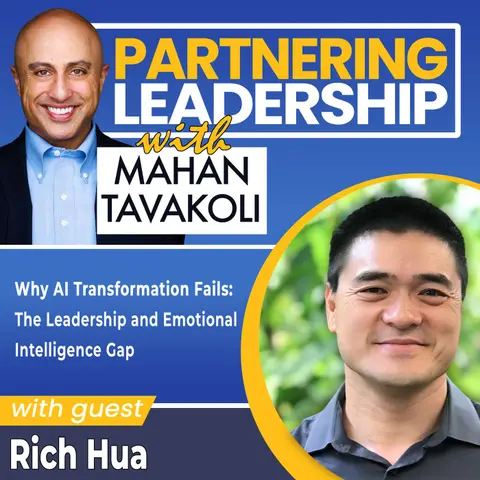
481 Why AI Transformation Fails: The Leadership and Emotional Intelligence Gap with Rich Hua
Key Takeaways
- AI transformation frequently fails not because of the technology itself, but due to a critical leadership and emotional intelligence gap in managing human change.
- Building an emotionally intelligent culture requires three essential components: ability through training, motivation through supportive systems, and opportunity to practice behaviors in everyday work.
- When leaders roll out AI initiatives without acknowledging employee fears about job security, they risk driving resistance and even active sabotage rather than enthusiastic adoption.
- Emotional intelligence is rooted in data, as emotions provide vital behavioral signals that leaders must understand to make optimal, customer-obsessed decisions.
- Over-relying on AI as an agreeable, always-on collaborator can gradually degrade human social skills, judgment, and self-awareness if individuals fail to maintain meaningful interpersonal connections.
- The 'feed-forward' exercise developed by Marshall Goldsmith allows leaders to consult trusted colleagues for actionable advice, turning self-awareness into measurable behavioral growth.
Organizations are investing heavily in artificial intelligence, yet many are struggling to translate that investment into meaningful transformation. The technology is advancing rapidly, but getting people to embrace new ways of working, navigate uncertainty, and change established behaviors remains extraordinarily difficult. What if one of the biggest obstacles to AI transformation isn't the technology itself, but how leaders approach the human side of change?
In this episode of Partnering Leadership, Mahan Tavakoli welcomes back Rich Hua, former Worldwide Head of the EPIC Leadership Program at Amazon and a leading advocate for emotional intelligence in organizations. At Amazon, Rich built an emotional intelligence movement that reached more than 1.5 million people inside and outside the company, demonstrating how leadership behaviors and organizational culture can be influenced at extraordinary scale. Drawing on that experience, he shares what executives often misunderstand about organizational change and why the approaches that worked in the past may prove inadequate in an AI-enabled world.
The conversation explores a fundamental tension facing CEOs and senior executives: Leaders are under enormous pressure to accelerate AI adoption, while employees may see those same initiatives as threats to their jobs and futures. Rich examines why traditional approaches to driving change frequently fall short, what separates genuine organizational commitment from reluctant compliance, and how leaders can build movements that people want to participate in rather than simply issuing mandates they are expected to follow.
Mahan and Rich also explore a less obvious consequence of AI adoption: Could the technology that makes us more productive also weaken some of the human capabilities we need most? As AI becomes an increasingly capable and agreeable collaborator, Rich raises important questions about judgment, self-awareness, interpersonal skills, and our ability to navigate disagreement. He also introduces a memorable way of thinking about AI's intelligence and limitations that challenges how leaders might approach consequential decisions.
Throughout the discussion, Rich connects emotional intelligence to business performance, organizational culture, leadership development, and the execution of strategic change. From the hidden messages organizations send through their promotion decisions to the limitations of traditional leadership training, this episode offers CEOs and senior executives a different perspective on what it takes to lead successful transformation. For leaders seeking to build organizations that can adapt and thrive as AI reshapes work, this conversation challenges assumptions about where to focus their attention and what capabilities will matter most.
Actionable Takeaways
- Discover why AI transformation struggles even in organizations led by highly intelligent, experienced executives. Hear Rich's perspective on the leadership challenge that technology investments and implementation plans alone cannot resolve.
- Explore the paradox of asking employees to embrace AI initiatives that may threaten their jobs. Learn why the disconnect between executive priorities and employee motivations can undermine transformation before it gains momentum.
- Hear how Rich built an emotional intelligence movement at Amazon that reached more than 1.5 million people. Discover what his experience reveals about generating commitment and influencing organizational behavior without relying primarily on formal authority.
- Consider whether AI could make people less capable of working effectively with one another. Rich explores an unexpected consequence of relying on technology that is always available, agreeable, and ready to help.
- Learn why highly rated leadership training programs often fail to produce lasting behavioral change. Explore the organizational conditions that determine whether newly developed capabilities translate into everyday leadership practices.
- Discover what promotion decisions reveal about an organization's real priorities. Hear how seemingly successful talent decisions can unintentionally reinforce behaviors that undermine the culture leaders are trying to build.
- Explore why Rich describes AI as a "genius child actor." Consider what this unusual analogy reveals about the differences between intelligence, judgment, self-awareness, and genuine human understanding.
- Hear why emotional intelligence belongs in the conversation about data-driven decision-making. Learn how Rich made the business case for emotional intelligence within Amazon's analytical, results-oriented environment.
- Understand why the ability to operate without immediate answers is becoming increasingly important for executives. Explore the leadership capabilities needed to navigate uncertainty without allowing pressure to drive premature decisions.
- Discover a practical approach to strengthening leadership self-awareness and accountability. Rich shares an exercise that helps leaders draw on the perspectives of people around them and turn those insights into meaningful behavioral change.
Connect with Rich Hua
Rich Hua EPIQ Leadership Website
Connect with Mahan Tavakoli:
Frequently Asked Questions
Why do most AI transformations fail in organizations?
Most AI transformations fail because organizations treat them purely as technology challenges rather than human adaptability and change management challenges, ignoring the emotional disconnect between executive priorities and employee fears.
What is the EPIC leadership framework created by Rich Hua at Amazon?
EPIC stands for Empathy, Purpose, Inspiration, and Connection, a movement built to elevate emotional and social intelligence across Amazon to drive better business results and innovation.
How can leaders build an emotionally intelligent organizational culture?
Leaders must provide training for ability, align systems and rewards for motivation, and create everyday opportunities for employees to practice and receive feedback on emotionally intelligent behaviors.
What is Rich Hua's analogy for artificial intelligence?
Rich Hua describes AI as a 'genius child actor' that is incredibly smart and eager to please, but lacks genuine judgment, self-awareness, and a true value system, meaning it should not be trusted with deep human context.
Welcome to Partnering Leadership, a top global leadership podcast for purpose-driven leaders with a growth mindset. Sticking to learn from the leadership journey of change makers and business insights from leading global thinkers. For additional leadership insights and bonus content, visit us at partneringleadership.com. Now here is your host, Mahan Tavakouli.
SPEAKER_01Rich Rao, welcome to Partnering Leadership. I am thrilled to have you back with me.
SPEAKER_02It's so great to be back with you today, Mahan. Thank you for having me.
SPEAKER_01Rooch, we had a great conversation, episode 2, 0 to October 13th, 2022, on the importance of emotional intelligence. What were you trying to build back then at Amazon Rich?
SPEAKER_02That's amazing that it's been four years. I really appreciate being able to do a little bit of time-lapse and go, what has occurred since then. So I have been studying, practicing, and helping people develop this skill set called emotional intelligence for decades. And everywhere I went, I saw very high IQ people with varying degrees of EQ, emotional social capabilities. And in every situation, almost every situation, it was the EQ holding them back from achieving greater success, greater happiness, greater influence, not the IQ. They didn't need to be smarter per se. They needed something else. And I saw that at Amazon, and I've been doing it for a few years off the side of my desk, helping people understand it, delivering trainings and workshops and sessions. And then I wrote a six-pager, which is how we present ideas in Amazon. I put it before my VP and his leadership team, and I said, I believe that if we elevate the emotional social intelligence of our Amazonians and leaders, that they will be more successful, better with customers, deliver results, more innovative, everything we want to do. And the science backed it up and they said, yes, let's do it. So I created my own job as the worldwide head of the Epic Leadership Program at Amazon. And Epic said for Empathy, Purpose, Inspiration, Connection. And as also the chief EQ Evangelist, basically, because I had a whole cohort of people, dozens who were out there transmitting the skills as well. And it's chief EQ Evangelist Amazon and also worldwide head at Epic. And that was an incredible run for about four years with my team, bringing it to over a million and a half people, both inside and outside Amazon.
SPEAKER_01Now, one of the things that you were able to do at Amazon is make this part of the culture.
SPEAKER_02One of the biggest myths and failings of EQ initiatives is that it's all about training. That equals failure. And that's because training does absolutely nothing if you don't change the environment. And that's something that I ran face to face with at Amazon because there was training already in various topics. I delivered trainings. And what I realized was giving training and even developing skills in a workshop is very different than an environment where it's generally practiced by the people who are trained, but then all levels. And so that's the big difference. And there's a model that came out of Yale from some colleagues and friends of mine, Mark Brackett and Azrano Pringle and Levitatts, that found that you need three things to actually develop an emotionally intelligent culture. It's ability, motivation, and opportunity. And what a lot of organizations focus on is the ability part. We'll deliver training. We have this really fancy workshop, and this is great. Everyone loves it. They give it high ratings, they really enjoy it, and they go back to reality and literally within five hours is completely forgotten because you need motivation. You need systems that reward, that support, that expect certain types of behaviors that are emotionally intelligent. And you need the opportunity to be able to practice it, to develop it, to get feedback, to grow in it. And so to have all three is the secret to being able to develop not individual skills that are temporary, but to actually build an emotionally intelligent culture. And that is what I do now. I help organizations build emotionally intelligent cultures because training honestly is a dime a dozen out there. It can be virtual, it can be in person, it can be even if it's really high quality in science back, you need the cultural mechanisms to be able to actually produce a change.
SPEAKER_01So you said it has to be part of the culture. So I'm sitting as a listener, I'm a manager of a department, I'm an executive director of a nonprofit, and they're up to the CEO of an organization. What are the types of things we need to do that can start making EQ part of our organizational culture?
SPEAKER_02So, really the key is to make the desired behaviors expected, supported, and rewarded. And I mentioned ability, motivation, opportunity, but it's like, what do we actually want? What are we looking for? Right. And some really important things are one, the leader modeling the behaviors that they're looking for and even talking about their own journey, right? It has to that that's one of the greatest motivators to see our leaders modeling it and then creating systems that actually, again, make these desired behaviors expected, support, and reward, right? If you're promoted because you're a lying, cheating son of a gun, or you just deliver results and half your team quits every year, people are gonna go, okay, that seems like a good career progression path. Or you don't actually have the opportunity in team meetings, even simply to be able to express things or have disagreement respectfully or be able to raise concerns or questions, then people are gonna be like, I'm not gonna do that, right? And so leadership modeling is big. The second is actually understanding what the real culture is. One of the biggest failings, I think, of a lot of initiatives is that they go, Oh, we're gonna change our culture from A to B. And they think that A is actually what they have on their website. When A is something completely different. It's like websites of trust, integrity, initiative, experimentation. But what boy, when you try it, it's punished. So we have to go, what is the real culture? And then any initiative has to align with the real culture and evolve it, not try to oppose it. And I say that because one of the biggest things that Amazon was a sort of philosophy of mine or a mental model was I use cultural jujitsu. Right? And I've taken martial arts, hopkito, and it's this derivative of IT jujitsu for 25 years. And so when someone punches you in the face, it is inefficient to block it at a 90-degree angle because you're exerting a lot of force and it might hurt your arm. It's better to slightly deflect it so that it misses your face and it only needs to miss by an inch and they don't punch you. So it's cultural jujitsu. Instead of trying to oppose it, move it slightly in a more positive direction. And so that's what I did. I took all the strengths, and there are many amazing strengths of Amazonian culture: the leadership principles, day one mindset, bias reaction, deliver results, customer obsession, all those were amazing. And I took them and I go, let's humanize them more, integrate EQ into it so that we can be even more awesome Amazonians by being emotionally intelligent. I wasn't trying to make you less, I was trying to make you more of what we actually believed. And so leaders love that. They're like, heck yeah, let's do it. This will make us more successful.
SPEAKER_01What a powerful example of how you can actually make it more likely that the initiative, in this case, emotional intelligence in the organization can succeed. A big part of it is modeling by the leader. But as you said, it's understanding the culture and incorporating it into the culture in a way that's not confrontational to the culture, but builds on it. Now, the other thing about Amazon is that Amazon is very analytical, metrics-driven. People that might think we were talking soft, touchy, feely stuff there, Rich, when we talk about emotional intelligence. How were you able to build this movement inside of Amazon, which is so metrics driven?
SPEAKER_02So I will tell you the key is empathy. It's understanding what the listeners and the audience really cared about and how they thought. But one of the biggest questions that I get a lot or pushbacks is hey, we are data-driven, hyperlogical, results-oriented company. What does all this emotional fluffy crap have to do with data? And what I tell them is emotions are data. They're actually really important data points to understand and integrate into our analysis so we can make optimal decisions. And if you ignore them, then you do it at your own peril. Right. We believe in customer obsession. We believe in earning trust. We believe in bias for action. We believe in respectfully disagreeing. How can you do that effectively without understanding what the other person is thinking or feeling? Right. You cannot. And so we must incorporate that data. If you're in sales and you're a sales leader and you meet the CEO of a company and their facial expression is this versus their facial expression is this, you should probably have a different approach. That's like an important piece of data. That's emotional challenges. And then the other thing that I did was, again, I framed it in a way that would help them with their pains, challenges, hopes, and dreams. I did not go and say, I'm really passionate about EQ. Would you like a serving of EQ? This is great. I went ahead and laughed out of the room. It was more like, what business challenges are you facing that could be solved with greater connection, understanding, adaptability, collaboration? It's like, oh, let me tell you, wow, we've got this issue, that issue, retention, attracting talent, silos, adapting to new ways of working, massive organizational change. The list goes on and on. And then my response is, I believe I can help you solve some of those business challenges. Here's what it is. So it's empathy, right? It wasn't about me, it was about them, and I have a solution for their pains and challenges. And that was what actually convinced a lot of skeptical people, instead of laughing under their breath or laughing out loud, actually taking seriously what I had to say. And of course, there's a lot of science behind it. I'm a veritable repository of research and science. I've read almost every book there is about it, and every new one that comes at it, I read it. Because I want to be very science-backed. This is not about Rich Wild's opinion. This is about lots and lots of science-backed data-driven results that come from applying these skills.
SPEAKER_01That Rich is showing some emotional intelligence in bringing people to your way of thinking rather than trying to stuff it down their throats because you believe it's the right way to approach it. Now, the other thing I love that you were able to do is create a movement around emotional intelligence. When you say a million and a half people that have been touched, that is a movement. And I think movement thinking becomes really important in any kind of change, including in organizations. How were you able to conceive of and approach building a movement around this?
SPEAKER_02Well, it's really interesting because I love that word. I and my fellow movement members do refer to it as a movement. And here's why it's so important. Because, and you said it earlier, no change happens without it being some form of a movement. Initiatives, edicts, strategies, programs don't change anything. Movements change things because that implies, by definition, that the movers are personally invested in wherever they're moving, right? Otherwise, it's just an edict. My my leader told me to do X, and I guess I'll do it begrudgingly, but I'm not really bought into it. But so the key is to tap into there's a few things, right? One is trust. There must be trust, right? There must be a sense of transparency, authenticity. And hey, we're we're actually we we have a positive relationship, meaning that we believe our leader cares about us. And they obviously are running a business, but they actually care. This isn't like decisions are being made despite me. I'm actually factored in, and vice versa. There's obviously competence as well as consistency along with trust, but the big part is positive relationship. Like we feel like they care. The second is it has to tap into our own internal motivations. No one's going to act long term, basically in misalignment with their own motivations and values. You can do it short term, but long term, you're like, I'm out of here. Forget it. And so you have to tap into it. And one of the things I find really interesting is when leaders go to their people and say, I've got a grand plan. We're going to optimize our workforce. And basically, this AI and this technology, this rollout, is going to reduce the number of people we need to do this work and it's going to save us a lot of money. And they say some version of that, not as obviously as I just said it, because that would be really dumb, but some version of that. That's what people hear. You're like, am I supposed to be inspired by that? The beating will stop when morale improves? Seriously? That's the thing. You did not tap into my motivations. In fact, you literally controverted and opposed my motivation for survival and thriving. Do you really think I'm going to buy into that? And that's why Writer, that's it's an AI company. They literally did a research and they found that 29% of workers, including 44% of Gen Z, admit to sabotaging their company's AI efforts. Sabotage. Because they're like, wait a minute. You're trying to basically get rid of my job and get rid of me. Do you really think I'm going to buy into this? No, thanks. So it's that, right? But then on the other hand, I know leaders are facing an incredible challenge, right? It's like it's almost three-quarters of CEOs say that their company's AR effort, AI efforts are causing personal anxiety and stress. And 38% of them say it's a higher crippling amount of stress. So you got leaders over here really trying to drive something. Their board of directors is breathing down their throats. They're reading the news and go, why aren't you doing what's over there is purporting to be doing? And they're trying to make it happen. And then they got individuals that are like, I'm just trying to save my job. And it's dysfunctional. Right. And instead of focusing on how do we make this more functional to move together in the right direction, it's like a three-legged race where two people are running at different paces and they're tripping and falling and wondering why they're not winning the game. Anyway, I'm saying a lot about that, but the point is that Amazon, 99.9% of the people who are part of the movement were doing it as volunteers. When I launched my initiative and became worldwide head of the Epic Leadership Program, I had a grand total of three and a half employees. Right? It was Kelly, Elias, and Charis, and then I had a consultant named Bill, and that was the whole team. And yet we were able to build a community of 70,000 people inside Amazon and then go out and reach a million and a half because a vast majority of the people who were champions and evangelists and workshop facilitators were all doing it off the side of the desk. Because it tapped into their internal motivation. They got so much joy and satisfaction out of doing it, out of making a positive difference, out of doing something they really cared about that they were glad to do it for free and even devote time in a very busy schedule to be able to do extra stuff because they got so much out of it, and so did their audiences. And so it was that virtuous cycle of tapping into motivation, built on trust, and having a common mission.
SPEAKER_01There is so much to learn from what you just shared, Rich. One with respect to emotional intelligence. The other is with respect to change within organizations, in that if you think about it, you were not the CEO of Amazon stomping your foot down and saying, we shall do this. Yeah. You had to get buy-in with three and a half employees, get 70,000 people energized for a movement that then touched a million and a half people. So there is a lot to be learned from all of that.
SPEAKER_02Yeah, so what does that mean for us? As humans, I'm not going to talk so much about the alignment issue because that's a whole nother topic, but we individually need to be very thoughtful and intentional about how we use AI because it is really easy to over-rely on it, to offload too much because it's so awesome, right? There is one recent study that was done where among people who use AI a lot, 62% of them preferred engaging with AI than human beings. Why is that surprising? It's not because you know what? AI doesn't have a bad day, it's always on, it doesn't give you a bad attitude, doesn't talk back to you, doesn't say no. It's like the ideal colleagues. So rather work with AI than with you, because you might be having a bad hair day. Not you wouldn't be having a bad hair day. So it's fascinating. So what happens with that is we can allow our social skills to degrade if we're used to working with something that's always doing our bidding. If we're surrounded by AI that's always pleasant to work with, our ability to deal with unpleasant people called all people at some point, maybe our own children or partner or friends, it can degenerate. Guys, in that movie, Wally, remember that movie where people are just kind of sitting, those chairs floating around. Why would anybody want to walk when you can just jump in a chair and float to wherever you want to go? That's AI, which is efficient, but there are downsides to that, right? And your brain literally becomes like those bodies in WAL-E if we jump on that floating chair too much. On the other hand, AI can actually be used to also improve your EQ. So I did want to say on the positive side, there are studies that if you use AI coaching the right way, if you use interventions, it is a way to scale EQ skills in a way that can make it accessible to everybody.
SPEAKER_01And that can be helpful to that end. But to your point, Rich, I just interviewed Eric Zoe. He is a professor at MIT Sloan and has written a book, The Collision, What AI Does to Us. And he raises that exact concern that he is even noticing with his students at MIT, which draws on some of the smartest IQ people from around the world. However, they're cognitively offloading to AI in many instances. So it can become a real concern. As well then for organizations. So in what ways do you think human capabilities need to be built in an AI-enabled organization?
SPEAKER_02This is such a profound question. It's what I'm devoting my life's work to, basically. And it is that we must help people both develop, practice, and then apply these epic skills in an AI environment, or we will run ourselves off the edge of a cliff in a bad way. And what I mean by that again is things like judgment, right? Focus, creativity, influence, and as I mentioned earlier, metacognition, right? These are all things that are vital because AI can generate dizzying amounts of output and content and all that, but it has no value system except what is to make you happy, or whatever was programmed into it, or whatever it learned from the internet. It does not have its own actual sense. So our human, distinctly human values are more and more important. And so what's interesting is that more and more companies are now realizing this. As part of their AI readiness, companies like Principal Financial, Price Waterhouse Cooper's, PwC, Goldman Sachs are actually training people in these exact human skills. It's part of the AI training. They're training EQ as part of the AI training. So they're recognizing that it's actually really important. EY, Ernest Young, literally recently in the news, they allocated $100 million to reward employees that exercise human skills along with AI proficiency. It's like creativity and empathy and judgment and strategy and business innovation. Hey, if you have that along with AI use, we're going to actually reward you. So more and more companies are realizing how important this is in this world. And of course, is everything that can be automated gets automated. What's the differentiator? It's literally this human interaction right here that we neurobiologically need. And we cannot function and thrive without. And so those who can provide that are going to have an outsized advantage.
SPEAKER_01The other thing that you've also mentioned a couple of times, Rich, is the importance of self-awareness, which is a critical part of EQ. I wonder what your thoughts are with respect to AI's impact on our self-awareness.
SPEAKER_02I think my answer would be don't rely on AI for it. That's the only answer. It can provide us some data points, but think of it as looking at a somewhat foggy mirror. Well, the somewhat foggy mirror can kind of give you the general idea, but don't rely on the somewhat foggy mirror to help you see what you really look like. Go talk to a person who actually has an opinion and actually cares about you, knows your context, has their own value system, has a sense of morals, or and can tell you're full of crap. And the way that I describe AI is my sort of metaphor is it is a genius child actor. It's incredibly smart. It is a child. You really have to tell what to do and train. It really wants to make you happy. And if it'll Take on whatever persona you want it to be. It literally can is an infinite number of acting jobs. It is what it is. So if you're trying entrusting something important to a genius child actor, not a good idea. And so you need the human sort of now. If you want to tap into the genius part, that's great. But if you want to actually know anything meaningful, deep, have context or actual judgment or life, lived experience, or real care, please do not go to the genius child actor. So I think that's where some of that self-awareness does have to come to realize there are certain things I should go talk to the genius child actor about. And there's some things that I really shouldn't do with this. I need an actual human being who's not a genius, not a child, not an actor. Maybe my wife or my husband or my partner.
SPEAKER_01I love the genius child actor. So it's such a clear way of framing what we can and what we can't expect from AI. Now you also mentioned this, Rich, that a lot of the CEOs and executives I interact with are incredibly stressed because the pace of change in their organizations and in the outside environment has become faster in part as a result of AI. AI is not the only contributor to it. So they need to lead their organizations in change. What role do you believe emotional intelligence plays in leading change in this environment?
SPEAKER_02I say it is the critical component. There's a reason that based on the recent report from Atlassian, they say that 96% of companies are failing to drive AI transformation. Only 4% are actually really doing it. Why is that? Because we have a whole bunch of dumb senior leaders? No, of course not. They're all very experienced, have high IQ, and have been very successful. They're facing something they never faced before. And the reality is change initiatives have always been in a massive failure mode, right? 20% of change initiatives, even before AI, were successful. And that's because they think of it as a technology challenge rather than a human adaptability challenge. So, what do leaders need to do? There are a few things. I'm gonna go on and on. This is actually what I do. I help leaders figure out what to do there, but a few things. Number one, manage your own stressors. You have to be able to think clearly and not freak out, or you're gonna make suboptimal decisions. And there's a higher level of stress than maybe you're ever used to. So you got to kind of take care of your own brain so you can think clearly and be able to do that. Number two, adaptability. You've got to be able to adapt and shift your thinking and be very agile and not be stuck in any ideas or old ways of working or that, because there's no nothing in the past that will tell you what you're doing in the future, right? The third is have to develop your negative capability. It's a term that has emerged more lately. And that basically is the ability to sit with not knowing. I don't know the answer. I have to let it emerge. I don't have this clear path, right? This negative capability is actually really important, right? Brene Brown's talk about it. Others have talked about it. And so that's a new sort of epic skill and capability that people need to have. Because if you kind of just jump to something and try something just because you're under pressure, you're gonna, you're gonna fail. Right. Now, if it's an experiment and you're learning along the way, then hey, that's great, right? That's something that you can iterate, but you do need to be able to manage yourself well. And then on the other side is you have to be able to earn trust, right? The reason that things are not moving at the speed or direction people want is there's not this thing called trust. People don't necessarily trust their leaders or where they're going or the alignment issue or that they're considering them in these decisions. And so being willing to listen, being willing to factor in what people are thinking and feeling, doing something that does have a clear mission and where there is a sense of, okay, I'm trying to do what's best for the business and for the people, that goes a long way, right? So you need curiosity, you need humility, you need to ask these questions. And so this is not easy. What I'm describing sounds like, wow, that sounds really hard. That's why most people don't do it. The easy part is I'm really smart, I talk to my techno people, and I've got a three-page plan and strategy of how we're gonna roll out AI and everyone better do it. That's the easy part. It's the hard part that determines whether or not you succeed or fail, and that's squarely on the human side. And so if you read in the news and just pay attention, you see all these companies that are, hey, they're seeing successes with AI adoption, or they see things really changing, you'll see that human factor is very much front and center. You don't see any companies go, we told everyone to use the latest LLM and everyone did it, and voila, we're all successful. There's no story like that.
SPEAKER_01So technology doesn't become the differentiator. If anything, technology can be duplicated by any competitor. It's the advantage that the people bring. So as you're doing that, Rich, we'd love to get your thoughts for the listeners of the podcast on a few things you would urge them to do as managers and leaders of others, and a few things they should do for themselves when it comes to EQ.
SPEAKER_02Surrounding yourself with people who will help you become a better version of yourself. So instead of giving a bunch of sort of generic ideas, I'll give you one really simple exercise. I learned it from Marshall Goldsmith, the world's most famous executive coach. He actually has given me some executive coaching. So I'm actually great for it. It's called feed forward. Feed forward. Go to five to seven trusted people and saying, I'm trying to improve, blank. I'm trying to improve my empathy, I'm trying to improve my inspiration, I'm trying to improve my communication, whatever it is. Okay, be thoughtful about what you want to say. I'm trying to improve. Or if you really don't know, just say I'm trying to improve as a leader, okay? But the more specific, the better. Can you give me a couple of ideas about what I could do? Have them tell you, write it down, say thank you. That's it. And then after talking to five or seven people, you get a better idea because you see some patterns. Four out of the seven said the same thing, do it. Now you may decide there's a bunch of crap, I don't want to do it. That's up to you. But if a bunch of people said it, there's probably something. That is one of the most powerful self-awareness exercises there is. It also gives you a way to be able to act on it. And then the really great thing is go back to those people and go, I decided I'm going to put this into practice. Can you hold me accountable? Can you help me? Because I'm working on it. And as I'm doing it, tell me if it's working or not. And so you're honoring them by taking their advice. You're also displaying vulnerability and humility by asking them to help you as you go along, and they become co-invested in your success. And so it's a genius way of being able to grow in anything. And boy, if leaders would just do that, it's amazing how much impact we'd make. So that to me is a targeted way of self-awareness and an action plan. Those are great recommendations, Rich.
SPEAKER_01So for the audience to find out more about Epic Leadership, follow your writing and work. Where would you send them to, Rich?
SPEAKER_02Yeah, two things. Follow me on LinkedIn. You can look for Richard Hua and you can find me there. But also go to epicleadership.com, ep-i-quleadership.com. There's whole lots and lots about what I do and the things that I offer and my thoughts about things. I do post on LinkedIn every day. I have a Substack newsletter that I also write called Epic Success. And I will say one thing, Mohan, you made me think about something, which is we're now in a world where all relationships, we have been, but it's changer the AI. Relationships are either relational or transactional. Right. And so if I'm going through McDonald's and I just want my order done correctly, it's transactional. I don't really care about much else. I just want the right order and for you not to overcharge me. Fine. AI can do that. That's great. I don't really care. I don't want a long-term relationship with the person who's selling me my Big Mac. Okay. Fine. But anything that's relational, AI cannot replace that. Right. And so if I'm doing something transactional, use AI. That's fine. Do the heavy lifting, the undifferentiated stuff. But for relational, we must be really thoughtful because that is based on this, this interpersonal, right? And so differentiating between the two. And I will say for anybody who's trying to drive AI transformation, it is not a transactional affair. It is very much a relational affair. That's why empathy, understanding, listening, even building these communities. And in other ways that I'll underline that any AI transformation must be a movement, not an edict, not a strategy, not a program if they actually wanted to be successful at the organization. So I love that framing.
SPEAKER_01I so appreciate you being back on the podcast, sharing your fan script. Look forward to having more conversations as you reach more people on your way to impacting a billion. Thank you so much for joining the conversation, Richard Huao.
SPEAKER_00Thank you as well. It's been a pleasure. You have been listening to Partnering Leadership with your host, Mahan Tavakoli. If you enjoyed this episode, please leave a rating and review of the podcast on your favorite podcasting app and forward the conversation to a friend or colleague so you can help more people discover their purpose, grow professionally with meaning, and have a greater impact. For additional leadership insights and bonus content, visit us at partneringleadership.com.