How to Build Thought Leadership Without Creating AI Slop
In an era where generative artificial intelligence can produce polished text in seconds, producing a higher volume of content is no longer a competitive advantage for enterprise leaders. Executives who rely on automated tools to flood professional networks with surface-level commentary quickly find themselves contributing to a growing sea of digital noise. True influence requires more than publishing frequently; it demands a deliberate strategy that turns hard-earned expertise into ideas that travel, scale, and shape industry decisions.
Key Takeaways
- AI-generated content fails to build authority when it merely echoes existing ideas without adding original perspective or problem-solving value.
- Effective thought leadership targets a specific addressable market rather than attempting to broadcast to an entire global audience.
- Simplicity in an idea ensures it remains sticky and memorable during high-pressure scenarios without sacrificing sophisticated depth.
- Credibility, reliability, and low self-orientation form the mathematical foundation of trust in professional advisory relationships.
- Executives must focus on giving substantial value to their audience long before asking for attention, commercial return, or opportunity.
The Trap of AI Slop in Executive Comms
The democratization of writing tools has made it remarkably easy to publish weekly insights, thought-starter lists, and motivational commentary. Yet, much of this output constitutes what industry practitioners describe as AI slop: content that is superficially plausible, grammatically correct, and entirely devoid of original thought. When every competitor can generate the same level of average commentary with a single click, the output ceases to differentiate the organization.
For C-suite executives and board members, the challenge is not generating more words. The real challenge is determining whether an insight solves a genuine industry problem, addresses an unarticulated pain point, or challenges a flawed operational assumption. If an executive's published material could have been written by a generic algorithm parsing public web pages, it will fail to influence prospective clients, partners, or internal talent.
Leveraging technology effectively means using AI to refine and structure proprietary insights rather than outsourcing the core thinking. The value lies entirely in the underlying perspective, the proprietary framework, and the lived experience of the leader behind the recommendation.
Narrow-Casting Over Broadcasting
A common mistake among enterprise leaders attempting to build visibility is treating thought leadership as a broad marketing megaphone. They measure success by impression counts, follower growth, and superficial engagement metrics. However, aiming for a million passive followers who rarely read past the first sentence creates zero commercial or strategic impact.
Effective leaders practice point-casting. They accept that their insights will be profoundly irrelevant to 99.9 percent of the population. By narrowing their focus to the exact ecosystem of buyers, regulators, partners, and internal stakeholders whose decisions actually drive the business, they create deep relevance.
- Identify the exact total addressable market for your core ideas.
- Accept that niche, highly relevant engagement outperforms broad, empty visibility.
- Design content to solve specific problems rather than to win popularity contests on social platforms.
When an executive speaks directly to the unresolved friction points of a specific buyer persona, the conversation shifts from a race-to-the-bottom marketing pitch to an indispensable industry dialogue.
Balancing Simplicity and Depth in Frameworks
Transforming complex enterprise expertise into a scalable idea requires mastering the tension between simplicity and sophistication. If an idea is too complicated, busy managers facing high cognitive load on a Tuesday afternoon will discard it. If it is oversimplified, experienced executives will dismiss it as trite.
The strongest intellectual frameworks operate on two distinct levels. They are accessible enough that a new manager can understand the core premise within minutes, yet sufficiently deep that a seasoned C-suite leader can spend a career attempting to master its application. For example, established professional service frameworks use simple categorical equations to evaluate trust and advisory dynamics, allowing junior practitioners to learn client management basics while senior partners use the same foundational model to diagnose multi-million-dollar organizational friction.
Accountability and Credibility in the Age of Abundant Intelligence
As intelligence becomes a near-zero-cost commodity, the strategic advantage shifts from data retrieval to human accountability. When a CEO faces a high-stakes merger, acquisition, or structural transformation, they do not simply want a probabilistic recommendation generated by an algorithmic black box. They demand a human expert who stands behind their judgment.
Real thought leadership provides a face, a brand, and an explicit track record of sourcing and accountability. Clients and partners invest in leaders who demonstrate reliability, intimacy, and low self-orientation. When an advisor or executive gives away significant, high-value insights freely before asking for commercial return, they establish a level of market trust that automated engines cannot replicate.
Conclusion
Building meaningful executive influence requires looking past the temptation of automated content generation and focusing on original problem-solving. By narrowing your audience, simplifying complex ideas without diluting their sophistication, and standing firmly behind your professional judgments, you can elevate your impact far beyond the executive suite.
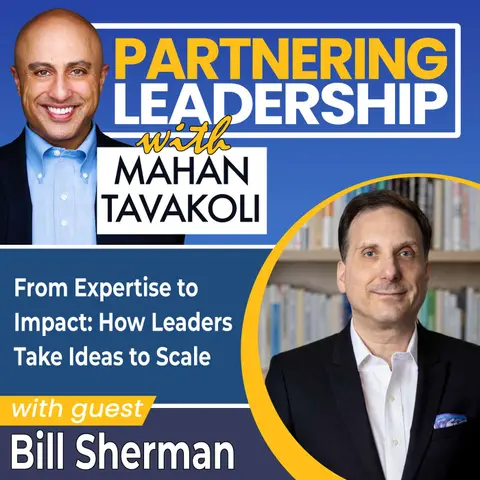
To explore these concepts further and learn how to scale your unique expertise without relying on empty digital noise, Listen to the full episode of Partnering Leadership with Mahan Tavakoli and Bill Sherman for a deeper discussion on turning ideas into enterprise impact.
Frequently Asked Questions
How can executives use AI for thought leadership without sounding generic?
Executives can use AI as a collaborative writing assistant to organize thoughts and draft posts, provided the underlying ideas are based on hard-earned, unique insights rather than generic prompts that summarize existing industry tropes.
What is the difference between broadcasting and point-casting in executive visibility?
Broadcasting is the ineffective strategy of pushing generic content to a massive, uninterested audience. Point-casting focuses deeply on relevance, targeting the specific 1% of the market whose decisions and thinking you genuinely need to influence.
How do you know if an idea is too simple for senior leaders?
A truly strong thought leadership framework is accessible enough for a newly minted manager to grasp in minutes, yet deep enough to challenge a seasoned CEO trying to master it over a career.
Why does brand credibility matter more in an era of abundant intelligence?
As AI makes information and intelligence nearly free and instantaneous, buyers and decision-makers increasingly look for accountability, real human judgment, and a known brand that stands behind a recommendation.
Strategy Means Choice: Why Leadership Requires Hurting Feelings to Succeed